
Mirka OS 383CV Manual
PDF manual · 124 Pages
English


Quick check
Incorrect answer, please try again.
Chat with your Mirka OS 383CV manual using AI
Get instant AI answers from your Mirka OS 383CV manual
Ask anything about the Mirka OS 383CV. Answers come from this manual, with the pages they are based on.
Ask a Question
Do you recommend OS 383CV?
Yes NoFrequently Asked Questions
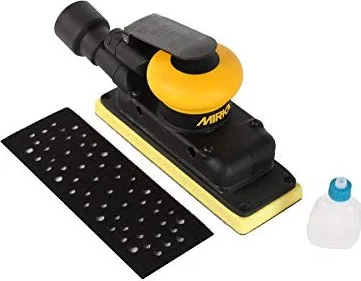
The Mirka OS 383CV uses a 70 x 198 mm backing pad, equivalent to 3 x 8 inches. This long, narrow shape is useful for sanding strips, panels, edges, and other areas where a standard round pad is not ideal.
Is this answer helpful?
This model uses a 3 mm, or 1/8 inch, orbit. That orbit size is intended for controlled sanding and surface finishing rather than aggressive material removal.
Is this answer helpful?
The recommended maximum operating pressure is 6.2 bar, or 90 psig, measured while the tool is running with the throttle fully engaged. Lower pressure may reduce performance, while higher pressure should not be used.
Is this answer helpful?
Yes. The CV version is designed for central vacuum extraction. It uses a standard 28 mm, or 1 inch, vacuum hose fitting, with 19 mm, or 3/4 inch, options available for compatible setups.
Is this answer helpful?
A 10 mm, or 3/8 inch, internal-diameter air hose is recommended, with a maximum suggested length of 8 m, or 25 ft. Correct hose size helps the tool maintain air flow and operating speed.
Is this answer helpful?
Use clean, lubricated compressed air with a filter, regulator, and lubricator where possible. Without an inline lubricator, add two to three drops of suitable pneumatic motor oil at the air inlet and run the tool briefly to distribute it.
Is this answer helpful?
Advantages and Disadvantages
Advantages

- 70 x 198 mm pad is well suited to narrow panels, edges, and elongated repair areas.
- 3 mm orbit and 10,000 OPM support controlled, finish-oriented sanding.
- Central vacuum configuration helps manage dust and keep the work area cleaner.
- Light 0.96 kg design can reduce fatigue during repetitive sanding tasks.
- Serviceable motor, bearing, valve, vacuum, and muffler components support maintenance.
Disadvantages

- Requires a capable compressed-air supply delivering 6.2 bar and about 453 l/min.
- Central vacuum equipment, hose, and fittings are needed to use the dust extraction feature.
- Pneumatic motor needs clean, lubricated air or regular manual lubrication.
- Long rectangular pad is specialized and may be less versatile than a round pad for curved work.
- Noise and vibration require appropriate personal protective equipment and work practices.
Product Specification
Type
Orbital sander
Operating pressure
90 psi
Air consumption
16 CFM
No-load speed
10,000 rpm
Orbit diameter
0.12 in
Sanding surface
7.8 x 2.76 in (L x W)
Tool attachment
Hook-and-loop fastening
Features
Soft grip, dust extraction
Weight
2.12 lb
Included
Sanding pad
Product Description
Mirka OS 383CV Pneumatic Orbital Sander - Read, Download & Print Free
The Mirka OS 383CV Pneumatic Orbital Sander is a purpose-built finishing tool for professionals who need controlled sanding across long, narrow surfaces. Its 70 x 198 mm (3 x 8 in.) backing pad gives it a practical footprint for panels, edges, frames, repair areas, and detailed production work where a round pad is less effective. The 3 mm (1/8 in.) orbit supports a refined sanding pattern suited to surface preparation and finish-oriented applications.
Powered by compressed air, this orbital sander operates at 10,000 OPM and is designed for use with a clean, lubricated air supply. The recommended operating pressure is 6.2 bar (90 psig), with a 10 mm (3/8 in.) air hose up to 8 m (25 ft) long. A filter, regulator, and lubricator arrangement helps deliver stable performance while protecting the internal pneumatic motor from contamination and excess wear.
Central Vacuum Dust Control
The OS 383CV is configured for central vacuum extraction, helping collect sanding dust at the source. This can improve visibility of the work area, reduce cleanup time, and support a more orderly workshop. The vacuum setup uses a 28 mm (1 in.) standard hose fitting, with 19 mm (3/4 in.) options also available. Keeping the extraction path and collection equipment clean is important because clogged bags, hoses, or fittings can reduce airflow and sanding efficiency.
At approximately 0.96 kg (2.1 lb), the sander is light enough for repeated use while retaining the stability expected from a pneumatic finishing tool. Its listed air consumption is 453 l/min (16 scfm), so it is best paired with a compressor system that can maintain pressure under load. The tool is suitable for sanding materials such as metal, wood, stone, plastics, and similar surfaces when matched with the correct abrasive.
Built for Serviceability
The design includes serviceable components such as bearings, rotor vanes, valve parts, muffler pieces, pad hardware, seals, and vacuum fittings. Replacement kits are available for key assemblies including the spindle bearing, air inlet, speed valve, rotor and vane set, cylinder, and muffler. This supports planned maintenance and can help extend the useful working life of the tool.
Notes
- Use only pads and abrasives rated for at least 10,000 OPM.
- Disconnect the air supply before changing abrasives or performing maintenance.
- Wear eye, hearing, respiratory, and hand protection during sanding.
- Inspect hoses and fittings regularly, and do not exceed 6.2 bar operating pressure.
Search for 67,732 Manuals online


Type-in Brand or Model