
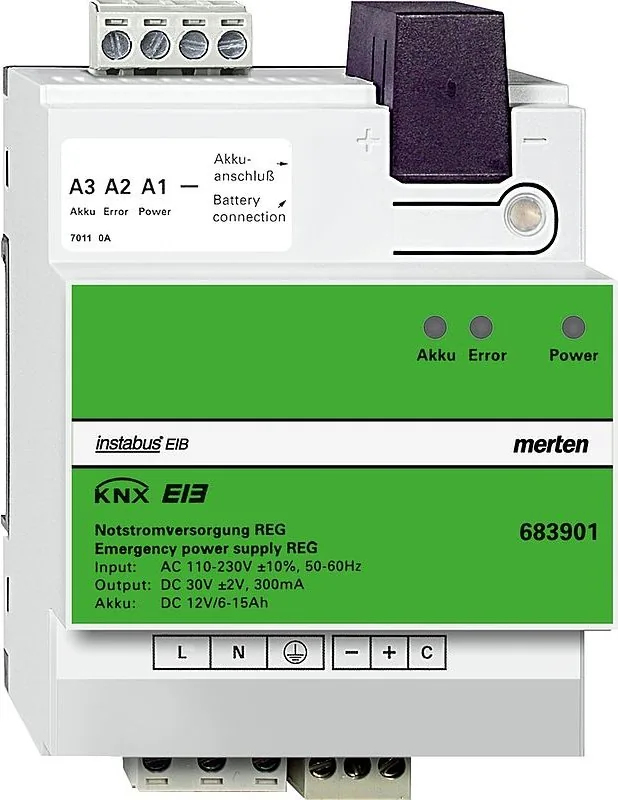
Merten Emergency Power Supply REG Manual
PDF manual · 17 Pages
English



Quick check
Incorrect answer, please try again.
Chat with your Merten Emergency Power Supply REG manual using AI
Get instant AI answers from your Merten Emergency Power Supply REG manual
Ask anything about the Merten Emergency Power Supply REG. Answers come from this manual, with the pages they are based on.
Ask a Question
Do you recommend Emergency Power Supply REG?
Yes NoFrequently Asked Questions
The system switches to battery mode instantly. A yellow indicator confirms that stored energy powers the entire bus line reliably while the main grid is down.
Is this answer helpful?
Only qualified skilled electricians should handle connections due to high voltage risks nearby. Safety regulations from DIN VDE must be observed strictly during installation.
Is this answer helpful?
Backup runtime approximates thirty minutes at full load with a fully charged lead-acid battery. Duration varies based on the capacity of the connected accumulator.
Is this answer helpful?
Sealed lead-acid batteries rated at 12 volts and between six to seventeen ampere hours are required for safe and compliant operation.
Is this answer helpful?
The yellow light indicates that the emergency power supply is active and battery mode is currently powering the system. It may also show charging status.
Is this answer helpful?
Yes, pressing the reset key clears error states after short circuit removal. If errors persist, disconnect terminals manually for extended resets.
Is this answer helpful?
Operation is restricted between minus five and plus forty-five degrees Celsius for optimal performance. Storage and transport ranges are wider.
Is this answer helpful?
Advantages and Disadvantages
Advantages

- Ensures uninterrupted bus voltage during mains failure using integrated battery support.
- Clear LED status indicators provide easy visual fault diagnosis for technicians.
- Compact 4TE REG width saves significant space in standard DIN rail enclosures.
- Compatible with KNX guidelines and INSTABUS EIB system architecture securely.
- Offers automatic reset functionality to recover from overload or short circuit events easily.
Disadvantages

- Requires installation by qualified electricians due to high voltage safety risks present.
- Limited backup runtime approximates thirty minutes depending on connected load current.
- Strict wiring distances limit flexibility between supply unit and battery locations.
- Specific lead-acid battery models required, limiting third-party replacement options.
Product Specification
Type
Power supply
Standard
KNX
Function
Power supply
Topology
Bus
Product Description
Advanced Power Solutions for Intelligent Buildings
In modern intelligent building systems, reliability is paramount for security. The Merten Emergency Power Supply REG provides an essential layer of protection for KNX networks effectively. By deploying this unit alongside compatible infrastructure, technicians guarantee continuous operation during unexpected utility outages globally. The Merten Emergency Power Supply REG works in tandem with standard power distribution equipment to minimize operational disruption significantly. Facility owners often reference the Power Supply Unit Manual specifications to understand configuration options fully before starting installation tasks.
Operational Workflow Explained
Under normal conditions, the unit draws power consistently from the main grid connection safely. A green light indicates total system readiness immediately. Should the AC voltage drop suddenly, the internal system switches to battery mode instantly without delay. A yellow indicator confirms that stored energy powers the entire bus line reliably. This transition occurs within milliseconds, preventing any potential data loss during switching events. The hardware fits onto a 35mm DIN rail, conserving valuable space in compact enclosures easily. Each module measures forty-five millimeters wide, fitting the 4TE REG profile perfectly for standard mounting rails.
Detailed Status Indicators
Visual feedback helps maintenance teams locate faults very quickly and accurately. Red lights signal overcurrent issues or short circuits requiring immediate attention. Green lights confirm active power flow throughout the system reliably. Yellow lights denote battery charging status or active usage phases clearly. These signals can be queried digitally through dedicated binary inputs if configured correctly by professionals. Proper cabling using SELV standards is mandatory for safety compliance. Connectors must be protected by covers when not in use to prevent accidental contact hazards.
Technical Parameters and Longevity
Safety is the top priority during setup procedures. Local electrical codes must be followed strictly at all times. Professionals should isolate power sources before beginning work indoors. Wire gauges matter significantly; minimum cross-sections prevent voltage drops over distance. Batteries used must be sealed lead-acid types rated between six and seventeen ampere hours. Charging times vary based on capacity but generally take several hours daily. Do not place devices near combustible materials ever. Environmental limits restrict operation between minus five and plus forty-five degrees Celsius for optimal performance. Periodic testing of backup capabilities ensures functionality remains high over years. Replace batteries showing signs of weakness to maintain confidence during actual emergencies.
Integrating these supplies into the larger automation strategy creates robust redundancy for users. Every component plays a role in keeping the digital nervous system alive consistently. Planning includes accounting for maximum current loads on every single branch circuit managed carefully. Detailed technical parameters define performance limits clearly for engineers. Nominal voltage stays stable at DC thirty volts always. Current capacity handles sixty-four milliamperes continuously under stress. Short circuit resistance prevents damage during faults effectively. Overload thresholds trigger red warnings automatically without human intervention. Cable distances between power source and supply unit must stay under one meter. Battery links allow slightly longer runs but require thicker conductors for voltage integrity. Ventilation requirements apply if multiple units share enclosure slots together. Heat dissipation occurs passively through the metal housing surface area.
Search for 67,732 Manuals online


Type-in Brand or Model