
Marstek B2500 Manual
PDF manual · 60 Pages
English



Quick check
Incorrect answer, please try again.
Chat with your Marstek B2500 manual using AI
Get instant AI answers from your Marstek B2500 manual
Ask anything about the Marstek B2500. Answers come from this manual, with the pages they are based on.
Ask a Question
Do you recommend B2500?
Yes NoFrequently Asked Questions
The B2500 uses a LiFePO4 (Lithium Iron Phosphate) battery, offering enhanced cycle life and thermal stability compared with many other lithium chemistries.
Is this answer helpful?
Yes. Use solar panels that meet the specified input range (12–59 V DC) and respect the recommended maximum PV power. The B2500 uses MPPT to optimize charging; actual performance depends on panel output and weather.
Is this answer helpful?
No. Due to its high battery capacity, the B2500 exceeds airline transport limits for lithium batteries and cannot be carried on aircraft.
Is this answer helpful?
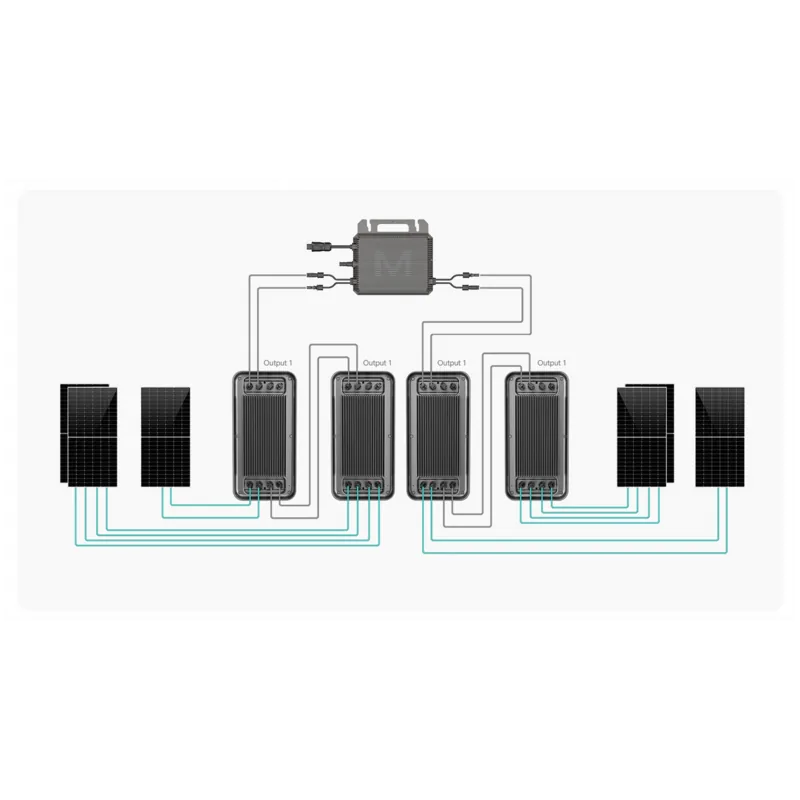
Connect the micro inverter MC4 input to the B2500 MC4 OUT and PV panels to PV IN. If micro inverters behave abnormally, connect one micro inverter to Output1 and leave the other disconnected or tied directly to solar to avoid internal reference conflicts.
Is this answer helpful?
The MARSTEK app (Android 6.0+/iOS 12.0+) provides Bluetooth/Wi‑Fi pairing, real-time PV charge/discharge displays, charging/discharge mode configuration, scheduling output periods and power limits, smart power control and device sharing.
Is this answer helpful?
Charging is recommended between 0–50 °C; operation is supported from -10–50 °C. For best battery longevity, use and store around 20–30 °C and avoid prolonged exposure to direct sunlight or extreme temperatures.
Is this answer helpful?
The product includes a three-year warranty from the purchase date (proof required). Exclusions cover damage from misuse, unauthorized repairs, natural disasters and cosmetic wear. For long-term storage, discharge to ~20% then recharge to ~80% every three months.
Is this answer helpful?
Advantages and Disadvantages
Advantages

- High-cycle LiFePO4 battery (≈6000 cycles) and 2240 Wh usable capacity for long service life.
- MPPT-enabled dual PV inputs and MC4 output support flexible solar charging and micro inverter feeding.
- IP65 rating and multiple protection circuits (overcharge, over-discharge, overcurrent, short-circuit).
- Mobile MARSTEK app offers real-time monitoring, scheduling, smart power control and device sharing.
- Expandable via extra battery ports to increase overall system capacity (additional battery sold separately).
Disadvantages

- High battery capacity prevents air travel transport; not airline-friendly.
- Some micro inverters with common internal reference points can malfunction when both channels connect to the same battery.
- Extra batteries and certain accessories are not included and must be purchased separately.
- Weight (~18.7 kg) and dimensions limit portability for some users.
- Requires temperature-aware charging and periodic maintenance cycles to preserve battery life.
Product Specification
Note
Prices partly include 0% VAT tax rates for AT and DE
Battery type
LiFePO4
Battery modules
1 Module (max. 3)
Nominal capacity
50Ah, 2240Wh
Nominal voltage
44.8V
Discharge current
18.5A
Discharge power
800W
Operating temperature
14°F to +122°F
Lifespan
6000 charge cycles (up to 80% remaining capacity)
Special features
Battery management system
Interfaces
Wi-Fi (WLAN), Bluetooth 5.2, 1x RJ-45
Mounting type
freestanding
Protection class
IP65
Dimensions
6.89x13.90x11.77in (WxHxD)
Weight
0.04 lb
Product Description
Marstek B2500 — Reliable LiFePO4 Portable Solar ESS
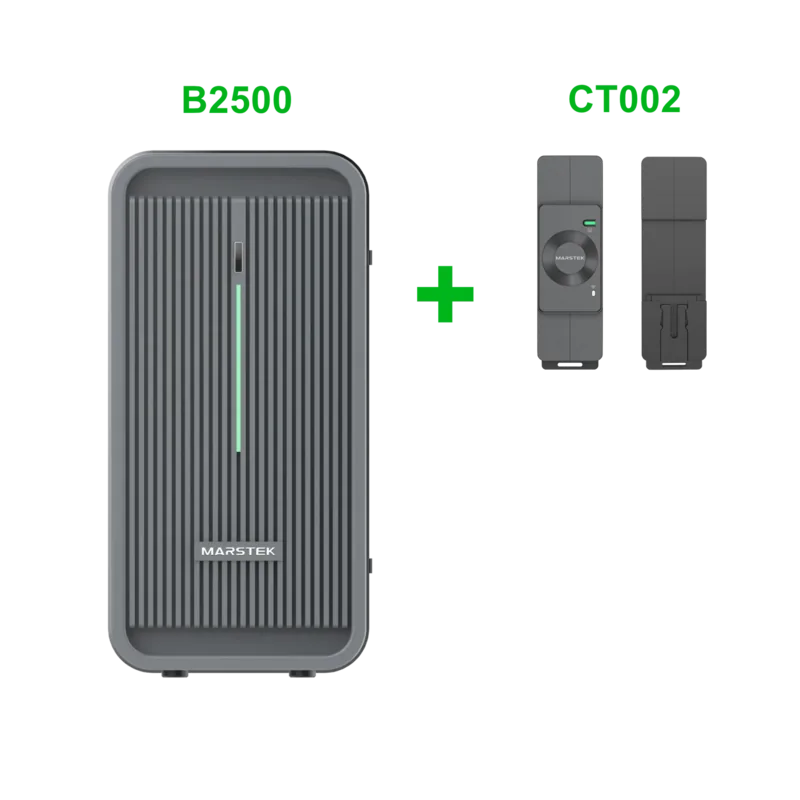
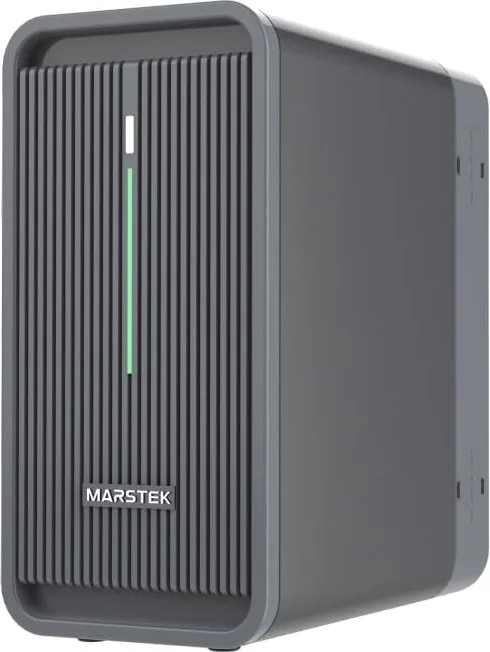
The Marstek B2500 is a compact, rugged portable energy storage system built around a 2240 Wh (50,000 mAh / 44.8 V) LiFePO4 battery. Designed for off-grid, backup and small-scale solar setups, it supports PV inputs, PV outputs and MC4 micro inverter connections while offering IP65-rated protection and multiple safeguarding circuits including overcharge, over-discharge, overcurrent, short-circuit and overtemperature protections.
Its form factor (approximately 296 × 175 × 350 mm, 18.7 kg) and modular design let users expand capacity via optional extra battery ports. Dual PV inputs (12–59 V) with MPPT charging deliver efficient solar harvesting and can be configured to either fully charge and then discharge the unit or route PV power to micro inverters. The unit provides robust PV output characteristics and a dedicated MC4 OUT for micro-inverter feeding.
Operation is straightforward: connect PV panels to PV IN, attach micro inverter MC4 input to MC4 OUT, then long-press the power button to start. The B2500 includes LED indicators for battery state, Wi‑Fi/Bluetooth connectivity and warnings. The MARSTEK app (Android 6.0 / iOS 12.0+) enables device pairing via Bluetooth/Wi‑Fi, real-time monitoring of charge/discharge and energy production, scheduling of discharge windows, power output limits, smart power control and device sharing.
Thermal and usage guidance emphasize charging between 0–50 °C, operating -10–50 °C, and storing periodically (recommended cycle every 3 months: discharge to 20% then recharge to 80%). The battery is rated for roughly 6000 cycles at 25 °C. The product is not airline-transportable due to battery capacity restrictions.
Safety and maintenance notes stress keeping the unit out of prolonged direct sunlight, avoiding immersion in water despite IP65 rating, preventing overloads, and using only approved accessories. Certain micro inverter models with internal common references can misbehave if multiple channels are tied to the same battery; recommended connection practices and stepwise troubleshooting are documented.
With a three-year limited warranty (requires proof of purchase), support is provided through Marstek’s customer service channels. The unit ships with the B2500, four MC4 extension cables and a tool; extra batteries and some accessories are sold separately.
Notes
- Uses LiFePO4 chemistry for safety and long cycle life.
- MPPT charging improves solar efficiency; actual performance depends on weather and panel specs.
- For long-term storage, perform maintenance charge/discharge every three months.
- Not permitted on aircraft due to battery capacity limits.
Search for 67,706 Manuals online


Type-in Brand or Model