Manual.ly Logo

Laica PL8032 Manual

0.0 · 0 Ratings

PDF manual · 20 Pages

English

M: QW-35-FL
page

/ 20

Loading...
a61a470ab8c0756fa3fac46eece0b6c08ff4 page 7
12 13
Instructions and guarantee
EN
English
EN
English
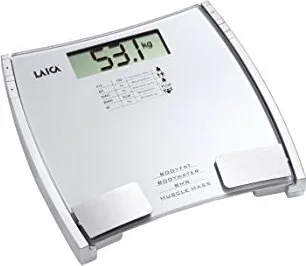
New electronic personal scale allowing the detection of the basal metabolic rate and of the body composition
(percentage of fat, water and skeletal musculature) according to the height, age, gender and level of physical
activity.
The exact knowledge of your body composition (calculation of lean body mass, fat body mass and total body water
contents), allows a correct estimate of the excess fat and at the same time determines the advisable weight as a
function of your nutritional condition.
Furthermore, the knowledge of your body composition allows to combine a correct nutrition and physical activity
as essential conditions to improve the quality of life, promote health and prevent pathologies.
It has a memory function with a 10-person capacity.
Capacity 150 kg / 330 lb / 23 st 8 lb
Division 100 g / 0.2 lb / 1/4 lb
Warning!
• The percentage of body fat and water, as well as of skeletal musculature and the value of the basal
metabolic rate are to be considered merely indicative.
For any further information, refer to a doctor or dietician.
• Self-measuring means control, it does not mean diagnosis or treatment.
Any unusual levels should always be discussed with your doctor.
Under no circumstances must you change the dose of medicines prescribed by your Doctor.
IT IS IMPORTANT TO CAREFULLY READ THE INSTRUCTIONS AND WARNINGS IN THIS BOOKLET BEFORE USE
AND TO KEEP THE BOOKLET IN A SAFE PLACE.
BODY COMPOSITION
It is important to know the body composition of an individual in order to be able to estimate his/her health condition.
Actually, it is not enough to know one’s weight but it is necessary to define its quality, which means dividing the
human body in its two major component masses:
• lean body mass: bones, muscles, viscera, water, organs, blood;
• fat body mass: adipose cells.
Under the same conditions of weight, these two masses have different volumes.
By means of electrodes placed on the platform, the scale sends a weak low intensity electric current that passes
through the body mass.
The electric current reacts in a different way according to the masses it passes through: the lean body mass
opposes a weak resistance, while the fat body mass has a greater resistance.
This body resistance, called bioelectrical impedance, varies also in function of sex, age and height.
For a correct control of your healthy weight, besides the weight, it is important to compare the percentage of fat
calculated by the scale with the parameters quoted in the table, as well as to assess your own percentage of water,
skeletal musculature and basal metabolic rate using the information provided here below.
Should the percentages be outside the normal values, it is suggested you refer to your own doctor.It is
suggested to take note of these values for a given period of time in order to understand them better.
In order to obtain a valid comparison, you should weigh yourself always at the same time of the day and under
the same conditions. The best moment to weigh yourself is in the morning, before breakfast, without clothes. You
have to wait 15 minutes after getting up, so that the water can distribute itself throughout the body.
Body fat mass percentage
The percentage of fat listed in the following table, represents the total fat, calculated by summing up the essential
fat (or primary fat) and the spare fat (or storage fat).
The essential fat is necessary since it is needed for the metabolism. The percentage of this fat is different between
the two sexes: about 4% for men and about 12% for women (percentage calculated on the total body weight). The
spare fat, which is theoretically superfluous, is necessary in a minimum quantity for a healthy condition, especially
for those who carry out physical activities.Even in this case, the fat percentage is different between the two sexes:
12% for men, 15% for women (percentage calculated on the total body weight). Therefore, the normal percentage
of fat mass on the body weight is approximately 16% for men and 27% for women. Such percentages differ with
the person’s age as shown in the table here below.
BODYFAT TABLE %
WOMAN
Age
EXCELLENT GOOD NORMAL OVERWEIGHT OBESE
≤19 17.0 17.1-22.0 22.1-27.0 27.1-32.0 >32.1
20-29 18.0 18.1-23.0 23.1-28.0 28.1-33.0 >33.1
30-39 19.0 19.1-24.0 24.1-29.0 29.1-34.0 >34.1
40-49 20.0 20.1-25.0 25.1-30.0 30.1-35.0 >35.1
≥50 21.0 21.1-26.0 26.1-31.0 31.1-36.0 >36.1
MAN
Age
EXCELLENT GOOD NORMAL OVERWEIGHT OBESE
≤19 12.0 12.1-17.0 17.1-22.0 22.1-27.0 >27.1
20-29 13.0 13.1-18.0 18.1-23.0 23.1-28.0 >28.1
30-39 14.0 14.1-19.0 19.1-24.0 24.1-29.0 >29.1
40-49 15.0 15.1-20.0 20.1-25.0 25.1-30.0 >30.1
≥50 16.0 16.1-21.0 21.1-26.0 26.1-31.0 >31.1
% of skeletal musculature
The muscles are the motors of the skeleton and through the energy they give off during contraction, they let us
move, perform and control movements of the head, body and upper and lower limbs.
There are three different types of muscular tissue: smooth, striated skeletal and striated cardiac.
The striated cardiac muscle is the heart.
It is the only organ formed of striated fibre, which involuntarily contracts.
Smooth muscles are formed of smooth fibres, which are only found in the digestive tract, the respiratory tract and
the genitals, in the walls of the venous and arterial blood vessels.
Smooth muscular tissue is not voluntarily controlled. Striated skeletal muscular tissue, also called voluntary because
it contracts according to our will, forms the skeletal and facial muscles in humans.
The job of striated voluntary muscles is to move the skeleton, allowing us to move and communicate with our
surroundings.
This scale indicates the % of skeletal musculature in the body.
On an average, the 40% of the body weight is made up of the skeletal muscles.
In general, the percentage can increase in sportspeople in case of very prolonged physical activity. If a moderate
and daily physical activity is carried out, the % tends to increase but slowly.
(The difference can be noticed after months of activity.)
With the help of the physical activity, also the fluid balance in the body is improved.The percentage of musculature
starts to decrease with the increase of age (after 40).
Water percentage
Water is the main component of lean body mass; the water percentage over the fat body mass is 73%.
The lean body mass is obtained by subtracting from the total weight the fat body mass (for instance for a 25-year
old man, with a fat body mass of 17%, lean body mass is equivalent to 83%).
About 60% of the body weight is made up by water: it therefore represents the fundamental component of every
living being and it is necessary to keep us alive.
Women (having normally more adipose tissue than men), have a water percentage of about 55-58%, while men
have about 60-62% of it.
The water percentage is greater in childhood (at birth it varies from 70 to 77%), and it decreases with age (in old
people the percentage varies from 45% to 55%) and with the increase of fat deposits.
Obese people have a lower body water percentage than lean people.
Refer to this data to compare the obtained percentage.
Water accomplishes many biological functions:
- it promotes the digestive processes;
- it is a thinner for substances that are important for the organism;
- it removes metabolic wastes;
- it carries oxygen, nutrients, enzymes, hormones and glucose to the cells;
- it is a source of mineral salts;
- it regulates the body temperature.
The human organism excretes every day a given quantity of water, which must be regularly replaced; a water loss
of approximately 10% of the body weight, may put at risk the health condition.
Body weight variations, may occur throughout short (hours), medium (days) or long (weeks) periods.
Small weight variations that take place in a few hours, are completely normal and are due to water retention, since
the extra-cellular water (which includes interstitial fluid, plasma, lymph and transcellular fluid) is the only
compartment subject to such rapid variations.
When a weight reduction occurs in a few days, it is very likely that it affected the total water amount (distributed
by approximately 60% inside the cells - intracellular water - and by approximately 40% outside the cells -
extracellular water-) and therefore, it also affected the lean body mass.
To conclude, the fat body mass is subject to variations which can be recorded in weeks.
Therefore, in order to evaluate the progression of one’s body composition it is necessary to keep in mind
that:
- A weight reduction by itself, accompanied by an unchanged or even increased body fat percentage,
shows that the body has simply lost water (for instance after a training session, a sauna or a diet that
is limited to rapid weight loss).
- A weight increase accompanied by a decreasing or unchanged body fat percentage, shows the
development of precious muscular mass.
- When weight and body fat decrease at the same time, it means that the diet is effective and that we
are also losing volume.
- When there is a high percentage of fat or a reduced muscular mass, the body water percentage is
always too low.
Warning! When following a diet, it is necessary to expect a reduction in the fat body mass and not in the
muscular mass.
Basal metabolic rate
The basal metabolic rate (BMR) is the minimum quantity of calories necessary for the human body to survive, i.e.
to carry out basic processes such as the circulation, respiration, digestion, preservation of body temperature.
The basal metabolic rate is calculated on a person mentally and physically resting in supine position, not eating
for 12 hours, after at least 8 hours of sleep and at a constant room temperature of about 20°C.
The basal metabolic rate for the adults ranges between 1200 and 1800 kcal.
The BMR is influenced by various factors:
• Age: it is higher when one is young; with the increase of age, the muscular mass decreases and consequently
the BMR, too.
• Gender: the BMR is greater in men due to the testosterone and of the greater muscular mass.
• Height: the BMR is greater in tall and slim people.
• Body composition: the increase of the muscular mass involves an increase of the BMR; the increase of the fat
mass involves a decrease of the BMR.
• Fever/stress: the BMR increases in case of stress or of fever.
• Nutrition state: the fasting, poor nutrition or malnutrition decrease the BMR; while high protein diets increase
the BMR.
• Climate: with very high or very low environment temperatures, the BMR increases.
• Thyroxin: thyroxin is a hormone produced by the thyroid; this hormone has among its functions that of adjusting
the metabolism intensity. More thyroxin is produced and greater is the BMR.
Considering this information, the basal metabolic rate allows monitoring the number of calories required
by the body according to the physical state and to the life-style.
The greater is the muscular mass or the greater is the physical activity, more are the required calories: it is essential
to know such information to optimize a diet or physical activity.
Example of body composition
Person 1
Input Data: female, 162 cm tall, 30 years old, fitness level 1
Data calculated by the scale: Weight 61.7 kilos, Bodyfat 28.5%, Bodywater 52.1%, Basal metabolic rate 1381
kcal, muscles 38%
Analysis of body composition: According to the table the body composition is normal. Let’s analyze it in details.
The percentage of lean body mass is 71.5% (100% - 28.5)
The water percentage is 52.2% (71.5% x 73%).
The body fat is made up as follows:
• essential fat => 61.7 kilos x 12% = 7.4 kilos
• spare fat => 61.7 kilos x 15% = 9.3 kilos
The total body fat (essential fat + spare fat) is made up of 7.4 + 9.3 kilos = 16.7 kilos that over the total of body
weight (61.7 kilos) is equivalent to 27% (ideal percentage of fat mass for person 1).
The difference between 28.5% (fat body mass actual percentage) and 27% (fat body mass ideal percentage) is
1.5%, which applied to the total weight of 61.7 kilos is equivalent to 0.93 kilos.
0.93 kilos represent the excess weight of person 1. A water percentage of 52.1% is a little low compared to the
normal percentage for women but it is due to a higher fat body mass percentage and therefore to a reduced
muscular mass.
The percentage of the skeletal muscles (38%) is lower than the average due to a reduced physical activity.The
basal metabolic rate is 1381 kcal and it is influenced by the gender, weight and height (woman, normal body
composition, therefore BMR tending to 1200 kcal).
TIPS FOR USE
• Place the scale on a flat, hard surface. Soft, uneven flooring (e.g. rugs, carpets, linoleum) can cause the
scale to give an uneven reading of your weight.
• Step onto the scale with your feet parallel and weight equally distributed (see illustrations).
Stand still while the scale measures your weight.
• It is important to weigh yourself with dry, bare feet, correctly positioned on the electrodes (see illustrations).
Moreover, for the scale to work properly, avoid your legs touching.
• This scale is in no way dangerous as it runs on a 3 volt lithium battery.
However, the following people should avoid using it:
ELECTRONIC PERSONAL SCALE WITH INDICATOR OF % OF FAT,
% OF WATER, % OF SKELETAL MUSCULATURE AND BASAL METABOLIC RATE

Chat with your Laica PL8032 manual using AI

Get instant AI answers from your Laica PL8032 manual

Ask anything about the Laica PL8032. Answers come from this manual, with the pages they are based on.

PL8032 Maintenance Schedule

As needed
Clean the scale surface

Clean the scale using exclusively a soft, dry cloth. Never use chemical or abrasive products.

When battery is low
Replace the lithium battery

Replace the CR2032 battery when 'LO' or the battery symbol appears on the display. Insert with positive pole upwards.

M: qwen/qwen3.8-flash

Ask a Question

0/1000

Do you recommend PL8032?

Yes No

Frequently Asked Questions

A

This scale measures total body weight, body fat percentage, water percentage, skeletal muscle mass, and basal metabolic rate to provide a comprehensive overview of your health status.

Is this answer helpful?

A

The device supports personalized tracking for up to ten different users, allowing each person to maintain their own set of health data and profile settings.

Is this answer helpful?

A

The instructions specifically warn against use during pregnancy. It is advised to consult a medical professional before using the device if you are pregnant.

Is this answer helpful?

A

The scale has a maximum weight capacity of 150 kilograms or 330 pounds, with a precision division of 100 grams for accurate measurement.

Is this answer helpful?

A

For consistent trends, you should weigh yourself at the same time daily, preferably in the morning before eating, while maintaining dry feet.

Is this answer helpful?

M: QW-35-FL

Advantages and Disadvantages

Advantages

  • Measures multiple body composition metrics including fat, water, and muscle percentage effectively.
  • Supports up to ten different user profiles for family or shared household tracking.
  • Features a durable glass platform with an easy-to-read LCD display screen.
  • Includes fitness level adjustment to improve accuracy of metabolic rate calculations.
  • Provides detailed data feedback to support long term health and fitness goals.
VS

Disadvantages

  • Readings serve as indicators and should not be used for medical diagnosis purposes.
  • Accuracy can be affected by hydration levels, food intake, and daily activity.
  • Requires bare, dry feet for measurement to ensure correct bioelectrical readings.
  • Not suitable for users with pacemakers or pregnant individuals due to warnings.
  • Maximum weight capacity is limited to 150 kilograms for user safety.
M: QW-35-FL

Product Specification

Power Source

Battery (1x Button Cell)

Material

Glass

Color

Silver

Weight Capacity

330.69 lbs

Graduations

0.22 lbs

Units

kg, lb, st

Analysis Data

Bone Mass, Body Fat, Body Water

Memory Function

User Memory (for 10 Users)

Display

Yes

M: QW-35-FL

Product Description

Laica PL8032 Digital Body Analysis Scale Review

Achieving optimal health requires more than just monitoring the number on a standard scale. The Laica PL8032 digital body analysis scale Manual model offers a comprehensive approach to understanding your physique through advanced bioelectrical impedance analysis. By stepping onto this device with bare, dry feet, individuals receive instant insights into crucial metrics including total body fat percentage, water content, skeletal muscle mass, and basal metabolic rate. This data empowers users to make informed decisions about their nutrition and exercise routines tailored to their specific body composition needs. Understanding body composition helps determine excess fat and ideal weight targets based on nutritional status.

Unlike basic models that only display weight, this scale distinguishes between fat and lean mass. This distinction is vital because two people can weigh the same but have vastly different health risks. The device accommodates up to ten different users, making it suitable for families. Each user profile stores specific health data, allowing for personalized tracking over time. The measurement process is straightforward. After entering personal details like age and height into the memory, the scale calculates results automatically. The display cycles through weight, body fat percentage, water percentage, basal metabolic rate in calories, and skeletal muscle percentage. Keeping track of these metrics allows for better dietary planning.

To ensure accuracy, weigh yourself at the same time daily, preferably in the morning. Consistency is key. The device features a durable glass platform and an LCD screen. Technical specifications indicate a maximum weight capacity of 150 kilograms with a precision division of 100 grams. Power efficiency is managed through a single replaceable lithium battery. The product operates safely within environmental conditions ranging from ten degrees Celsius upwards. Users should be aware that these readings serve as indicators rather than medical diagnoses. Maintaining dry feet and avoiding leg contact ensures reliable impedance readings. Regular monitoring helps identify trends that single-weight measurements miss.

The device specifies three fitness levels to adjust calculations based on lifestyle. Sedentary individuals use Fit 1, while active users might select Fit 2 or Fit 3. This customization improves the relevance of the basal metabolic rate calculation. Basal metabolic rate represents the minimum calories needed for survival processes. Higher muscle mass typically increases this rate. Water intake influences readings significantly, as dehydration alters results. The scale warns against use in specific medical conditions like pacemakers. Adhering to safety guidelines ensures device longevity. Long term commitment benefits from this detailed data feedback.

Notes

Remember to keep feet dry. Consult doctor if needed.

M: QW-35-FL

© Copyright 2026 Manual.ly