
Kathrein VWS 2900 Manual
PDF manual · 10 Pages
English



Quick check
Incorrect answer, please try again.
Chat with your Kathrein VWS 2900 manual using AI
Get instant AI answers from your Kathrein VWS 2900 manual
Ask anything about the Kathrein VWS 2900. Answers come from this manual, with the pages they are based on.
Ask a Question
Do you recommend VWS 2900?
Yes NoFrequently Asked Questions
The VWS 2900 amplifies satellite (8 x Sat‑IF) and terrestrial signals in multiswitch distribution systems, compensating for cable and splitter losses and providing power to LNBs via its integrated switched‑mode power supply.
Is this answer helpful?
No. The unit is designed for indoor installation (protection class IP30) and must be kept dry and free from condensation; outdoor or exposed locations are not suitable.
Is this answer helpful?
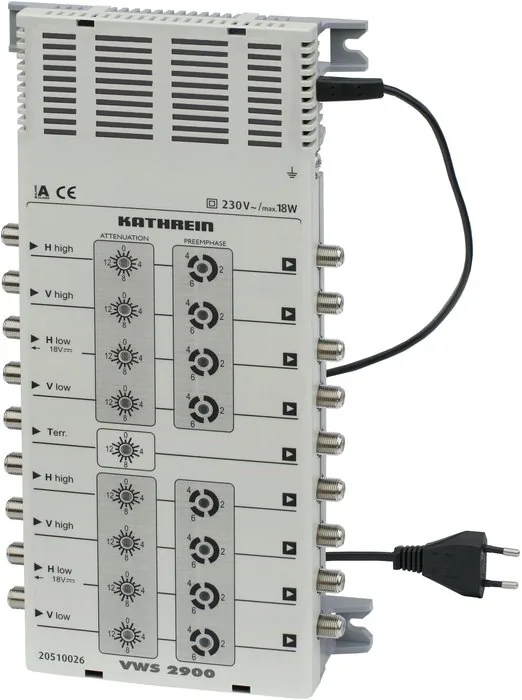
Use the built‑in attenuators to adjust gain in 1 dB steps for satellite and terrestrial branches independently; select pre‑emphasis (2/4/6 dB) per satellite branch to correct attenuation slope over long cable runs.
Is this answer helpful?
Use high‑quality, well‑shielded coaxial cable and F‑type 75 Ω connectors or compression fittings. Ensure the inner conductor diameter does not exceed 1.2 mm and is free of burrs to avoid socket damage.
Is this answer helpful?
Equipotential bonding with a copper conductor of at least 4 mm² is required; use the device's grounding screw. The amplifier has an internal switched‑mode PSU and can feed remote devices via the H low port.
Is this answer helpful?
Target an input level between approximately 50 and 80 dBµV to ensure proper operation and avoid overdriving downstream multiswitches; use an antenna meter for accurate leveling.
Is this answer helpful?
Yes. The VWS 2900 meets relevant EN standards and Kathrein provides an EU Declaration of Conformity under Directive 2014/53/EU; full documentation is available from Kathrein.
Is this answer helpful?
Advantages and Disadvantages
Advantages

- High dynamic range and strong inter‑stage decoupling for clean amplification
- 1 dB attenuator steps and 2/4/6 dB pre‑emphasis for precise leveling
- Efficient integrated PSU and DC/DC converter reduce power consumption
- Designed for 8 x Sat‑IF multiswitch cascades and CATV terrestrial compatibility
- Compact indoor form factor with standard F‑type connectors
Disadvantages

- Indoor use only (IP30) — not suitable for outdoor installation
- Requires proper equipotential bonding (Cu ≥ 4 mm²) and earthing
- Inner conductor diameter limit (≤ 1.2 mm) restricts cable choices
- Risk of overdriving downstream gear if input levels exceed 80 dBµV
- Needs clearance for ventilation and cannot be ceiling mounted
Product Specification
Type
Basic Amplifier
Inputs
9
Outputs
9
Satellite Gain
17-24dB, 47-2150MHz
Terrestrial Gain
17-24dB, 47-2150MHz
FM Gain
17-24dB, 47-2150MHz
Attenuation
0-15dB
Power Connection
yes
Dimensions
11.22x1.69x5.83in
Weight
2.43lb
Product Description
Kathrein VWS 2900 — Powerful Sat‑IF and Terrestrial Distribution Amplifier
The Kathrein VWS 2900 is a compact, indoor distribution amplifier engineered for robust satellite (8 x Sat‑IF) and terrestrial signal amplification in medium to large reception systems. Designed with high dynamic range amplifier stages and excellent inter‑stage decoupling, the unit delivers reliable, low‑noise performance for cascaded multiswitch installations. Its GaAs final stage ensures the terrestrial amplifier is suitable for CATV/BK applications while the satellite paths offer fine‑tuning to match complex distribution networks.
Key features and operation
Adjustable 1‑dB step attenuators let installers precisely set gain for both satellite and terrestrial branches independently, reducing the risk of downstream overdrive. The satellite section includes selectable pre‑emphasis (2/4/6 dB) per SAT branch to correct slope introduced by long cable runs or varied line losses, enabling consistent levels across all outputs. An integrated efficient switched‑mode PSU and DC/DC converter power both the amplifiers and connected LNBs while keeping power consumption minimal.
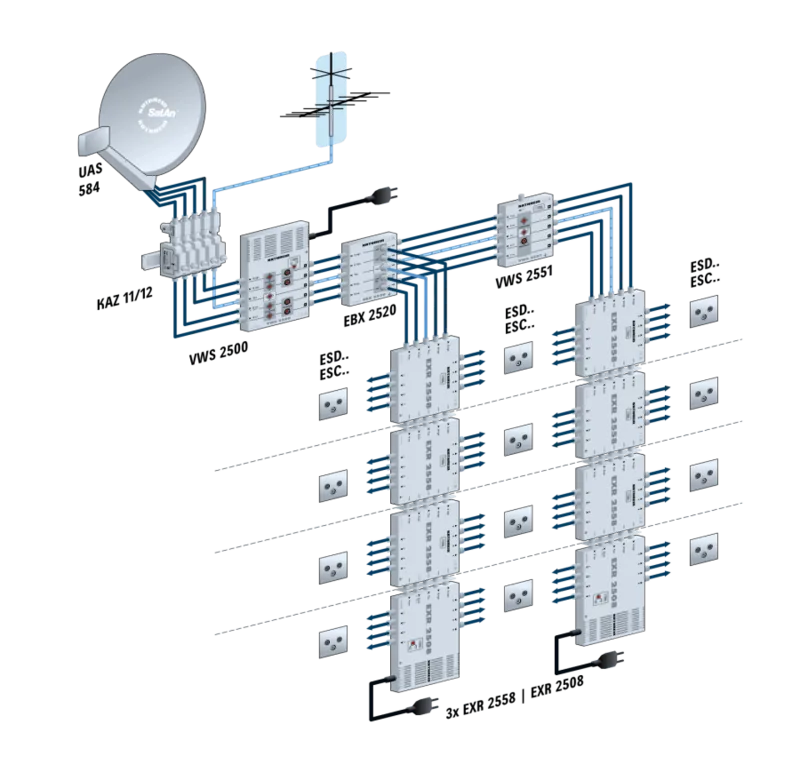
Installation is straightforward: the VWS 2900 is intended for indoor mounting and connects via standard F‑type 75 Ω connectors. It works well at the head of multiswitch cascades or as a distribution network amplifier to compensate splitter and cable losses. Leveling is done using an antenna meter and the built‑in attenuators; typical input target is 50–80 dBµV to avoid overloading downstream multiswitches.
Practical considerations
Mount the device only in dry indoor environments, ensure proper equipotential bonding (Cu ≥ 4 mm²) and comply with EN 60728‑11 and EN 62368‑1 safety standards. Use high‑quality coaxial cables and F‑connectors (or compression fittings) to preserve shielding and avoid ingress of interference. Observe the maximum inner conductor diameter (≤ 1.2 mm, burr‑free) to prevent socket damage. For earthing, use the provided grounding screw and bond every unit in the reception chain.
Installation notes include maintaining at least 5 cm clearance for cooling, avoiding ceiling mounting, and ensuring the mains plug remains easily accessible. The switched‑mode power supply also feeds the H low port to supply remote devices when required.
Technical highlights
- Frequency ranges: Terrestrial 47–862 MHz; Sat 950–2150 MHz
- Gain: Terrestrial ~17–21 dB; Sat ~22–24 dB
- Attenuator range: 0–15 dB in 1 dB steps
- Pre‑emphasis options: 2 / 4 / 6 dB (satellite branches)
- Max output levels: up to ~115 dBµV (depending on IM performance)
- Protection class: II (double insulated), IP30
Pros and Cons
Pros:
- High dynamic range and strong inter‑stage decoupling for clean amplification
- Fine 1 dB attenuator steps and selectable 2/4/6 dB pre‑emphasis for precise leveling
- Efficient integrated PSU and DC/DC converter reduce power consumption
- Suitable for cascaded multiswitch setups with 8 Sat‑IF outputs
- Standard F‑connectors and compact indoor form factor ease installation
Cons:
- Indoor use only (IP30) limits outdoor deployment options
- Requires careful grounding and adherence to safety standards
- Max inner conductor diameter constraint (≤1.2 mm) demands specific cables
- Downstream equipment can be overloaded if input levels exceed specs
- No ceiling mounting; needs airflow clearance around the unit
Most important results
- Precise level control: 1 dB attenuator steps for satellite and terrestrial paths enable accurate system balancing without coarse adjustments.
- Pre‑emphasis flexibility: selectable 2/4/6 dB per SAT branch compensates long‑cable slope and preserves signal uniformity.
- Low power draw: integrated efficient switch‑mode PSU plus DC/DC converter minimize consumption while powering LNBs.
- System compatibility: intended for 8 x Sat‑IF multiswitch cascades and suitable for CATV terrestrial use due to GaAs final stage.
- Installation constraints: indoor mounting, proper earthing (Cu ≥ 4 mm²) and cable specs (≤1.2 mm inner conductor) are required for reliable operation.
FAQ
-
Q: What is the primary use of the Kathrein VWS 2900? A: The VWS 2900 amplifies satellite and terrestrial signals in multiswitch distribution systems, compensating cable and splitter losses and providing power to LNBs via its integrated power supply.
-
Q: Can the unit be used outdoors? A: No. The VWS 2900 is intended for indoor installation (IP30) and must be protected from moisture and condensation.
-
Q: How is gain and equalisation adjusted? A: Gain is adjusted in 1‑dB steps via separate attenuators for satellite and terrestrial branches; satellite branches also offer pre‑emphasis settings of 2, 4 or 6 dB to correct frequency slope.
-
Q: What cable and connector requirements apply? A: Use high‑quality coaxial cables with excellent shielding and F‑type 75 Ω connectors or compression fittings. Inner conductor diameter must not exceed 1.2 mm and must be burr‑free.
-
Q: What are the power and grounding needs? A: The amplifier is powered by an internal switched‑mode PSU and can feed LNBs via H low. Equipotential bonding with a Cu conductor ≥ 4 mm² and using the device grounding screw is mandatory.
-
Q: What input levels should be observed to avoid overdrive? A: Ensure input levels are maintained between about 50 and 80 dBµV so downstream multiswitches are not overloaded; use an antenna meter for precise leveling.
-
Q: Is the device compliant with regulations? A: Yes. The VWS 2900 complies with applicable EN standards and Kathrein provides an EU Declaration of Conformity per Directive 2014/53/EU.
Notes:
- Keep the unit ventilated with at least 5 cm clearance; do not mount on ceilings.
- Dispose of the device per local electronic waste regulations.
- Contact Kathrein service or your dealer for support and the latest documentation.
Search for 67,706 Manuals online


Type-in Brand or Model