
Kathrein VOS 137/RA Manual
PDF manual · 33 Pages
English



Quick check
Incorrect answer, please try again.
Chat with your Kathrein VOS 137/RA manual using AI
Get instant AI answers from your Kathrein VOS 137/RA manual
Ask anything about the Kathrein VOS 137/RA. Answers come from this manual, with the pages they are based on.
Ask a Question
Do you recommend VOS 137/RA?
Yes NoDo you recommend VOS 137/RA?
Yes NoFrequently Asked Questions
The device supports a frequency range spanning from 47 to 1006 MHz, making it suitable for modern HFC networks requiring high bandwidth capabilities for both downstream and upstream signals.
Is this answer helpful?
Gain is switchable at 40, 34, or 30 dB using interstage attenuation jumpers. The default setting upon delivery is 34 dB, but it can be adjusted to suit network needs.
Is this answer helpful?
Yes, safety regulations mandate that installation and servicing must be performed only by authorized specialist staff due to the high voltage risks involved in handling the components.
Is this answer helpful?
The unit operates on a 230 V AC supply voltage. Users must exercise extreme caution as this voltage can be fatal if touched or handled improperly during maintenance tasks.
Is this answer helpful?
Yes, the return path can be configured as active, passive, or disabled via specific jumper settings, allowing flexibility for network configurations that do not require upstream transmission.
Is this answer helpful?
The permissible ambient temperature range is from minus 20 degrees Celsius to plus 55 degrees Celsius, ensuring stability in various environmental conditions during operation.
Is this answer helpful?
Advantages and Disadvantages
Advantages

- Modern GaAs-MMIC technology ensures high efficiency and reliability for signal transmission.
- Adjustable gain settings allow flexible configuration to meet specific network demands precisely.
- Integrated test sockets facilitate accurate bidirectional measurements without external equipment.
- Die-cast housing with F connectors provides durability and secure physical connections.
- Internal LED indicators offer immediate visual feedback on power supply function status.
Disadvantages

- High operational voltage of 230 V AC presents a significant electrical shock hazard during handling.
- Installation requires authorized specialist staff which may increase initial setup labor costs.
- Must be installed in dry indoor areas limiting placement options for outdoor applications.
- Potential equalization is mandatory adding complexity to the grounding system requirements.
- Cover must remain closed preventing access to internal components during normal operation.
Product Specification
Type
Broadband Amplifier
Inputs
1
Outputs
1
Terrestrial Gain
40dB, 47-1006MHz
VHF Gain
40dB, 47-1006MHz
Attenuation
0-20dB
Power Connection
Yes
Features
Attenuation Control
Dimensions
8.58x3.15x5.91 in
Weight
2.87 lbs
Product Description
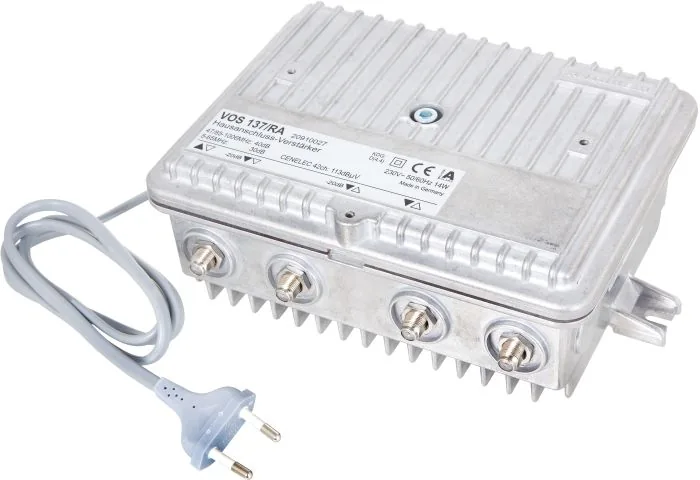
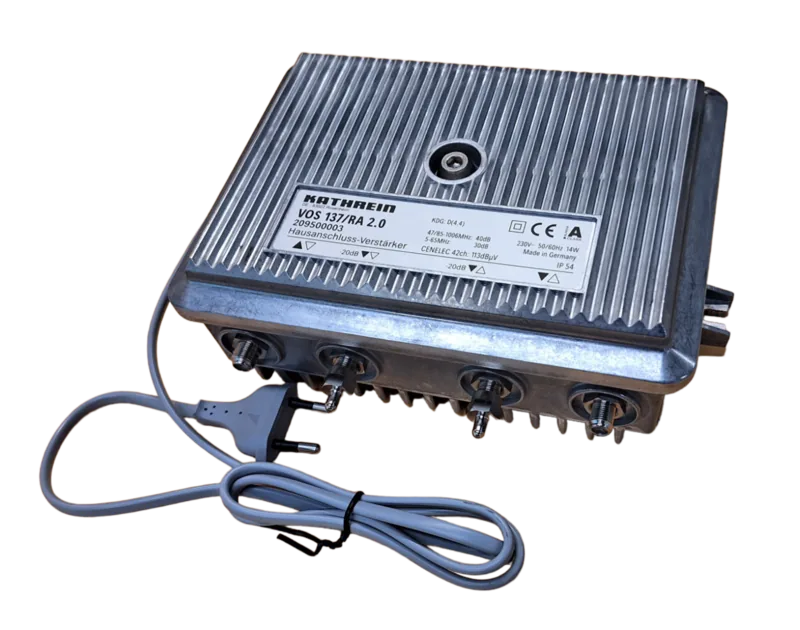
Kathrein VOS 137/RA: Enhancing Modern HFC Networks
The Kathrein VOS 137/RA serves as a vital component in infrastructure, designed specifically for house connections within modern HFC environments. This device stands out for its robust performance and compliance with rigorous European safety standards.
Technology and Performance
At the heart of this amplifier lies modern GaAs-MMIC technology, ensuring high efficiency and reliability. Users benefit from a very high output level paired with a favorable energy balance. The gain is not fixed but adjustable, offering settings of 40, 34, or 30 dB through interstage attenuation. By default, the device ships configured at 34 dB. This flexibility allows technicians to fine-tune the system based on specific network requirements without needing additional hardware. The unit operates within a frequency range spanning from 47 to 1006 MHz, supporting both downstream and upstream signals effectively.
Safety and Installation
Safety remains a paramount concern when dealing with power supplies in telecommunications. The VOS 137/RA operates on a supply voltage of 230 V AC, which can be fatal if handled improperly during installation or maintenance. Therefore, authorized specialist staff must perform all mounting procedures. The amplifier must only be installed in dry indoor areas within locations protected from weather conditions. Ensuring potential equalization is mandatory to prevent electric shock risks associated with high touch voltages in the event of a fault. The cover must always remain closed during operation to ensure safety against live parts.
Features and Configuration
Configuration is straightforward thanks to an innovative operational concept. Technicians can simplify leveling using a rotary switch with a large adjustment range of 20 dB and a small step width of 1 dB. Basic configuration handles via jumper settings, ensuring exactly reproducible device settings. Additionally, test sockets are integrated for bidirectional testing of the amplification path. These sockets come equipped with directional couplers for accurate measurements. The housing is made of die-cast material with F connectors, providing durability and secure connections.
Compliance and Standards
The unit meets essential international standards including EN 60728-11 and EN 60065. It fits standard installation slots with dimensions of 218 x 150 x 80 mm. Whether used for forward or return paths, the device supports frequencies up to 1006 MHz. For return paths, options include active, passive, or disabled modes. This versatility makes it a suitable choice for upgrading existing infrastructure. The device classification aligns with KDG 1 TS 140 Type D specifications. Internal LED indicators provide immediate feedback on power supply functions during operation. Proper disposal follows WEEE regulations to prevent environmental harm at end of life.
Search for 67,732 Manuals online


Type-in Brand or Model