
Kathrein BZD 30 Manual
PDF manual · 12 Pages
English



Quick check
Incorrect answer, please try again.
Chat with your Kathrein BZD 30 manual using AI
Get instant AI answers from your Kathrein BZD 30 manual
Ask anything about the Kathrein BZD 30. Answers come from this manual, with the pages they are based on.
Ask a Question
Do you recommend BZD 30?
Yes NoFrequently Asked Questions
The BZD 30 requires a DVB-T compatible receiver or TV that supplies 5 V (approx. 30 mA) remote power via the coaxial cable. Do not connect it to satellite receivers or equipment that cannot provide the specified 5 V feed, as this may damage the antenna.
Is this answer helpful?
Place the antenna indoors near a window or higher location and avoid metal-clad rooms or enclosed metal cabinets. Because it has a near-omnidirectional vertical pattern, exact alignment is usually unnecessary; if reception is poor, change the polarization marking and try different positions.
Is this answer helpful?
The antenna covers VHF Band III (174–230 MHz) and UHF (470–790 MHz), making it suitable for terrestrial digital TV and radio signals within those bands when signal levels are adequate for indoor reception.
Is this answer helpful?
Use the supplied 2 m coaxial cable to connect the BZD 30 to a DVB-T receiver or TV. In the receiver’s setup menu, enable the 5 V antenna power (phantom power). The antenna receives its supply through the coax; no external adapter is required.
Is this answer helpful?
Poor reception can result from too weak or too strong signal levels, proximity to the transmitter, building materials like reinforced concrete or metalized windows, closed metal cabinets, or nearby transmitting electronics such as mobile phones.
Is this answer helpful?
Yes. A wall bracket and fixings are included. Test and find the optimal reception location before drilling. Ensure no electrical wiring is present in the wall to avoid electric shock during mounting.
Is this answer helpful?
Clean with a slightly damp cloth; avoid abrasive or acidic cleaners and never immerse the unit in liquid. Protect it from moisture, direct heat and prolonged sunlight exposure; store or use only in dry indoor conditions.
Is this answer helpful?
Advantages and Disadvantages
Advantages

- Integrated amplifier and low noise figure improve weak indoor signals without external power supplies
- Near-omnidirectional (vertical) pattern allows flexible placement and minimal alignment
- Integrated GSM/LTE trap filter reduces mobile interference
- Includes foot, wall bracket and 2 m coax with straight and angled IEC connectors for easy installation
- Compact, attractive design suitable for discreet indoor use
Disadvantages

- Only operable with DVB-T receivers that provide 5 V remote power; incompatible with SAT receivers
- Indoor performance limited in areas with very weak or excessively strong signal fields
- Reception can be degraded by building materials (reinforced concrete, metalized windows) and nearby electronics
- Not weatherproof—only for dry indoor installation
- May cause furniture discoloration from device feet on sensitive surfaces
Product Specification
Type
Flat antenna
Application area
Indoor
Mounting
Stand, Wall
Gain
active (18dB)
Reception
DVB-T, DVB-T2
Frequency range
174-790MHz
Special features
GSM filter, remote powered (5V)
Product Description
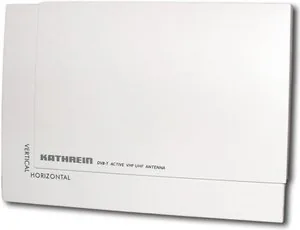
Kathrein BZD 30 18dB Manual
The Kathrein BZD 30 is a compact indoor DVB-T antenna with an integrated amplifier designed for reliable reception of terrestrial digital TV and radio in VHF (Band III) and UHF ranges. Engineered for convenience, it supports both horizontal and vertical polarisation and features a near-omnidirectional vertical radiation pattern so placement is simple and flexible. The antenna is powered via 5 V remote feeding through the coaxial cable from a compatible DVB-T receiver, eliminating the need for a separate power adapter.
With an attractive, space-saving design and very low noise figure, the BZD 30 boosts weak signals while guarding against common mobile and LTE interference thanks to an integrated trap filter. The unit includes a stable foot for desktop placement, a wall bracket with fixings for permanent mounting, and a 2 m coaxial cable featuring both straight and angled IEC connectors for easy connection to receivers and TVs. Measured performance includes reception ranges of 174–230 MHz and 470–790 MHz, a typical figure of merit around -28.5 dB/K and a typical maximum output of 95 dBμV.
Practical setup is straightforward: connect the antenna to a DVB-T capable receiver or TV using the supplied coax cable, enable phantom power (5 V) in the receiver menu, and fine-tune placement—near a window is often best. If reception is problematic, switch the polarization marking on the antenna, move the unit to another room or avoid window locations near strong transmitters. The product is intended strictly for indoor dry environments; do not connect to satellite receivers or apply voltages other than the specified 5 V.
The BZD 30 is well suited for users who need a low-profile indoor reception solution without complex alignment. It’s ideal when signal levels are moderate and quick, unobtrusive installation is important. For very weak or overly strong fields, an outdoor directional antenna or alternative measures may be required to achieve optimal reception.
Notes:
- Only use with DVB-T compatible receivers that supply 5 V via coax; connecting to unsuitable devices (e.g., SAT receivers) may damage the antenna.
- Keep the antenna dry and avoid placing it near heat sources or open flames.
- Avoid mounting locations with heavy metal shielding (reinforced concrete, metalized windows, closed metal cabinets) or close to transmitting electronics to prevent reception issues.
- Clean with a slightly damp cloth; do not use abrasive cleaners or immerse in liquids.
Search for 67,706 Manuals online


Type-in Brand or Model
Lena Schneider
10 months ago
Does this indoor TV antenna need power from the receiver (5V), or do I need an extra power supply if my receiver does not provide it?
Manual.ly
10 months ago
Yes, this is an active indoor antenna and it requires power. In many setups it is powered via a suitable receiver output (for example a 5V antenna feed, USB, or a powered TV input depending on your model). If your receiver does not supply the required power, you will need a separate power injector/power supply so the antenna can amplify the signal. Check the receiver's antenna power specifications and match the connector/power method to the antenna's requirements. If you are unsure, tell us your receiver model and the antenna cable type, and support can recommend the correct connection option.