

Karibu Merseburg 6 Manual
PDF manual · 17 Pages
English



Quick check
Incorrect answer, please try again.
Chat with your Karibu Merseburg 6 manual using AI
Get instant AI answers from your Karibu Merseburg 6 manual
Ask anything about the Karibu Merseburg 6. Answers come from this manual, with the pages they are based on.
Ask a Question
Do you recommend Merseburg 6?
Yes NoFrequently Asked Questions
First compare the material list with the package contents and report any missing or damaged parts before assembling. Complaints are handled only while components remain unassembled.
Is this answer helpful?
No. The bitumen roofing felt is intended as an initial, temporary covering. It should be supplemented or replaced by a permanent roofing product chosen by the customer, ideally within about two months of installation.
Is this answer helpful?
No. The roof is not safe to walk on and the structure is designed for distributed loads (snow, wind), not point loads. During installation, support the roof from below and avoid concentrated loads on the roof surface.
Is this answer helpful?
Shingle use depends on roof type: do not apply full bitumen underlay under shingles on gable roofs (only 20 cm strips at eaves), for arched roofs install bitumen under shingles, and shingles are not suitable for flat roofs.
Is this answer helpful?
The customer/installer must apply bitumen sealant to seal roof surfaces to adjacent components; the manual recommends on-site sealing and roof support during installation.
Is this answer helpful?
Claims for missing parts are generally accepted only if reported before assembly begins; preserve unassembled components and report issues promptly to the supplier.
Is this answer helpful?
Advantages and Disadvantages
Advantages

- Prefabricated, numbered components simplify identification and speed assembly.
- Temporary bitumen underlay provides immediate weather protection on delivery.
- Solid timber construction designed for distributed loads like snow and wind.
- Detailed parts list and fastener callouts reduce assembly errors.
- Flexible roofing guidance for different roof types (gable, arched, flat).
Disadvantages

- Bitumen underlayment is temporary and must be replaced within ~2 months.
- Roof is not walkable and not designed for point loads — limited rooftop access.
- Sealing to adjacent components and permanent roofing are the customer’s responsibility.
- Claims for missing parts accepted only if components remain unassembled.
- Shingles cannot be used on flat roofs and may require different underlay rules.
Product Specification
Color
natural
Material
Wood (Spruce, 0.55 in)
Roof type
Pent roof
Door
1x double swing door (incl. light cutout)
Window
no
Special features
lockable
Base dimensions
93.70x94.49 in (WxD)
Floor area
61.46 ft2
Product Description
Karibu Merseburg 6 Manual — Product Overview
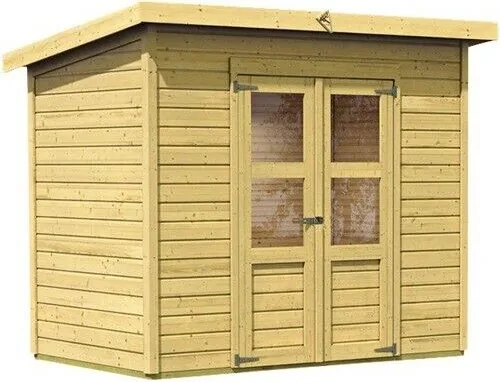
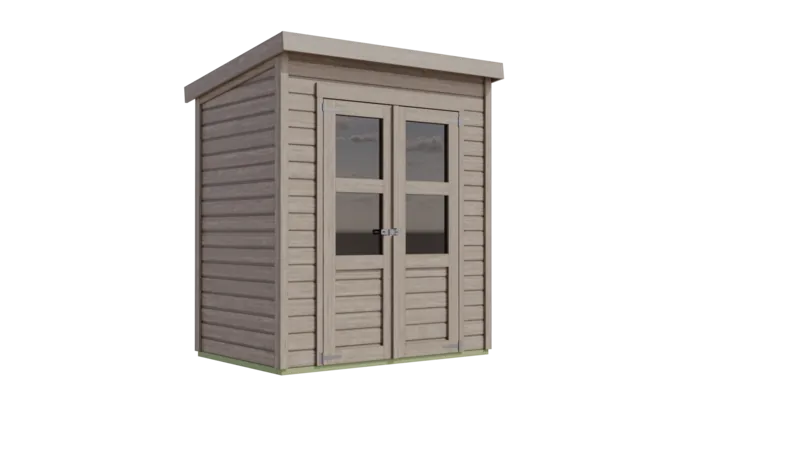
The Karibu Merseburg 6 is a wooden garden house designed for versatile outdoor use, offering a balanced combination of sturdy construction and user-focused assembly guidance. With its prefabricated wall elements, roof structure and included bitumen underlayment, the Merseburg 6 is suited for storage, hobby space or a small workshop. The product is engineered for distributed loads like snow and wind, not for concentrated point loads, and the roof is not intended to be walked on.
Design and Materials
Constructed from planed timber boards and precision-cut components, the Merseburg 6 arrives as a kit with numbered parts and a detailed parts list. Typical included elements are wall panels (B-series), roof panels (U/N-series), purlins and fasteners. The roof receives an initial bitumen roofing felt as a temporary weatherproofing layer; this underlayment should be replaced or supplemented with a permanent roofing product within about two months.
Assembly Notes
The manual emphasizes an initial inventory check — compare the material list to the package contents before assembly and report missing parts only while components remain unassembled. Assembly instructions use labeled parts and callouts (e.g., B1, B2, U1, N1) and show recommended fastener sizes and overlap dimensions for roofing felt (approx. 10 cm). During installation, it is recommended to support the roof from below and to ensure flush alignment of adjoining parts. Sealing between roof surfaces and adjacent components requires on-site bitumen sealant applied by the installer.
Roofing Guidance
The supplied bitumen roofing felt is for temporary initial covering. For gable-roofed houses using shingles, avoid a full bitumen underlay except for two 20 cm strips at the eaves; for arched (tonneau) roofs, install bitumen under shingles; for flat roofs, shingles are not suitable. Overlaps of roofing strips should be approx. 10 cm and the roof should not be used as a walkway. The manual stresses that the felt is a stop-gap solution and must be complemented by a durable roofing product chosen by the customer.
Practical Recommendations
Follow part numbering and orientation carefully, keep components unassembled if claiming missing items, use recommended fastener hole sizes and positions, and observe flush alignment where indicated. Provide temporary bracing for the roof during erection, and plan a permanent roofing solution after initial weatherproofing.
Notes
- Always compare the parts list to package contents before beginning assembly.
- The bitumen underlay is temporary; replace or supplement within approximately two months.
- The roof is designed for distributed loads; avoid point loads and walking on the roof.
- Sealing to adjacent building elements is the customer’s responsibility.
Search for 67,706 Manuals online


Type-in Brand or Model