

Kaiser RS2 XA Manual
PDF manual · 2 Pages
English



Quick check
Incorrect answer, please try again.
Chat with your Kaiser RS2 XA manual using AI
Get instant AI answers from your Kaiser RS2 XA manual
Ask anything about the Kaiser RS2 XA. Answers come from this manual, with the pages they are based on.
Ask a Question
Do you recommend RS2 XA?
Yes NoFrequently Asked Questions
It is designed for overhead photography and reproduction tasks where the camera must remain fixed above the subject. It works well for digitizing prints, artwork, and small product shots.
Is this answer helpful?
Height is changed with the crank. This gives controlled movement and makes it easier to position the camera accurately above the subject.
Is this answer helpful?
The manual suggests applying a very thin film of vaseline to the column using a cloth. If that does not help enough, the lower adjustment screws at the back of the holder arm can be loosened evenly.
Is this answer helpful?
Tighten the two lower screws evenly until the movement becomes more stable. The upper screws should always stay firmly tightened.
Is this answer helpful?
It uses a standard 1/4-inch mounting thread, which is common on many cameras and compatible accessories.
Is this answer helpful?
The maximum load is 1.5 kg. It is best suited to lightweight camera setups rather than heavy studio rigs.
Is this answer helpful?
Advantages and Disadvantages
Advantages

- Crank-driven height control makes framing precise and repeatable.
- Adjustable arm tension helps balance smooth movement with secure support.
- Standard 1/4-inch thread works with many cameras and accessories.
- Compact base and 76 cm column suit desk-based reproduction setups.
Disadvantages

- Maximum load is limited to 1.5 kg, so heavier cameras are not suitable.
- Stiff motion may require occasional lubrication and readjustment.
- Distance changes between plate and column need screw loosening, so adjustments are not instant.
Product Specification
Type
Slide accessory
Product Description
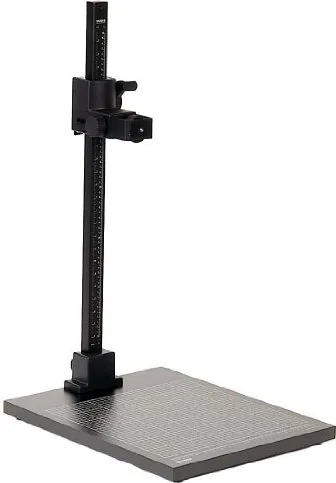
Kaiser RS2 XA Copy Stand
The Kaiser RS2 XA Copy Stand is a compact and practical tool for overhead photography, reproduction work, and detail-focused image capture. It is designed for situations where the camera must stay steady above the subject, making it a strong choice for digitizing prints, photographing artwork, documenting collectibles, or shooting clean product images. Its straightforward mechanical build keeps the workflow simple while still offering the control needed for precise results.
At the heart of the stand is a crank-operated height adjustment system. This allows smooth, measured movement, which is especially helpful when framing flat artwork or matching a repeatable shooting setup. If the motion becomes stiff over time, the Kaiser RS2 XA Copy Stand Manual recommends a very thin film of vaseline on the column, applied with a cloth, to help restore easier movement. That maintenance tip shows how the stand is built around long-term usability rather than complicated features.
The holder arm also offers useful adjustment options. The distance between the camera mounting plate and the column can be changed after loosening the fixing screw, giving users more flexibility when positioning the camera for different subjects. If the arm feels too loose or starts to move under load, the lower screws can be tightened evenly to improve resistance. Just as important, the upper screws should always remain firmly tightened for safe operation.
With a maximum load of 1.5 kg and a standard 1/4-inch mounting thread, the RS2 XA is well suited to lightweight camera setups and everyday studio tasks. Its column height of about 76 cm and baseboard size of roughly 400 x 25 x 500 mm provide a stable working platform without taking up excessive space. That balance makes it a good fit for desks, small studios, archive work, and other controlled environments where consistency matters.
For photographers who value reliability, the Kaiser RS2 XA Copy Stand delivers a reassuringly simple experience. There are no complex controls to learn, only practical adjustments that support accurate positioning and repeatable results. In that sense, it is less about flashy extras and more about dependable performance, which is exactly what many reproduction workflows need.
Notes
- Best for lightweight cameras and tabletop reproduction.
- Occasional adjustment can help maintain smooth movement.
- Stability and repeatability are its strongest advantages.
Search for 67,706 Manuals online


Type-in Brand or Model