
Joy-iT JT-DPM8624 Manual
PDF manual · 13 Pages
English



Quick check
Incorrect answer, please try again.
Chat with your Joy-iT JT-DPM8624 manual using AI
Get instant AI answers from your Joy-iT JT-DPM8624 manual
Ask anything about the Joy-iT JT-DPM8624. Answers come from this manual, with the pages they are based on.
Ask a Question
Do you recommend JT-DPM8624?
Yes No
Stefan Klein
7 months ago
Is this power supply digitally controllable via RS485 or community software for use in solar applications?

Manual.ly
7 months ago
Yes, the unit supports digital control. Community software is available on GitHub. It features RS485 connectivity for automated control, ideal for photovoltaic battery charging. Users note a solid build, and while the fan is audible under load, it is not excessive.
Klaus Weber
7 months ago
Is RS485 communication supported for external control, and can you share where to download the digital control software mentioned in reviews?
Manual.ly
6 months ago
Yes, RS485 communication is supported for automated tasks like PV battery charging. The digital control software is hosted on our GitHub page linked in the technical manual. You will find the latest binaries and documentation there. If you need help configuring the connection, please contact our support team with your firmware version.
Luca Werner
4 months ago
Is the power supply reliable for automated battery charging, and can it be controlled digitally?
Manual.ly
4 months ago
Yes. Reviews describe it as solid and reliable, with community software available on GitHub for digital control. It can also be integrated into automated setups via RS485, such as photovoltaic battery-charging systems. The fan is audible under load, but users report that its noise level remains moderate.
Lukas Weber
4 months ago
Is the power supply reliable for automated battery charging, and can it be controlled digitally?
Manual.ly
4 months ago
Yes. The unit is described as solidly built and reliable, and it can be digitally controlled using community-developed software available on GitHub. It is suitable for automated applications such as RS485-controlled battery charging in photovoltaic systems. The fan is audible under load, but reviewers found it not excessively loud.

Lena Voss
5 months ago
Is the power supply reliable for automated battery charging, and can it be controlled digitally?
Manual.ly
5 months ago
Yes. Reviews describe it as solid and reliable, with digital control available through community software on GitHub. It can be integrated into automated setups, including RS485-controlled battery charging for photovoltaic systems. The fan is audible under load but is generally not considered excessively loud.
Frequently Asked Questions
It provides an adjustable DC output from 0 to 60 V and 0 to 24 A, with a maximum output power of 1440 W. The actual available output depends on the connected input source and the operating conditions.
Is this answer helpful?
The unit requires a DC input between 10 and 75 V. The input voltage must be at least 0.5 V higher than the desired output voltage, so the supply can regulate correctly.
Is this answer helpful?
Yes. Users can set voltage and current limits, and the supply changes between constant-voltage and constant-current operation as load demand changes. Upper and lower setting limits can also prevent accidental adjustment outside a chosen range.
Is this answer helpful?
Yes. Its RS485 interface can be connected to a PC using a suitable adapter. It supports a simple communication protocol and Modbus RTU, with selectable baud rates and configurable communication addresses.
Is this answer helpful?
The power supply can save and load commonly used voltage and current configurations in memory locations numbered 0 through 9. This helps users quickly recall repeatable test conditions.
Is this answer helpful?
The unit monitors internal temperature and adjusts fan behavior as temperature rises. An over-temperature indication is provided, and protection shuts the unit down if the temperature reaches a critical level.
Is this answer helpful?
Advantages and Disadvantages
Advantages

- Delivers 0 to 60 V, up to 24 A, and up to 1440 W for demanding bench and project applications.
- Offers fine voltage adjustment, current limiting, CV/CC status indicators, and low output ripple below 50 mVpp.
- RS485 communication supports PC control, configurable settings, simple protocol, and Modbus RTU integration.
- Ten memory locations, configurable limits, key lock, and selectable output startup behavior improve repeatability.
- Temperature monitoring, variable fan operation, and over-temperature protection support safer operation.
Disadvantages

- Requires a separate 10 to 75 V DC input source, with input voltage at least 0.5 V above output voltage.
- The high-power output requires careful wiring, suitable loads, and experienced handling of DC electrical systems.
- PC communication requires an appropriate RS485 adapter and correct port, baud rate, and address settings.
- Wireless control is limited to compatible equipment and a stated operating range of up to 10 meters.
- Output accuracy tolerances and operating behavior should be verified for precision measurement applications.
Product Specification
Suitable for
Universal
Product Description
Joy-iT DPM8624 Netzgerät - Read, Download & Print Free
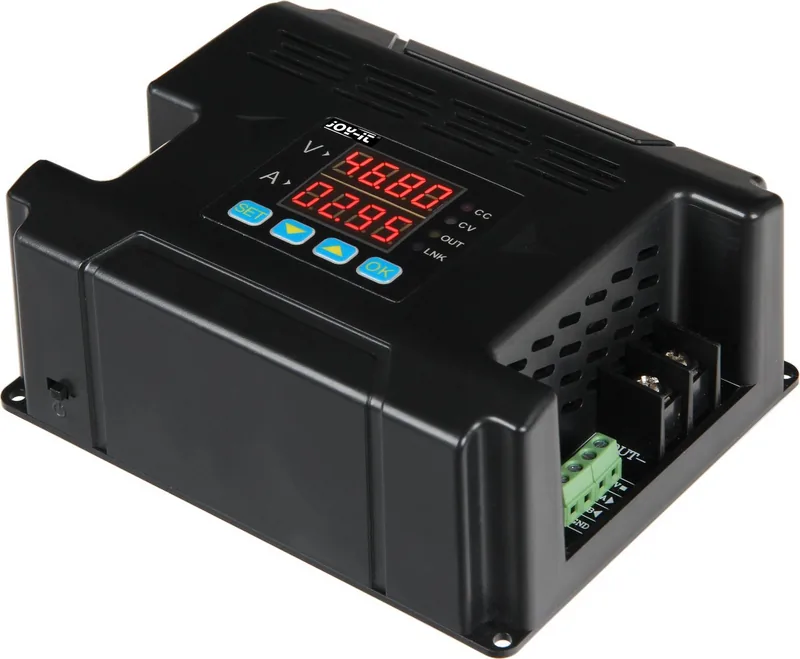
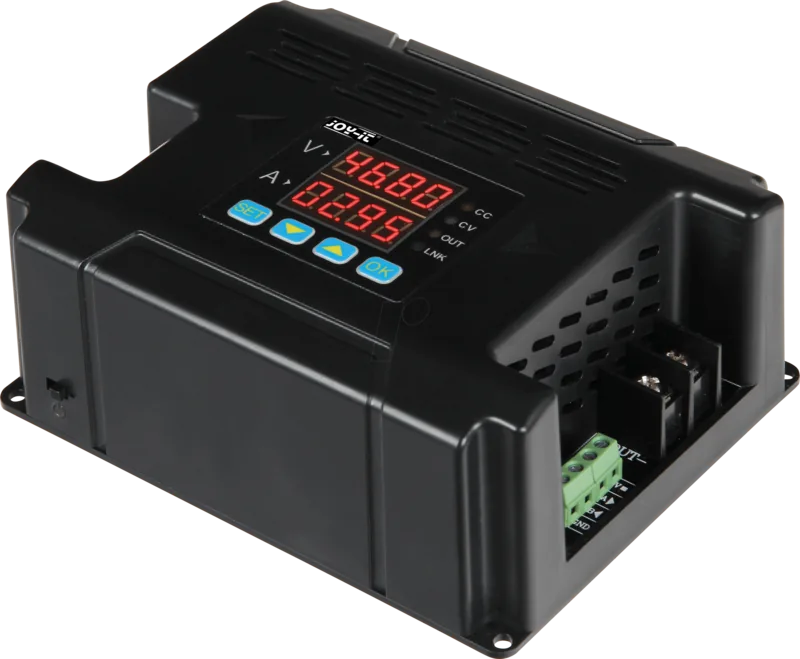
The Joy-iT DPM8624 Netzgerät is a programmable laboratory power supply designed for demanding electronics work, prototyping, testing, and controlled DC power applications. Its compact housing combines substantial output capability with practical adjustment options, making it suitable for workshops, development benches, solar projects, LED systems, and industrial control tasks.
High-output programmable power
With an input range of 10 to 75 V DC, the DPM8624 provides an adjustable output from 0 to 60 V and up to 24 A. Its maximum output power is rated at 1440 W, giving users ample headroom for projects that require more than a basic bench supply. Voltage can be adjusted in 10 mV steps, while the model offers 10 mA current adjustment resolution. Output ripple is specified below 50 mVpp, supporting stable power delivery for sensitive circuits.
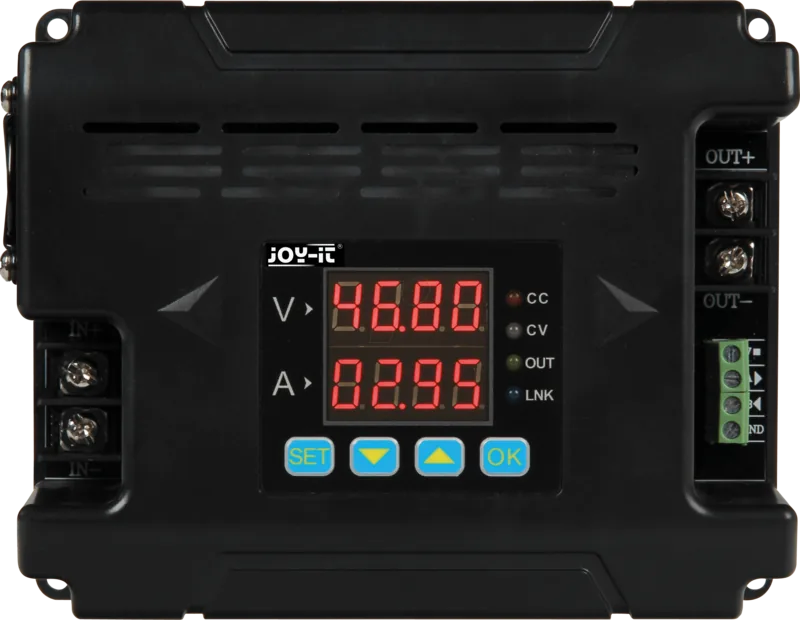
The front display clearly presents voltage and current values, while CV and CC indicators show whether the unit is operating in constant-voltage or constant-current mode. This makes it easier to observe changing load conditions and protect connected equipment through appropriate current limits.
Control, storage, and protection
Direct controls allow users to set output voltage and current, switch the output on or off, and save commonly used configurations in ten memory locations. Upper and lower voltage or current limits can also be configured to prevent accidental settings outside a defined working range. A key lock helps prevent unintended changes during longer test runs.
The Joy-iT DPM8624 Netzgerät includes adjustable startup behavior, allowing the output to remain off after power-up or activate automatically. A fast-response mode improves the time required to reduce output voltage, which is useful when test conditions change quickly. The unit also monitors internal temperature, manages fan speed, and activates over-temperature protection when needed.
Connectivity for automated projects
An RS485 interface enables connection to a computer through a suitable adapter. The unit supports both a simple communication protocol and Modbus RTU, with configurable baud rates, addresses, and communication channels. This flexibility is valuable for automated test systems, monitoring setups, and custom control projects.
A compatible wireless remote control can be used from up to 10 meters away and can operate multiple compatible power supplies. Its LCD display provides convenient access to key readings and settings without requiring direct access to the main unit.
Notes
- Ensure the input voltage is at least 0.5 V above the required output voltage.
- Work involving voltages above 60 V DC should only be performed by qualified electricians.
- Inspect the unit and connections before use, and do not operate damaged equipment.
- Start with suitable voltage and current limits to protect the load under test.
Search for 67,706 Manuals online


Type-in Brand or Model
Lukas Richter
10 months ago
How loud is the fan when the power supply is under load, and is it really possible to control it digitally with software?
Manual.ly
10 months ago
Users report the unit is solidly built and the fan can be audible under load, but not described as overly loud. Actual noise depends on load level and your ambient temperature, so providing good airflow around the PSU helps. Yes, it supports digital control via software. There is community-developed control software available on GitHub, and the device can be configured and managed through that software workflow. If you follow the setup instructions in the documentation, you can automate tasks such as RS485-controlled charging profiles (for example in PV battery charging setups).