
JBL Aquaristic Testlab Manual
PDF manual · 331 Pages
English



Quick check
Incorrect answer, please try again.
Chat with your JBL Aquaristic Testlab manual using AI
Get instant AI answers from your JBL Aquaristic Testlab manual
Ask anything about the JBL Aquaristic Testlab. Answers come from this manual, with the pages they are based on.
Testlab Maintenance Schedule
Change 20-30% of the water to control phosphate levels.
Change 10% of the water to maintain low phosphate concentrations.
Free maintenance reminders
Timed to your purchase date. Always free, unsubscribe anytime.
Ask a Question
Do you recommend Testlab?
Yes NoFrequently Asked Questions
It is a practical overview of JBL water test kits for aquariums and ponds. It explains how to measure major water parameters, why each one matters, and how to respond when values are too high or too low.
Is this answer helpful?
The range covers freshwater, saltwater, garden ponds, and in some cases koi ponds. Specific kits are designed for different environments, so users can choose the test that matches their setup.
Is this answer helpful?
KH helps stabilize pH, GH reflects the mineral content from calcium and magnesium, and pH affects fish comfort, plant growth, and many chemical processes. Together, they define much of the water’s basic stability.
Is this answer helpful?
Most kits use drop-based titration or color comparison. You add reagents to a measured water sample, wait for a color change, and compare the result with a chart or read it from the number of drops used.
Is this answer helpful?
Many of the JBL kits are designed to compensate for lightly colored water caused by tannins or treatments. That improves readability, though careful handling, correct timing, and proper lighting are still important.
Is this answer helpful?
The reagents themselves are consumed during testing, but many JBL sets offer refill packs. That makes regular monitoring more affordable and helps reduce packaging waste over time.
Is this answer helpful?
Advantages and Disadvantages
Advantages

- Covers a wide range of key water parameters for aquariums and ponds.
- Simple drop-count and color-matching methods make routine testing approachable.
- Several tests include compensation for lightly colored water, improving reliability.
- Refill reagents support long-term use and reduce waste.
Disadvantages

- Many reagents require careful handling because they can be corrosive or flammable.
- Some tests involve multiple steps, waiting times, and strict sample volumes.
- Color comparison can be affected by lighting and user judgment.
- Different water types may need separate kits or dilution for the most precise results.
Product Specification
Category
Water parameters
Type
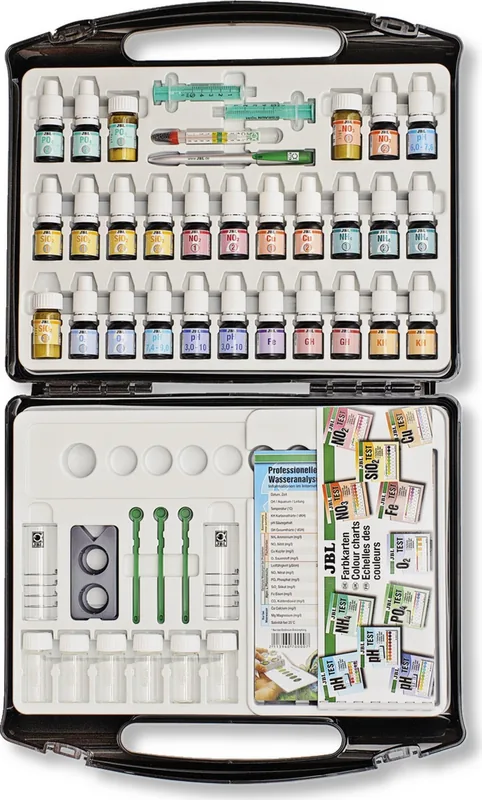
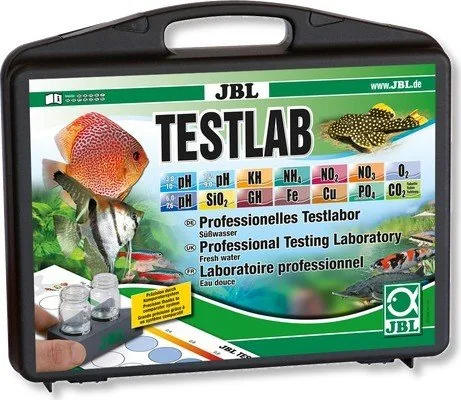
Water test (pH (3 ranges), Carbonate hardness, Total hardness, Phosphate, Nitrite, Nitrate, Iron, Copper, Silicate, Oxygen, Ammonium, Ammonia, CO2 indirectly), Test kit
Dimensions
15.04x3.35x12.52in (WxHxD)
Weight
2.82lb
Product Description
JBL Testlab Test Case Manual: Water Testing Made Practical
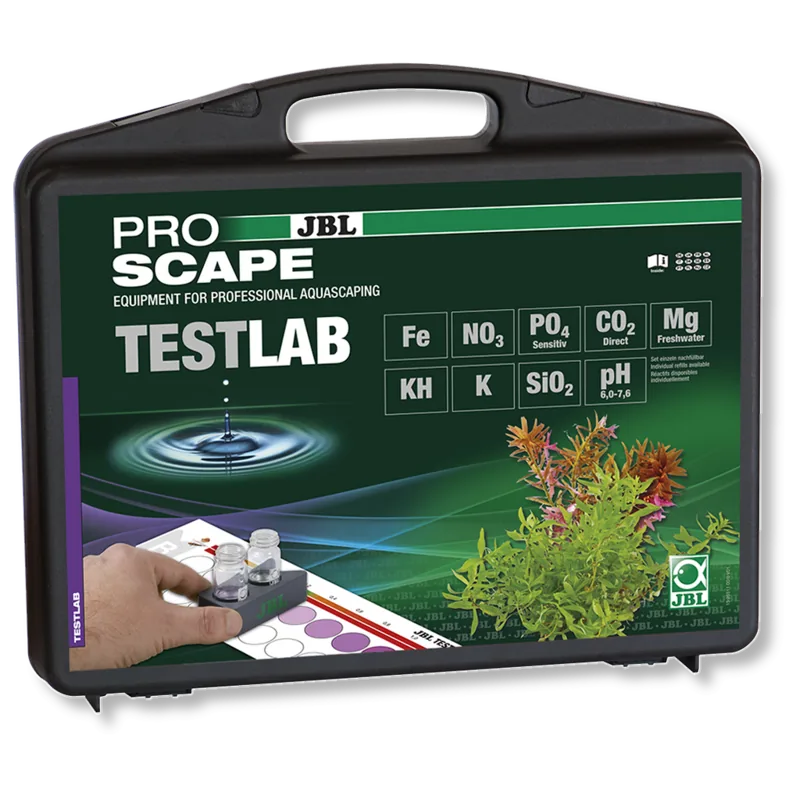
JBL’s Testlab line is built for aquarists and pond keepers who want clear answers about water quality, not vague assumptions. The range covers many of the most important parameters in freshwater, saltwater, and garden ponds, including KH, GH, pH, CO2, oxygen, ammonium, nitrite, nitrate, silicate, phosphate, iron, potassium, magnesium, calcium, and copper. In practice, that means you can track both the basics and the more advanced chemistry that shapes fish health and plant growth.
What makes this collection especially useful is its step-by-step approach. Most tests rely on simple drop counting or visual comparison against a color chart, so they are easy to learn even for beginners. Several kits also include compensation methods that improve accuracy in lightly colored water, which is helpful when tannins, treatments, or natural pond conditions make the water less clear. The result is a practical testing system that balances accessibility with serious monitoring power.
The manual-style format also reflects a strong focus on application. Each parameter is tied to a real-world outcome: KH helps stabilize pH, GH supports general mineral balance, pH affects fish comfort and biological processes, and CO2 and nutrients influence plant performance. Oxygen, ammonium, nitrite, and nitrate help reveal whether the biological cycle is working smoothly, while phosphate, silicate, iron, calcium, magnesium, potassium, and copper point to plant nutrition, algae pressure, and potential toxicity risks.
For planted aquariums, reef systems, and koi ponds, this makes the JBL Testlab approach especially valuable. It does not just measure water; it helps explain why a system may be thriving or struggling. Many kits also encourage regular retesting and offer refill reagents, which is a smart choice for long-term use and lower waste.
Notes
- Best suited for routine water care, problem solving, and targeted dosing.
- Many tests depend on careful timing, clean glassware, and good lighting.
- Safety matters: several reagents are corrosive, flammable, or harmful if mishandled.
- Refill packs make ongoing maintenance more economical and environmentally friendly.
Overall, JBL Testlab feels like a complete water-care companion: practical, detailed, and focused on keeping aquatic life in stable, healthy conditions.
Search for 67,706 Manuals online


Type-in Brand or Model