
JBL Aquaristic ProFlora m2003 Manual
PDF manual · 163 Pages
English



Quick check
Incorrect answer, please try again.
Chat with your JBL Aquaristic ProFlora m2003 manual using AI
Get instant AI answers from your JBL Aquaristic ProFlora m2003 manual
Ask anything about the JBL Aquaristic ProFlora m2003. Answers come from this manual, with the pages they are based on.
ProFlora m2003 Maintenance Schedule
If bottle pressure falls below 30 bar, refill the reusable bottle within the next 2 to 3 days. Replace disposable bottles only when empty.
Check after one day if the desired pH is reached. Monitor pH maintenance and CO2 levels using a permanent test regularly.
Start with about 15 bubbles per minute in the reactor per 100 liters of aquarium water (approx. 10 bubbles on the counter).
Free maintenance reminders
Timed to your purchase date. Always free, unsubscribe anytime.
Ask a Question
Do you recommend ProFlora m2003?
Yes NoFrequently Asked Questions
It is a CO2 fertilization system for planted aquariums, designed to support healthy plant growth and stable water conditions in large tanks up to 1000 liters.
Is this answer helpful?
It can be used by beginners, but it is more advanced than a simple CO2 kit. The automatic pH control helps, yet setup, calibration, and safe handling still require attention.
Is this answer helpful?
No. The system is sold without a pH sensor, and a new JBL pH sensor must be purchased separately for reliable operation of the pH control function.
Is this answer helpful?
The modular reactor lets the user adapt CO2 diffusion to aquarium size. For the m2003, the extended configuration helps handle very large volumes efficiently.
Is this answer helpful?
A refillable bottle should be refilled when pressure drops below about 30 bar. A disposable bottle is replaced only when it is fully empty and no bubbles remain.
Is this answer helpful?
The guide recommends about 15 to 35 mg/l, with 20 to 25 mg/l considered ideal. The exact target should be matched to KH and pH for fish safety.
Is this answer helpful?
Advantages and Disadvantages
Advantages

- Built for very large aquariums, with coverage up to 1000 liters.
- Modular reactor design helps match CO2 output to tank size.
- Automatic pH control can stabilize CO2 dosing with less manual work.
- Bubble counter and backflow protection improve safety and monitoring.
- Refillable CO2 bottle supports a more resource-friendly setup.
Disadvantages

- Setup is more complex than a basic CO2 kit.
- Initial calibration and tuning may take time.
- Refillable bottle systems require periodic refilling and handling.
- The pH sensor is not included and must be purchased separately.
Product Specification
Type
CO2 fertilization system
Product Description
JBL ProFlora m2003, up to 1000 l Manual
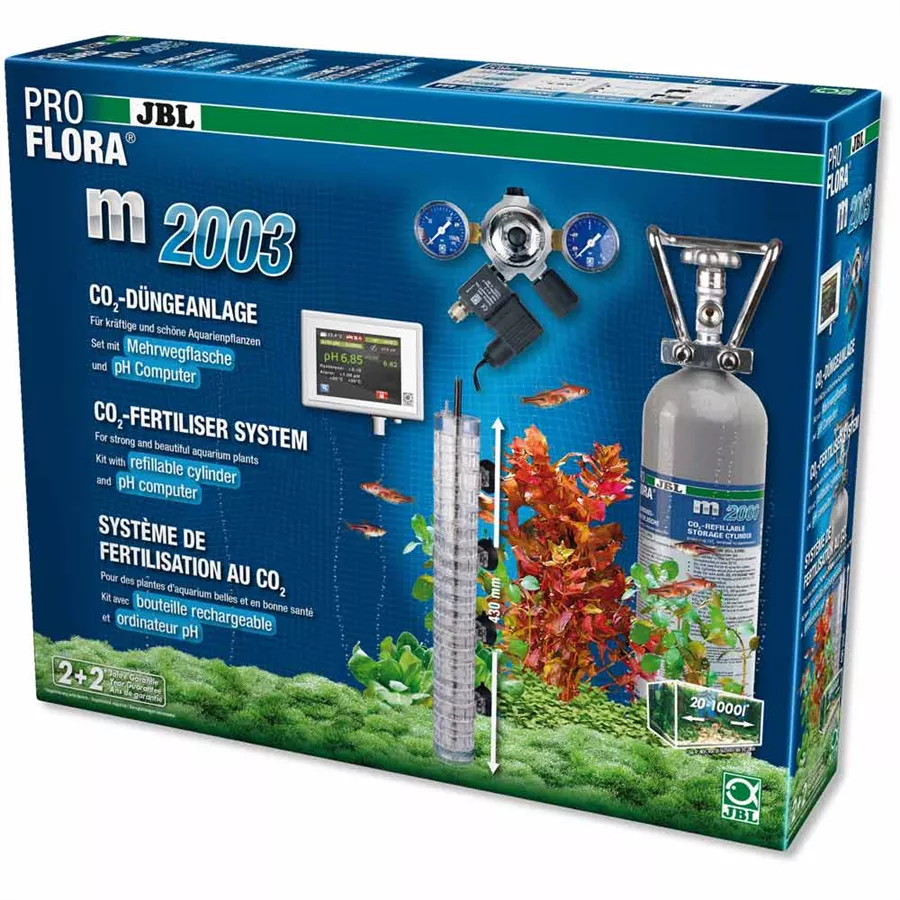
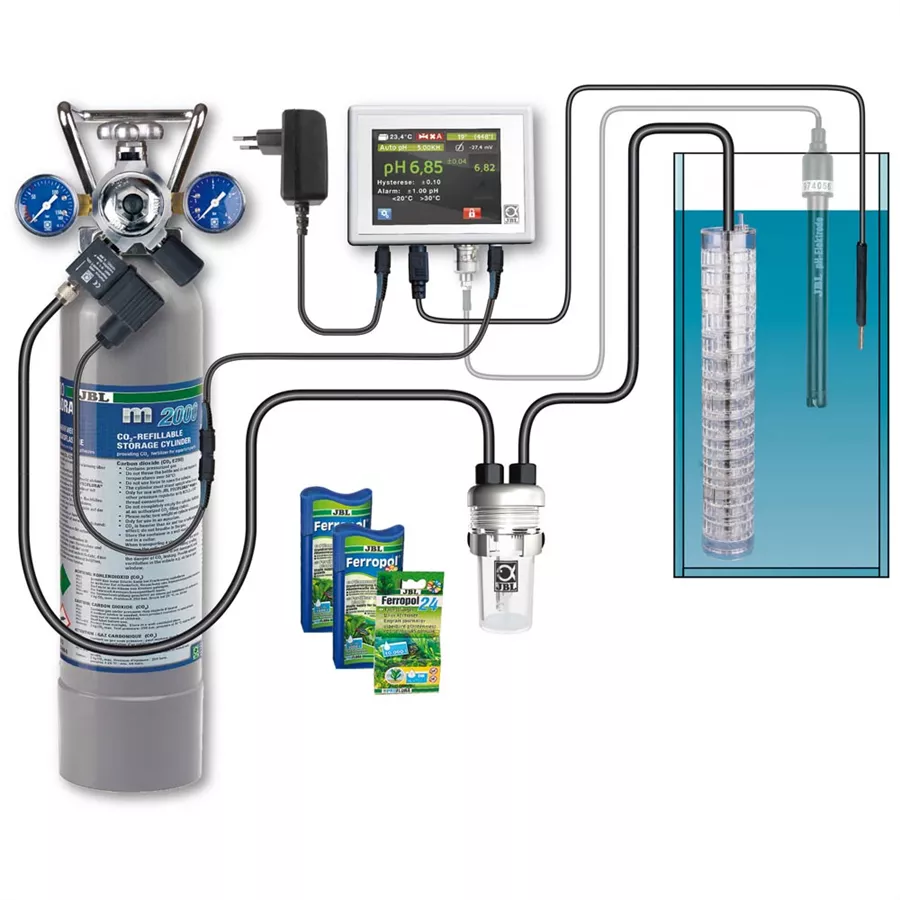
The JBL ProFlora m2003 is a high-end CO2 solution designed for large aquariums, offering stable plant nutrition and a healthier balance for fish and plants alike. Built for systems up to 1000 liters, it combines a powerful 2 kg refillable CO2 bottle with a precision pressure regulator, a modular Taifun reactor, a bubble counter, and a smart pH control system. In practice, that means more consistent CO2 delivery, better plant growth, and easier control over water chemistry.
What makes the JBL ProFlora m2003 stand out is its focus on accuracy and convenience. The pressure regulator is engineered for fine adjustment, while the modular reactor can be expanded to match aquarium size. This is especially useful in planted tanks where CO2 demand changes with lighting, plant mass, and water movement. For aquarists who want a cleaner setup, the system avoids the need for a separate water pump, relying instead on efficient passive diffusion.
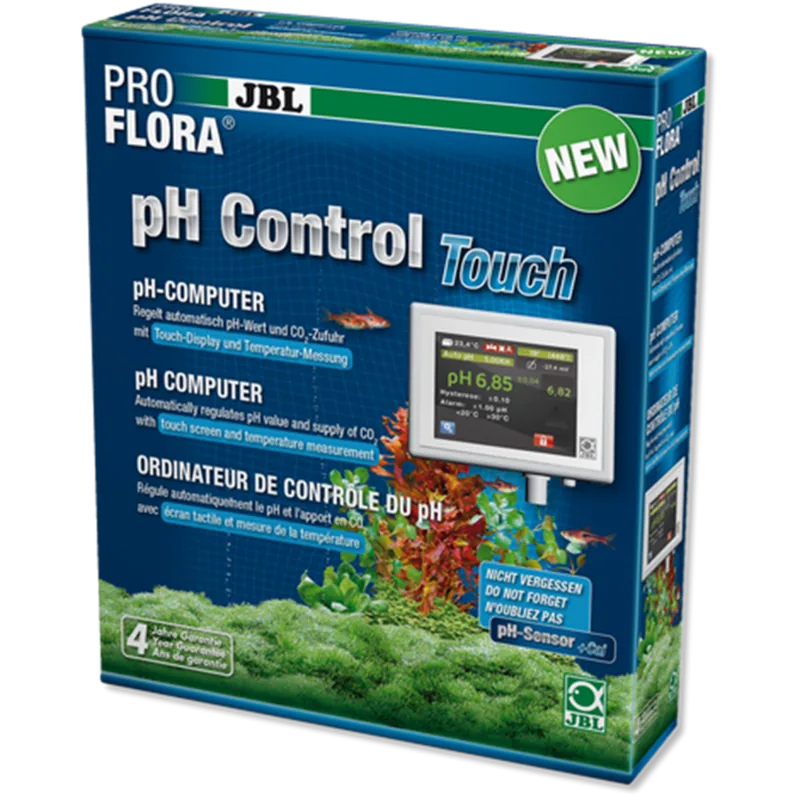
The integrated pH control touch unit adds another layer of confidence. It measures pH and temperature, then automatically adjusts CO2 output to keep conditions within a safe and effective range. That makes the system especially appealing for aquascaping or demanding planted aquariums, where small changes can have a big impact. The bubble counter with built-in backflow protection also helps safeguard the regulator and bottle from water intrusion.
Another advantage is the flexibility of the platform. The same family includes disposable and refillable bottle versions, optional night shutoff, and a glass diffuser variant for smaller systems. For the m2003, the larger bottle and extended reactor capacity make it suitable for serious planted tanks that need strong, reliable output over time. The result is a polished CO2 setup that balances performance, safety, and resource efficiency.
Notes
- Best suited for large planted aquariums and aquascaping.
- CO2 levels should be matched to KH and pH for fish safety.
- The reactor needs a short run-in period before peak performance.
- Refillable bottle handling should always follow safety rules.
Search for 67,706 Manuals online


Type-in Brand or Model