Manual.ly Logo

JBL Aquaristic ProAquaTest CombiSet Plus NH4 Manual

0.0 · 0 Ratings

PDF manual · 41 Pages

English

M: OA-GPT-5-NAN
page

/ 41

Loading...
e78d804930a391012363313587f06ce2b2d3 page 5
8 9
2. Put 5 ml sample water into the measuring vessel with
the syringe provided.
3. Add the reagent drop by drop. After each drop, swirl
and count the drops until the colour changes from
blue to yellow-orange.
4. One drop of reagent solution used corresponds to 1
degree of German carbonate hardness (°dH), 1.78
degree of French hardness (°fH), an acid binding
capacity of 0.36 mmol/l and a hydrogen carbonate
content of 21.8 mg/l.
Correcting deviating values:
Too low: Use hydrogen carbonate-containing JBL wa-
ter conditioners or mineral salt mixtures.
Too high: Soften the water by using a reverse osmosis
system, or similar.
JBL PRO AQUATEST GH
Features: JBL PRO AQUATEST GH is an easy-to-use
titration test to determine the general hardness of fresh-
water.
Why test? Depending on its origin, and often due to
the nature of the subsoil, water can contain different
amounts of different mineral salts. By denition, general
hardness is the total concentration of all alkaline earth
ions in water. The general hardness is mostly formed by
calcium and magnesium salts. Most sh and plants can
be kept successfully with a general hardness of about
8–25 °dH. In garden ponds, low values for the general
hardness are often measured and are due to the dilution
caused by precipitation.
Procedure:
1. Rinse the measuring vessel several times with the
water to be tested.
2. Fill 5 ml of sample water into the measuring vessel
with the syringe provided.
3. Add the reagent drop by drop. After each drop, swirl
and count the drops until the colour changes from
red to green.
4. One drop of each reagent solution needed corre-
sponds to 1 degree of German general hardness
(°dH) or 1.25 degrees of English (°e) and 1.78 de-
grees of French general hardness (°fH).
Correcting deviating values:
Too low: Apply JBL mineral salts.
Too high: Soften water by using a reverse osmosis
system etc.
JBL PRO AQUATEST pH 3–10
Features: JBL PRO AQUATEST pH 3–10 is an easy-to-
use colorimetric test for general guidance and monitor-
ing of the pH value covering a wide pH range for fresh
and marine water aquariums and garden ponds.
Why test? Maintaining the suitable pH value as stable
as possible is an important condition for the well-being
of all aquatic organisms. Fluctuations in the pH level,
ought to be avoided.at all costs. Many substances dis-
solved in water are also liable to changes caused by
the pH level. For example, the amount of CO
2
soluble
in water is directly related to the pH value. The pH level
most conducive for keeping the majority of freshwater
sh and plants is in the neutral range around 7. How-
ever, there are also freshwater sh which require slightly
acidic or slightly alkaline water. In garden ponds, values
around 7.5–8.5 are advantageous. In marine aquariums
the pH value should be 7.8–8.4. For particularly accu-
rate measurements of the pH value, there are, in each
case adjusted to the relevant pH ranges, the JBL PRO
AQUATEST pH 6.0–7.6 for freshwater aquariums (also
for monitoring the CO
2
fertilisation) and the JBL PRO
AQUATEST pH 7.4–9.0 for marine aquariums and gar-
den ponds.
Procedure:
1. Rinse the measuring tube several times with the wa-
ter to be tested.
2. Fill 5 ml sample water into the measuring vessel with
the syringe provided.
3. Add 5 drops of reagent, mix by swirling and allow to
stand for 3 minutes.
4. Compare the resulting colour on a white background
with the colour chart provided and read off the cor-
responding pH value.
Correcting deviating values:
Too low: Raise the pH value by adding JBL pH increas-
ers. When using a CO
2
fertiliser system, reduce the CO
2
supply.
Too high: Lower the pH value by adding a JBL pH re-
ducer or optionally in freshwater aquariums by adding
CO
2
with the JBL ProFlora CO
2
fertiliser system.
JBL PRO AQUATEST pH 7.4–9.0
Features: JBL PRO AQUATEST pH 7.4–9.0 is a nely
graduated, colorimetric test for the routine monitoring
of the pH value in marine water and in slightly alkaline
freshwater. A compensation method developed by JBL
allows reliable results to be obtained even in slightly
discoloured water (caused by peat ltering or disease
treatment etc.).
Why test? Maintaining the suitable pH value as stable
as possible is an important condition for the well-being
of all aquatic organisms. Fluctuations in the pH level, in
particular, ought to be avoided.at all costs. Many sub-
stances dissolved in water are also liable to changes
caused by the pH level. For marine water organisms,
pH values around 8.2 are to be regarded as optimal.
Especially in marine aquariums with lower animals (in-
vertebrates) the consumption of calcium bicarbonate
can reduce the pH value (and the carbonate hardness)
if a regular supply is not ensured. When keeping sh
from slightly alkaline freshwater waters, such as Lake
Malawi and Lake Tanganyika, values around 8–8.5 are
recommended. And pH values between 7.5 and 8.5 are
optimal for Koi and others. If there is a CO
2
deciency in
garden ponds, but also in freshwater aquariums, algae
in particular can consume the hydrogen carbonate in
water due to their rapid assimilation during photosyn-
thesis (biogenic decalcication) and thus drive the pH
value to levels dangerous for sh (above 10).
Procedure:
1. Rinse both test vials several times with the water to
be tested.
2. Use the enclosed syringe to ll each of the test vials
with 5 ml of sample water.
3. Add 4 drops of reagent 7.4–9.0 to one of the two test
vials and mix by swirling.
4. Place both test vials in the grey comparator block:
Place the vial with added reagent at the smooth end
and the vial with untreated sample water (blank sam-
ple) at the notched end of the comparator block.
5. Place the comparator block with the two test vials on
the colour chart in such a way that the notch points
to the values and move it on the colour chart until
the colour of the sample mixed with reagents corre-
sponds as closely as possible to the colour under the
blank sample.
6. Read the pH value in the notch of the comparator.
Correcting deviating values:
Too low: Raise the pH value by adding JBL pH increas-
ers. When using a CO
2
fertiliser system, reduce the CO
2
supply.
Too high: Lower the pH value by adding a JBL pH re-
ducer or optionally in freshwater aquariums by adding
CO
2
with the JBL ProFlora CO
2
fertiliser system.
JBL PRO AQUATEST NH
4
Features: JBL PRO AQUATEST NH
4
is an easy-to-use
colorimetric test for the routine monitoring of the ammo-
nium/ammonia content in fresh and marine water, and
in garden pond water. A compensation method devel-
oped by JBL allows reliable results to be obtained even
in slightly discoloured water (caused by peat ltering or
disease treatment etc.).
Why test? The degradation of all organic substances
(food and plant residues, sh excretions) in the aquar-
ium and pond follows the following stages: proteins à
ammonium à nitrite à nitrate. Certain bacteria are re-
sponsible for this process. By measuring the individual
intermediate stages of ammonium, nitrite and nitrate,
we can draw conclusions about how well the system is
"functioning". For example, medications for curing sh
diseases can damage the benecial cleansing bacteria,
leading to an increase in the ammonium and/or nitrite
content. As a rule, ammonium will not be measurable in
a well-maintained aquarium with an efcient biological
lter or in a properly laid out garden pond. Ammonium
is a plant nutrient and in low concentrations normally
non-toxic for sh. Depending on the pH value, however,
the ammonium ion (NH
4
+
) may convert into ammonia
(NH
3
) which is toxic to sh. This is why any ammonia
measurement should always be accompanied by pH
measurements (see table on last page).
Procedure:
1. Rinse both test vials several times with the water to
be tested.
2. Fill both test vials with 5 ml sample water each with
the syringe provided.
3. Add 4 drops of reagent 1 to one of the two test vials
and mix by swirling. Then add 4 drops of reagent 2
and mix again. Finally add 5 drops of reagent 3 and
mix. Wait 15 minute until the full colouring develops.
4. Place both test vials in the grey comparator block:
Place the vial with added reagent at the smooth end
and the vial with untreated sample water (blank sam-
ple) at the notched end of the comparator block.
5. Place the comparator block with the two test vials on
the colour chart so that the notch points to the values,
and move it on the colour chart until the colour of the
sample mixed with reagents corresponds as closely
as possible to the colour under the blank sample.
6. Read the ammonium content in the notch of the com-
parator.
Correcting deviating values:
Too low: The value should always be as low as pos-
sible.
Too high: Use a suitable biological lter and add JBL
cleansing bacteria. Carry out an approx. 50 % water
change in the aquarium as an immediate measure. The
pH value of the freshwater must never be higher than in
the aquarium. Possibly reduce sh stock.
JBL PRO AQUATEST NO
2
Features: JBL PRO AQUATEST NO
2
is an easy-to-use
colorimetric test for the routine monitoring of the nitrite
content in fresh and marine water aquariums, and in
garden ponds. A compensation method developed by
JBL allows reliable results to be obtained even in slightly
discoloured water (caused by peat ltering or disease
treatment etc.).
Why test? The degradation of all organic substances
(food and plant residues, sh excretions) in the aquar-
ium and pond follows the following stages: proteins à
ammonium à nitrite à nitrate. Certain bacteria are re-
sponsible for this process. By measuring the individual
intermediate stages of ammonium, nitrite and nitrate,
we can draw conclusions about how well the system is
"functioning". For example, medications for curing sh
diseases can damage the benecial cleansing bacteria,
leading to an increase in the ammonium and/or nitrite
content. As a rule, ammonium will not be measurable in
a well-maintained aquarium with an efcient biological
lter or in a properly laid out garden pond. Like ammo-
nia, nitrite is highly poisonous for sh. Depending on the
sensitivity of the sh species, concentrations between
0.5 and 1 mg/l (ppm) can be lethal. Marine sh and
young sh are more sensitive than adult ones.
Points to consider for garden ponds:
As the seasons change and the temperatures drop, the
activity of the cleansing bacteria will decline as well. If
food with a too high protein content is fed, a dangerous
increase in nitrite may occur. At low temperatures, it is
therefore particularly important to give food with a high
energy content (fat content) but little protein, such as the
winter food from the JBL ProPond range.
Procedure:
1. Rinse both test vials several times with the water to
be tested.
2. Use the enclosed syringe to ll each of the test vials
with 5 ml of sample water.
3. Add 5 drops of reagent 1 to one of the two test vials
and then 5 drops of reagent 2, mix by swirling after
each addition of reagent. Allow to stand for 5 minutes
until the full colouring develops.
4. Place both test vials in the grey comparator block:
Place the vial with added reagent at the smooth end
and the vial with untreated sample water (blank sam-
ple) at the notched end of the comparator block.
5. Place the comparator block with the two test vials on
the colour chart so that the notch points to the values
and move it on the colour chart until the colour of the
sample mixed with reagents corresponds as closely
as possible to the colour under the blank sample.
6. Read the nitrite content in the notch of the compara-
tor.
Correcting deviating values:
Too low: The value should always be as low as pos-
sible.
Too high: Use a suitable biological lter and add JBL
cleansing bacteria. Carry out an approx. 50 % water
change in the aquarium as an immediate measure. Pos-
sibly reduce sh stock.
en
en
en
en
en

Chat with your JBL Aquaristic ProAquaTest CombiSet Plus NH4 manual using AI

Get instant AI answers from your JBL Aquaristic ProAquaTest CombiSet Plus NH4 manual

Ask anything about the JBL Aquaristic ProAquaTest CombiSet Plus NH4. Answers come from this manual, with the pages they are based on.

Ask a Question

0/1000

Do you recommend ProAquaTest CombiSet Plus NH4?

Yes No

Frequently Asked Questions

A

It measures carbonate hardness (KH), general hardness (GH), pH (3–10 and 7.4–9.0 ranges), ammonium (NH4), nitrite (NO2), nitrate (NO3), phosphate (sensitive and Koi variants), iron (Fe) and includes a CO2 reference table.

Is this answer helpful?

A

First measure KH and pH. Find the intersection of your pH row and KH column on the CO2 table to estimate dissolved CO2 (mg/l). Use this to adjust CO2 dosing; 20–25 mg/l is ideal for most planted aquariums.

Is this answer helpful?

A

Ammonium (NH4+) can convert to toxic ammonia (NH3) depending on pH and temperature. Combining NH4 readings with pH lets you assess actual ammonia risk and decide on urgent countermeasures like water changes and filter support.

Is this answer helpful?

A

Perform an immediate ~50% water change, add biological filter support and JBL cleaning bacteria, reduce feeding or fish load, and ensure the filter is functioning. Long-term control may require stocking adjustments and improved biofiltration.

Is this answer helpful?

A

The 7.4–9.0 test is finely graduated for alkaline ranges and uses a compensation method for slightly colored water, making it better for marine tanks, alkaline freshwater systems and koi ponds where precise alkaline pH control is needed.

Is this answer helpful?

A

KH and GH titration tests are drop-count titrations where each drop corresponds to defined °dH increments; they yield precise, quantitative results when performed correctly and are suitable for guiding mineral corrections and CO2 calculations.

Is this answer helpful?

A

Store reagents dry at room temperature in their original packaging. Hold droppers vertically and avoid air bubbles; ensure droppers are dry externally. Proper storage preserves reagent stability and test reliability.

Is this answer helpful?

M: OA-GPT-5-NAN

Advantages and Disadvantages

Advantages

  • Comprehensive parameter coverage (KH, GH, pH ranges, NH4, NO2, NO3, PO4, Fe) for aquaria and ponds.
  • Includes comparator block and color compensation allowing reliable readings in slightly colored water.
  • Titration and colorimetric methods provide both precise (KH/GH) and sensitive (PO4 sensitive, NH4) measurements.
  • Clear corrective guidance links results to actionable remedies (mineral salts, RO, bacteria, partial water changes).
  • Suitable for diverse uses: freshwater planted tanks, marine aquaria, koi and garden ponds, and CO2-managed setups.
VS

Disadvantages

  • Manual reagent handling and waiting times make testing slower than automated meters.
  • Accuracy depends on correct technique (rinsing vials, droplet counting, comparator alignment).
  • Reagents have shelf-life and must be stored properly; replacements add recurring cost.
  • Colorimetric matching can be subjective under poor lighting or with inexperienced users.
  • Some corrections (RO, CO2 systems, filter media) require additional equipment or products.
M: OA-GPT-5-NAN

Product Specification

Category

Water parameters

Type

Water test (pH, carbonate hardness, nitrite, nitrate, ammonium, ammonia, CO2 indirectly), test kit

Dimensions

10.47x2.05x8.90in (WxHxD)

Weight

1.16lb

M: OA-GPT-54-NAN

Product Description

JBL Pro AquaTest CombiSet Plus NH4 Test Case Manual

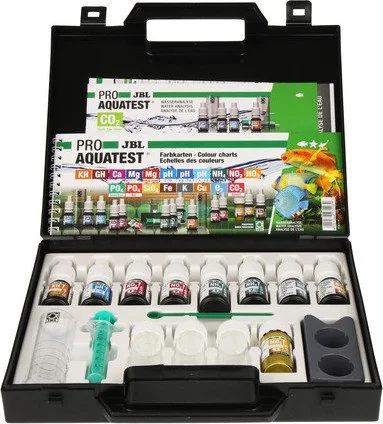
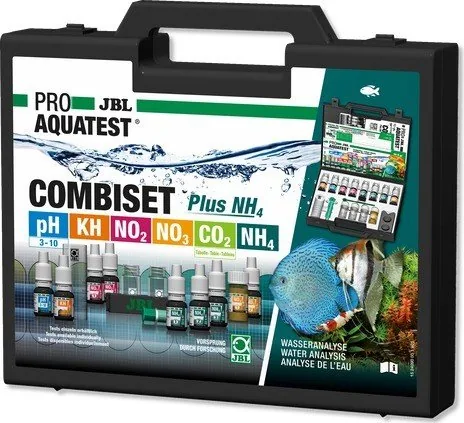
The JBL Pro AquaTest CombiSet Plus NH4 is a comprehensive water-testing kit tailored for aquarium and pond keepers who demand reliable, repeatable results. Combining a range of colorimetric and titration tests, this kit covers essential parameters—carbonate hardness (KH), general hardness (GH), pH (broad and fine ranges), ammonium (NH4), nitrite (NO2), nitrate (NO3), phosphate (PO4 Sensitive and PO4 Koi), iron (Fe) and a CO2 reference table—so hobbyists can monitor biological balance, nutrient availability and water safety at a glance.

What’s inside and how it helps

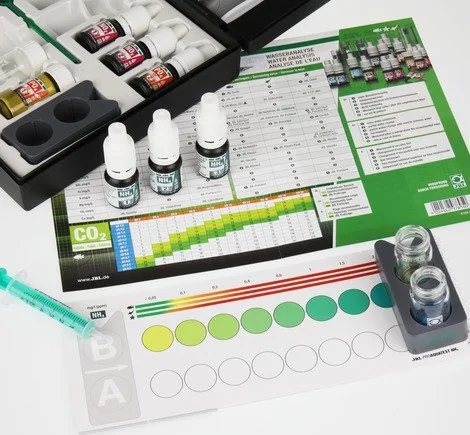
The set includes syringes, test vials, a grey comparator block, color charts and the required reagents for each assay. Titration-style GH and KH tests deliver precise drop-count results, where each consumed drop maps to specific °dH or mmol/l values. Colorimetric tests use reagent drops or measured powders and a comparator system that compensates for slightly tinted water—useful when peat filtration or treatments color the water.

Regular use of the kit informs key care actions: adjust KH/GH with mineral salts or reverse osmosis for extreme values; stabilise pH with JBL pH risers or reducers (or CO2 dosing for freshwater plant tanks); address elevated NH4/NO2 with biological filtration, beneficial bacteria and partial water changes; manage NO3 and PO4 through plant stocking, partial water changes, filter media and targeted fertilisers; and correct iron deficits with ferrous fertilizers. The CO2 table allows estimating dissolved CO2 from measured pH and KH, guiding safe and effective CO2 dosing for plant growth.

Practical workflow and advantages

Testing follows a consistent workflow: rinse vials, measure sample volumes with the syringe, add reagents by drops or measured spoons, wait for color development, and compare treated vs. untreated vials in the comparator block. The kit’s compensation procedures help produce dependable readings even in slightly colored water, reducing false readings during treatments or with humic-stained aquaria.

Who benefits most

This CombiSet is ideal for freshwater planted tanks, marine systems, koi ponds and garden ponds—any setting where monitoring KH, pH, nitrogen cycle intermediates, phosphate and iron is critical to animal health, algae control and plant nutrition. Hobbyists using CO2 fertilisation, high plant loads (aquascapes) or heavy fish stocking will find the NH4 and sensitive PO4 tests particularly valuable.

Notes:

  • Always hold droppers vertically and avoid bubbles; keep reagent bottles dry externally and store reagents at room temperature in original packaging.
  • Pair ammonium tests with pH checks since NH4/NH3 toxicity depends on pH.
  • Use the comparator method precisely: position treated and blank vials correctly for accurate color matching.
M: OA-GPT-5-NAN

© Copyright 2026 Manual.ly