
IVT Shunt 8A Manual
PDF manual · 8 Pages
English



Quick check
Incorrect answer, please try again.
Chat with your IVT Shunt 8A manual using AI
Get instant AI answers from your IVT Shunt 8A manual
Ask anything about the IVT Shunt 8A. Answers come from this manual, with the pages they are based on.
Ask a Question
Do you recommend Shunt 8A?
Yes NoFrequently Asked Questions
Yes, the model automatically detects and operates in either 12 volt or 24 volt systems without requiring any manual switching by the user.
Is this answer helpful?
You must remove the casing and cut the bridge jumper J6 on the electronic board to deactivate the gas control setting.
Is this answer helpful?
A 10 A glass fuse is built-in, but installing an additional fuse directly on the positive terminal of the battery is recommended.
Is this answer helpful?
Yes, but you must switch off the gas regulation function before operating on a boat to prevent dangerous gas accumulation.
Is this answer helpful?
Connect the battery first, then connect the solar module, and finally connect the loads to ensure polarity protection works correctly.
Is this answer helpful?
The green LED lights up when the battery is actively being charged by the solar cells during daylight hours.
Is this answer helpful?
The system resets at 12.6V for 12V systems and 25.2V for 24V systems, reactivating the load once the battery is healthy.
Is this answer helpful?
Advantages and Disadvantages
Advantages

- Automatic detection supports both 12V and 24V systems without manual switch
- Built-in temperature sensor adjusts charging voltage for environment
- Dynamically protects batteries from deep discharge damage
- Compact size measures 95mm x 95mm x 35mm for easy mounting
- Integrates a pulse-width modulation shunt charging method
Disadvantages

- Gas control function must be manually disabled for boats and gel cells
- Requires strict installation sequence to prevent component damage
- External fuse on positive battery line is recommended for safety
- Cannot operate in high humidity or temperatures over 50C
- Jumper J6 must be cut to disable gas regulation inside unit
Product Specification
Note
Prices include 0% VAT tax rates for Austria and Germany where applicable
Type
Charge Controller
Product Description
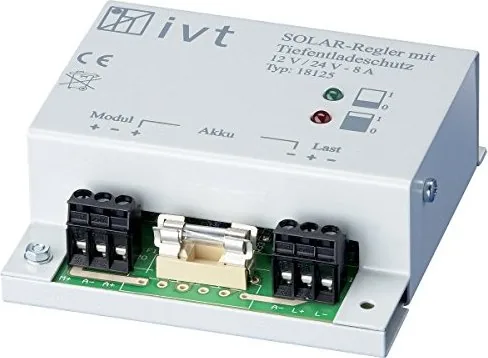
Harnessing solar energy requires robust components to protect your investment. The IVT Shunt IVT 12/24V, 8A Solar Charge Controller stands out as a reliable choice for many photovoltaic applications. Whether you are powering a small cabin or a marine setup, ensuring battery health is critical. This device manages the charging process to extend battery life significantly.
One of the standout capabilities is the automatic voltage switch. You do not need to manually adjust settings for your 12 volt or 24 volt system. The unit adapts instantly to the battery voltage. This flexibility simplifies installation for users who may upgrade their system later. The 8 Amp rating handles moderate loads effectively without overheating. It utilizes a shunt method for pulse-width modulation charging which reduces heat buildup during operation.
Safety is a major priority in the design. The unit includes dynamic protection against over discharge. If your battery voltage drops too low, the load disconnects automatically. This prevents damage to the cells inside the battery. Once sunlight returns and voltage recovers, the system reconnects power to your loads. Similarly, overcharge protection prevents gas formation that can ruin lead-acid batteries. It uses a temperature sensor embedded within the unit to adjust voltage thresholds. Hotter days require slightly lower voltage readings to ensure safety. This temperature compensation is vital for longevity.
For sealed gel batteries, a specific setting allows you to disable gas control. This prevents unnecessary gassing which harms sealed cells. Note that on boats, this gas regulation feature must be switched off to prevent explosion risks in confined spaces. Installation requires strict adherence to polarity. Always connect the battery first, then the solar module, and finally the loads. Reversing this order can damage sensitive components. A glass fuse protects the circuit internally, but an external fuse on the positive terminal is recommended for the battery line.
Users appreciate the compact dimensions measuring just 95 by 95 millimeters. It fits easily into control boxes without taking much space. Weights are minimal at 230 grams. Operating instructions emphasize avoiding wet environments. High humidity or temperatures above fifty degrees Celsius can impair function. Ensure the vents face downward to allow heat to escape properly. Checking the LED indicators helps diagnose issues quickly. Green means charging while red indicates load disconnect. This simple feedback loop keeps you informed of system status without needing extra tools.
For those seeking efficiency, the IVT Shunt IVT 12/24V, 8A Solar Charge Controller Manual provides detailed guidance on settings. While the device is intuitive, understanding the preset values ensures optimal performance. Regular checks on the fuse and connections prevent downtime. If errors occur, verify wiring and voltage levels before replacement. This comprehensive approach keeps your energy system running smoothly. Using wire with a cross-section of 2.5 to 4 square millimeters is recommended. The reset voltage for deep discharge protection ensures batteries are ready for the next charge cycle. The system operates from minus 25 degrees Celsius up to plus 50 degrees Celsius. Always check polarity carefully to avoid short circuits which generate dangerous heat. The built-in fuse is the first line of defense. The charge controller maintains final charging voltage at 13.7 V for 12 V systems to prevent overfilling cells. Deep discharge cutoff occurs at 11.1 V to preserve battery health. The device includes a reset voltage of 12.6 V to reconnect loads once healthy levels return.
Search for 67,706 Manuals online


Type-in Brand or Model
Carlie Lewis
8 months ago
Is this solar charge controller suitable for direct outdoor mounting without an extra protective box, or is an enclosure recommended for long term exposure?
Manual.ly
8 months ago
Our charge controllers are designed to handle various weather conditions. However, for optimal longevity and to easily monitor the LED indicators without exposing internal components, we recommend installing it in a weatherproof distribution box as suggested by experienced users. This protects the electronics from dust and rain while allowing visibility through a clear cover.