

Hartke TX600 Manual
PDF manual · 52 Pages
English



Quick check
Incorrect answer, please try again.
Chat with your Hartke TX600 manual using AI
Get instant AI answers from your Hartke TX600 manual
Ask anything about the Hartke TX600. Answers come from this manual, with the pages they are based on.
TX600 Maintenance Schedule
Wipe the exterior using only a dry cloth. Do not use liquids or cleaners.
Keep rear panel fan unobstructed and ensure fresh air circulation around the unit to prevent overheating.
Use in an environment free of dust to protect the variable speed cooling fan.
Ask a Question
Do you recommend TX600?
Yes NoDo you recommend TX600?
Yes NoFrequently Asked Questions
It suits players who want a lightweight but powerful bass head with flexible tone shaping. It works well for rehearsals, gigs, studio use, and practice sessions where portability matters.
Is this answer helpful?
Yes. The TX600 includes separate passive and active inputs, so you can match the input to your bass type and avoid overloading the preamp.
Is this answer helpful?
Use cabinets with a total minimum impedance of 4 ohms. The amplifier is designed to deliver its rated power safely at that load, so avoid going below it.
Is this answer helpful?
Yes. The headphone jack disconnects the speaker output, letting you practice silently. The aux input also lets you play along with an external audio source.
Is this answer helpful?
The compressor evens out volume differences between notes, adds punch, and helps control sudden peaks. It is especially useful for slap, pop, and fast, dynamic playing.
Is this answer helpful?
Yes. The TX600 includes a balanced direct out, preamp out, and power amp in, so it can integrate with effects processors, recording gear, or a PA system.
Is this answer helpful?
Advantages and Disadvantages
Advantages

- 600 watts at 4 ohms delivers strong output for rehearsals and live shows.
- Light 7 lb aluminum construction makes transport and setup easy.
- 12AX7 preamp, Shape, BRITE, and EQ controls offer broad tone shaping.
- Direct out, preamp out, power amp in, aux, and headphones add flexible routing.
Disadvantages

- Requires careful speaker impedance matching, with a 4-ohm minimum load.
- The interactive tone stack may take some trial and error to dial in.
- Brite and compressor effects depend on gain and playing style, so results can vary.
Product Specification
Type
Top
Instrument
Electric Bass
Design
Hybrid
Power
600W
Channels
1
Features
FX Loop, Compressor, AUX In (3.5mm Jack), Balanced Out (XLR), Headphones (3.5mm Jack)
Dimensions
13.98x2.60x10.63in (WxHxD)
Weight
7.05lb
Product Description
Hartke TX600: A Compact Bass Head with Serious Muscle
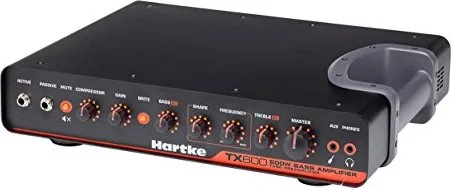
The Hartke TX600 Manual points to a bass amplifier built for players who want big tone without dragging heavy gear to every rehearsal or gig. At just 7 pounds, this 600-watt Class D head combines portability with the familiar warmth of a 12AX7 tube preamp, creating a blend of modern efficiency and classic character. It feels tailored for real-world use: quick to set up, easy to shape, and ready for everything from home practice to stage performance.
One of the TX600’s biggest strengths is its flexible tone section. The three-band EQ works alongside Hartke’s Shape control and BRITE switch, making it easy to move from a rounded low end to a brighter, more forward voice. The compressor adds another layer of control, helping tame peaks, tighten slap lines, and keep the bass sitting evenly in the mix. For players who enjoy fine-tuning their sound, these controls offer plenty of range without making the panel feel crowded.
Connectivity is another strong point. The TX600 includes passive and active inputs, 1/4-inch and Speakon speaker outputs, a balanced direct out, and preamp out/power amp in jacks for integrating effects or external preamps. That makes it practical in the studio, on stage, or in a rehearsal space where signal routing matters. The headphone jack and aux input also make it useful as a quiet practice amp when the rest of the band is off the clock.
Build quality follows the same road-ready mindset. Its aluminum chassis, integrated handle, and cooling fan suggest a design that can handle regular transport and long sessions. The Hartke TX600 Manual also emphasizes safe operation, proper ventilation, and correct speaker matching, which is a useful reminder that a powerful amp performs best when paired with the right cabinet load and careful setup.
For bassists who want a lightweight amplifier that still feels professional, the TX600 is easy to appreciate. It offers practical power, musical compression, and versatile routing in a compact format. If your priorities are strong output, tube-inspired tone, and a no-nonsense control layout, this head deserves attention.
Notes
- Best used with cabinets rated at 4 ohms or higher.
- Compression can smooth dynamics and protect your sound.
- Experiment with EQ and Shape to find your preferred voice.
Search for 67,732 Manuals online


Type-in Brand or Model