
Hartke HD15 Manual
PDF manual · 52 Pages
English



Quick check
Incorrect answer, please try again.
Chat with your Hartke HD15 manual using AI
Get instant AI answers from your Hartke HD15 manual
Ask anything about the Hartke HD15. Answers come from this manual, with the pages they are based on.
HD15 Maintenance Schedule
Clean the unit only using a dry cloth. Do not use liquids or cleaning agents.
Ensure no objects block ventilation openings and maintain a good ventilation environment around the entire unit.
Protect the power cord from being walked on or pinched, especially at plugs and where it exits the apparatus.
Ask a Question
Do you recommend HD15?
Yes NoDo you recommend HD15?
Yes NoFrequently Asked Questions
The HD15 delivers 15 watts into a specially designed 6.5" Hartke Hydrive hybrid-cone speaker that combines a paper outer cone for warm lows and an aluminum inner cone for defined mids.
Is this answer helpful?
Place the amp with good ventilation, ensure the power switch is off before connecting the grounded AC cord, set Volume to minimum and EQ to noon, then power on. Use the correct regional fuse rating and never operate with the grille removed.
Is this answer helpful?
Start with all EQs at 12 o’clock. For reggae/Motown, boost Bass and cut Treble. To reduce boxiness, attenuate Mid. For a cutting, twangy tone, boost Treble and slightly roll off Bass. Avoid excessive low boost to prevent overload.
Is this answer helpful?
Yes. The 1/4" Phones jack mutes the speaker when plugged in and follows the main Volume control. The 3.5mm AUX input accepts line-level sources like CD or MP3 players for practicing with tracks.
Is this answer helpful?
The HD15 is ideal for practice, home use, and small situations. Its 15W power and small speaker limit stage volume for full-band live use; it lacks a dedicated DI/line output for direct recording or FOH, so mic’ing or additional gear is recommended for recording or larger performances.
Is this answer helpful?
The HD15 includes a built-in limiter to protect the speaker and amplifier from overload and is supplied with the correct regional fuse. Follow fuse replacement guidelines and never bypass the grounding pin.
Is this answer helpful?
Do not mix the unit with household waste. Follow local electronic-waste recycling regulations; in the EU, Switzerland and Norway you can return used electronics free to designated collection points or retailers when purchasing similar new equipment.
Is this answer helpful?
Advantages and Disadvantages
Advantages

- Compact 15W combo with a unique Hydrive hybrid speaker for warm lows and clear mids
- Three-band EQ tailored for bass (Bass 100Hz, Mid 400Hz, Treble 10kHz) for flexible tone shaping
- AUX input and headphone output (mutes speaker) for silent practice with backing tracks
- Built-in limiter and robust construction protect speaker and make the unit road-worthy
- Lightweight and portable with molded strap handle and simple, intuitive controls
Disadvantages

- Only 15 watts — limited loudness for bigger venues or full-band use
- Small 6.5" speaker may lack very deep low extension compared to larger cabinets
- Mid control is cut-only passive, offering less boost versatility for some tones
- No DI or line-level output for direct stage/system connection
- Headphone output level tied to main volume — less independent level control
Product Specification
Type
Combo
Instrument
Electric Bass
Technology
Transistor
Power
15W
Channels
1
Speaker
1x 6.5" (HyDrive)
Features
AUX In (0.14in Jack), Headphones (0.25in Jack)
Dimensions
15.75x14.57x11.02in (WxHxD)
Weight
16.53lb
Product Description
Hartke HD15 — Compact Hydrive Bass Combo
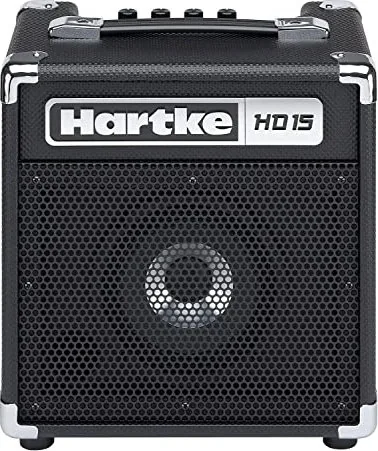
The Hartke HD15 is a portable 15-watt bass combo built around a 6.5" Hydrive hybrid-cone speaker that blends a warm paper outer cone for deep lows with an aluminum inner cone for cutting mids. Designed for practice, bedroom sessions, and small gigs, the HD15 offers flexible input handling for passive and active basses, a three-band EQ (Bass, Mid, Treble) tuned for bass frequencies, an AUX input for backing tracks, and a headphone output that mutes the speaker for silent practice. A molded strap handle and rugged construction make it easy to carry; an internal limiter and proper fusing protect the amp and speaker from overload.
Controls and Connectivity
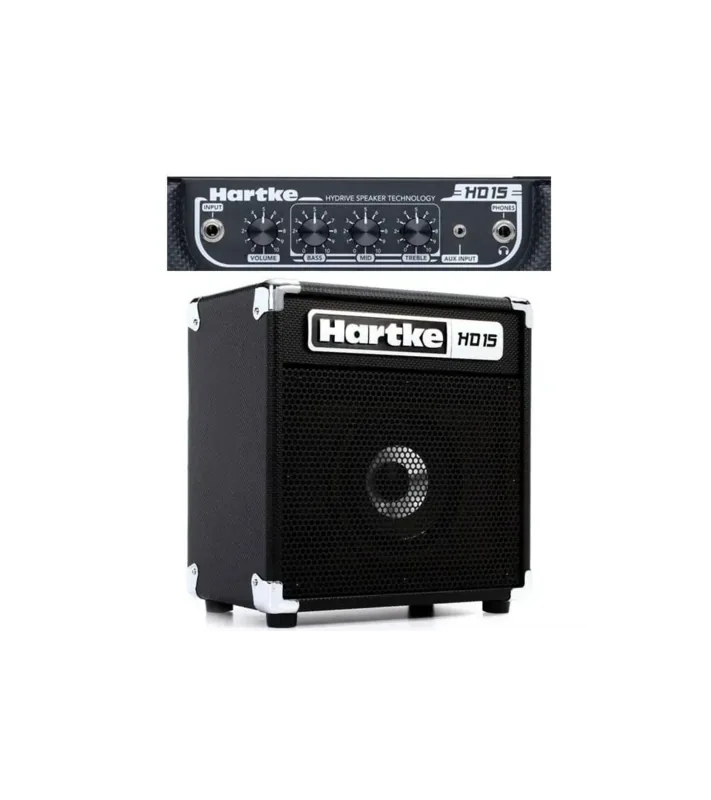
On the top panel you’ll find the instrument input, overall Volume, Bass, Mid and Treble controls, an AUX 3.5mm input and a 1/4" Phones jack. The rear panel houses the power switch, grounded AC inlet and fuse holder. The EQ uses shelving Bass (100 Hz) and Treble (10 kHz) with a passive, cut-oriented Mid (400 Hz) for tone shaping. Headphone output provides 137mW into 32Ω; inserting headphones mutes the speaker and the headphone level follows the main Volume control.
Practical Usage and Tips
Start with all EQs at noon and Volume down. Set your bass output high and adjust amp Volume for best signal-to-noise ratio. Use the AUX input for practice tracks—set the external player’s level to balance with your bass. For style tips: boost Bass and reduce Treble for reggae/Motown; cut Mid to reduce boxiness; boost Treble and slightly reduce Bass for a cutting, twangy tone. Beware that excessive low-frequency boost can overload the amp or speaker.
Safety & Maintenance
Observe standard safety: keep vents clear, avoid water exposure, use the supplied grounded power cable and the specified fuse rating for your region. Do not open the enclosure—no user-serviceable parts inside. Dispose of the unit according to local electronics-recycling rules.
Notes
- Rated output: 15 W into 4Ω; THD ~0.13% near rated output.
- Signal-to-noise ratio: 57 dB; Gain: 46 dB.
- Dimensions: 12.5" x 12.2" x 8"; weight ~6.1 kg (13.44 lb).
- Includes built-in limiter and molded top carry handle.
Search for 67,732 Manuals online


Type-in Brand or Model