

Hanseatic HGS8555CW Manual
PDF manual · 60 Pages
English



Quick check
Incorrect answer, please try again.
Chat with your Hanseatic HGS8555CW manual using AI
Get instant AI answers from your Hanseatic HGS8555CW manual
Ask anything about the Hanseatic HGS8555CW. Answers come from this manual, with the pages they are based on.
HGS8555CW Maintenance Schedule
Remove ice and frost from inner walls at least once a year or when frost layer reaches approx. 4 mm thick to prevent insulation and increased power consumption.
Check seals regularly to ensure no warm air enters; clean dirty seals only with clean water.
Free maintenance reminders
Timed to your purchase date. Always free, unsubscribe anytime.
Ask a Question
Do you recommend HGS8555CW?
Yes NoFrequently Asked Questions
Set the freezer to −18 °C for optimal preservation. The stepless controller ranges from MIN to MAX; MED is usually sufficient at normal ambient temperatures if the door is not opened frequently.
Is this answer helpful?
Unplug the appliance, remove food and baskets, place a bowl of hot (not boiling) water inside to speed defrost, collect melt water with a cloth, gently remove loose ice with a plastic scraper, then clean and dry before restarting.
Is this answer helpful?
Choose a dry, well-ventilated, cool spot; avoid direct sunlight and placing the freezer directly next to ovens, radiators or heat sources. Maintain recommended clearances and, if necessary, use an insulation plate to reduce distances.
Is this answer helpful?
The unit uses R600a (isobutane), an environmentally friendly but flammable refrigerant. Ensure good ventilation, avoid damaging refrigerant tubing, and do not create sparks or pull the plug in case of a suspected leak.
Is this answer helpful?
If the unit was transported on its side, stand it upright and leave it for about 2 hours before plugging in so compressor lubricant can settle back into place to avoid damage.
Is this answer helpful?
Excessive frost (around 4–5 mm) acts as insulation and reduces cooling efficiency, increasing energy use. Defrost at least annually or whenever frost reaches that thickness.
Is this answer helpful?
Contact the retailer’s product advice or the manufacturer’s service line listed in the manual. Spare parts are available for a minimum period after model launch and door seals for up to ten years.
Is this answer helpful?
Advantages and Disadvantages
Advantages

- Compact footprint with three removable freezer baskets for organized storage.
- Simple stepless temperature control; MED setting suitable for normal use.
- Low-maintenance: easy cleaning, manual defrosting guidance and accessible parts.
- Reversible door hinge and adjustable feet for flexible installation and leveling.
- Long spare-parts availability and clear troubleshooting/service contacts.
Disadvantages

- Uses flammable R600a refrigerant — needs ventilated installation and careful handling.
- Manual defrosting required; no frost-free (automatic) function.
- Basic feature set lacking advanced controls or digital thermostat.
- Not suitable for medical or laboratory storage (household use only).
- Requires space around unit and minimum room volume per refrigerant safety rules.
Product Specification
Appliance type
Freestanding appliance
Energy efficiency class
C (A to G)
Energy consumption
105kWh/year
Front color
white
Net capacity
22.99gal
Star rating
4
Freezing capacity in 24h
9.70lb
Storage time in case of malfunction
16h
Display
no
Climate class
N/ST/T
Noise level
40dB(A)
Airborne acoustical noise emission class
C (A to D)
Door system
Right-hand door hinge, reversible
Dimensions
21.65x33.46x22.83in (WxHxD)
Product Description
Hanseatic HGS-8555CW — Reliable compact freezer
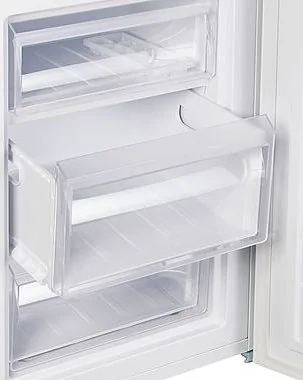
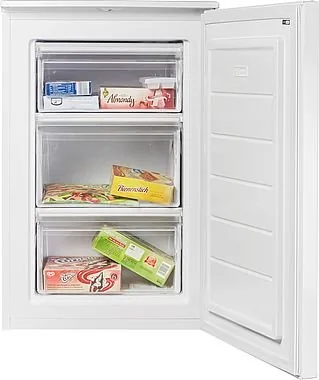
The Hanseatic HGS-8555CW is a freestanding upright freezer built for household use, offering practical cold storage and simple controls for daily life. Designed to operate in ambient temperatures between +16 °C and +43 °C, it accommodates typical family needs: freezing fresh groceries, long-term storage of deep-frozen food, and producing ice cubes. Its modest footprint (approx. 85 × 55 × 58 cm) and three removable freezer baskets make organizing portions and quick access straightforward.
Inside, the HGS-8555CW is engineered to reach and maintain the recommended freezer temperature of −18 °C. A stepless temperature controller ranges from MIN to MAX, with a MED setting suitable for normal conditions. For heavy loads or summer use you can set the controller toward MAX to ensure fast freezing. The unit uses R600a refrigerant (environmentally friendlier but flammable), so careful installation and ventilation are required.
Practical features include an ice tray, plastic insert, adjustable screw feet for leveling, and reversible door hinges for left- or right-handed placement. The user manual emphasizes safe handling: keep the appliance on a level surface, avoid placing heat sources nearby, ensure the mains plug remains accessible, and allow the compressor lubricant to settle after transport by leaving the appliance upright for two hours before switching on.
Maintenance is straightforward: regular inspection and gentle cleaning of door seals, annual or as-needed defrosting when frost exceeds ~4 mm, and cleaning interior surfaces with mild detergents. When defrosting, unplug the unit, remove food (keep it cool elsewhere), and accelerate thawing with hot (not boiling) water; avoid mechanical or heat-based shortcuts such as open flames, knives, or defrost sprays because they can damage insulation or pose safety risks.
The HGS-8555CW includes a clear troubleshooting table for common issues (no cooling, noises, excessive frost), and service contact details for spare parts and repairs. Spare parts are supported for years after purchase, and the product information is available via the EU EPREL database. Overall, the Hanseatic HGS-8555CW is a cost-conscious, easy-to-maintain freezer for households seeking dependable frozen storage without complex features.
Notes
- Ideal internal temperature: −18 °C for safe long-term storage.
- Use MED for normal conditions; move toward MAX for heavy freezing loads.
- R600a refrigerant requires caution: avoid sparks and ensure installation space ventilation.
- Allow 2 hours upright after transport before powering on.
- Defrost before frost exceeds ~4–5 mm to maintain efficiency.
Search for 67,706 Manuals online


Type-in Brand or Model
Kane Lesch
8 months ago
How quiet is the device for a 2-person household, and what should I do if it arrives with a cosmetic dent or repair marks?
Manual.ly
8 months ago
Customers report the unit runs very quietly and works reliably, making it suitable as an additional device for a small 2-person household. If you receive the product with visible cosmetic damage (for example, a dent) or signs of repair, please inspect it immediately upon delivery and contact our support as soon as possible with photos and your order details. We will review the case and help with the next steps, such as replacement or an appropriate remedy, depending on the condition and timing. This ensures any issues are handled quickly and smoothly.