
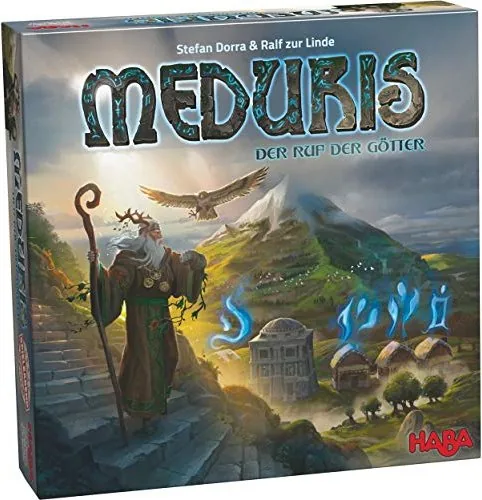

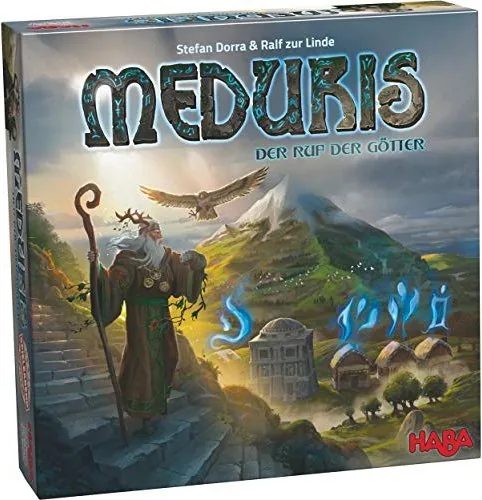
HABA Meduris The Call of the Gods Manual
PDF manual · 8 Pages
English



Quick check
Incorrect answer, please try again.
Chat with your HABA Meduris The Call of the Gods manual using AI
Get instant AI answers from your HABA Meduris The Call of the Gods manual
Ask anything about the HABA Meduris The Call of the Gods. Answers come from this manual, with the pages they are based on.
Ask a Question
Do you recommend Meduris The Call of the Gods?
Yes NoFrequently Asked Questions
The goal is to score the most victory points by building huts and temples, collecting rune stones, and making effective offerings to the druid throughout the game.
Is this answer helpful?
Players use workers on the mountain’s high plains to collect wood, wool, copper, and stone. The die and worker stacks determine who gains materials each turn.
Is this answer helpful?
Huts unlock rune stones, create settlements, and give players the only way to make offerings to the druid. Their placement can strongly influence later scoring.
Is this answer helpful?
As settlements grow, building new huts inside them becomes more expensive. The more huts already connected, the more materials are needed for the next hut.
Is this answer helpful?
The druid moves across the board and stops at huts to trigger offering rituals. Players can gain or lose victory points depending on what they contribute.
Is this answer helpful?
Temples score mainly at the end of the game. Their value depends on how many huts stand next to them, so careful placement can create strong final points.
Is this answer helpful?
Advantages and Disadvantages
Advantages

- Deep strategic choices in hut placement, offerings, and temple scoring.
- The druid system creates lively interaction and shifting scoring chances.
- Resource conversion helps players recover and stay flexible.
- Settlement growth adds tension and makes every building decision matter.
Disadvantages

- The rules are fairly detailed, which may slow down first-time players.
- Scoring has several layers, so endgame evaluation can feel busy.
- Bad placement early on can make later construction much harder.
- Players who dislike indirect interaction may find the offering system stressful.
Product Specification
Type
Board game
Genre
Strategy
Players
2 to 4
Playtime
75 min
Age recommendation
10+ years
Author
Stefan Dorra, Ralf zur Linde
Publisher
Haba
Product Description
Meduris - The Call of the Gods Manual: A Strategic Journey to the Foot of the Mountain
Meduris - The Call of the Gods invites players into a rich Celtic world where settlement planning, resource management, and timing all matter. The experience blends worker placement with territory building, offering a race to develop huts, raise temples, and earn the favor of the gods through carefully chosen offerings. The Meduris - The Call of the Gods Manual highlights a game that is easy to start, but full of tactical tension as the mountain slowly fills with settlements.
At the heart of the game is a clever production system. Workers gather wood, wool, copper, and stone from the mountain, and the results depend on the die, the positions of the workers, and the hierarchy of stacked laborers. Because materials are hidden behind screens, every player must plan ahead and balance immediate gains against future construction needs. The result is a steady push-and-pull between collecting, spending, and preparing for the druid’s movement.
Building huts is more than simple expansion. Each hut can unlock rune stones, trigger scoring opportunities, and shape the growth of settlements. As settlements expand, construction becomes more expensive, which adds a satisfying layer of risk: the best locations are often the hardest to claim. Temples work differently, rewarding players at the end of the game based on the surrounding huts and neighboring settlements, which makes placement matter from the very beginning.
The druid adds one of the game’s most memorable twists. He moves across the mountain, stopping at huts to demand offerings and creating moments where players can score big—or lose ground—depending on how well they prepare. Rune interim scoring, final temple scoring, and the endgame rune bonus all make every build choice relevant until the last turn. The game rewards long-term thinking, flexible resource conversion, and smart timing.
Why it stands out
- Strong mix of planning, resource collection, and tactical scoring.
- Settlement growth creates meaningful pressure and changing build costs.
- The druid mechanic adds interaction and memorable scoring moments.
- Multiple scoring paths keep the game engaging from start to finish.
Notes
- Best suited for players who enjoy layered strategy and spatial planning.
- Smart placement is often more important than fast expansion.
- Converting materials can save a weak turn and open new options later.
Search for 67,706 Manuals online


Type-in Brand or Model