
Grundfos SP3A-6 Manual
PDF manual · 35 Pages
English



Quick check
Incorrect answer, please try again.
Chat with your Grundfos SP3A-6 manual using AI
Get instant AI answers from your Grundfos SP3A-6 manual
Ask anything about the Grundfos SP3A-6. Answers come from this manual, with the pages they are based on.
SP3A-6 Maintenance Schedule
During storage, turn the shaft by hand at least once a month.
Replace all rubber parts every three years if pumping liquid at 40 to 60 C.
Free maintenance reminders
Timed to your purchase date. Always free, unsubscribe anytime.
Ask a Question
Do you recommend SP3A-6?
Yes NoFrequently Asked Questions
It is suited to private water supply, irrigation, agricultural water systems, groundwater lowering, pressure boosting, waterworks, and selected industrial liquid-transfer applications. Final suitability depends on the required flow, head, motor selection, water quality, and installation conditions.
Is this answer helpful?
The pump is intended for clean, thin, non-explosive liquids without solid particles or long fibers. Water should contain no more than 50 g/m3 of sand. Liquids with different viscosity, density, or chemical aggressiveness may require a different pump version or motor configuration.
Is this answer helpful?
Yes, horizontal installation is possible when the connected motor is approved for that orientation. The discharge outlet must not point below horizontal. A cooling sleeve is recommended where water flow around the motor may be insufficient.
Is this answer helpful?
Full submersion prevents air from entering the pump and ensures water moves around the motor for cooling. Operating with air-containing water or a low water level can damage pump components and cause inadequate motor cooling.
Is this answer helpful?
The pump must be grounded and connected by a qualified electrician. Suitable motor protection is required according to the motor type. Dry-run protection is recommended when well yield is uncertain, and surge protection can help reduce risks from voltage disturbances.
Is this answer helpful?
Run the pump, record flow and pressure, stop it, and interchange two supply phases. Run it again and compare results. The correct rotation is the connection that produces the higher flow rate and discharge pressure.
Is this answer helpful?
Advantages and Disadvantages
Advantages

- Designed for water supply, irrigation, groundwater lowering, pressure boosting, and industrial transfer duties.
- Submersible design supports deep-well installation while keeping the inlet immersed in the pumped liquid.
- Can be installed vertically or, with compatible motors, horizontally for flexible system layouts.
- Supports motor-protection, dry-run protection, and variable-speed control options for better system management.
- SP range sound pressure levels are generally below 70 dB(A) for smaller pump types.
Disadvantages

- Intended only for clean, thin, non-explosive liquids without long fibers or significant solids.
- Sand content above 50 g/m3 can reduce service life and increase the possibility of blockage.
- Installation, grounding, cable selection, and motor protection require qualified electrical personnel.
- The pump must remain submerged; air intake can damage components and reduce motor cooling.
- Cooling sleeves or added protection may be needed for horizontal, warm-water, or low-flow applications.
Product Specification
Power
370 W (380 V)
Flow rate
792.52 gal/h
Head
88.58 ft
Pressure connection
1 1/4 in
Features
without tank
Weight
25.13 lb
Product Description
Grundfos SP3A-6 Electric Deep Well Pump - Read, Download & Print Free
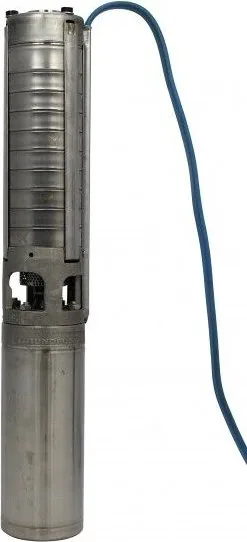
The Grundfos SP3A-6 Electric Deep Well Pump is a submersible pumping solution designed for dependable water supply and liquid-transfer duties. As part of the Grundfos SP range, it is suited to applications such as private water systems, irrigation, agricultural supply, groundwater lowering, pressure boosting, and selected industrial pumping tasks. Its submerged design supports efficient operation below the water surface while helping provide a compact answer for deep-well installations.
Built for Clean Water Applications
This pump is intended for clean, thin, non-explosive liquids without long fibers or solid particles. Water with excessive sand can shorten service life and increase the risk of blockage, so the recommended sand content should not exceed 50 g/m3. For liquids with viscosity, density, or chemical properties different from water, the pump and motor selection should be reviewed carefully before installation.
The SP3A-6 can be installed vertically or horizontally when the selected motor permits it. In either orientation, the inlet section must remain fully submerged during operation. Proper immersion protects the pump from drawing air and helps maintain the water flow needed to cool the motor. Horizontal installations may benefit from a cooling sleeve, especially where surrounding water movement is limited.
Installation and Electrical Considerations
Correct installation is essential to reliable deep-well performance. The borehole should offer adequate clearance, the rising main must be properly secured, and the submersible cable should be protected from damage during lowering. Plastic pipework may help reduce transmitted noise, but it must be suitable for the operating pressure and water temperature.
Electrical work should be completed by qualified personnel in accordance with local requirements. The pump must be grounded and connected through suitable isolation and motor-protection equipment. Three-phase installations require rotation testing after connection. The correct direction is the one that produces the higher flow and pressure. Where variable-speed operation is used, suitable filters and protective measures can help limit voltage spikes and motor noise.
Operating Notes
Start the pump only after it is completely immersed. During initial operation, restrict the discharge valve to approximately one-third of nominal flow, then open it gradually as the water runs clear. Monitor the operating water level so it stays above the inlet. Dry-run protection is strongly recommended where the well yield may be lower than pump capacity.
Notes
- Use qualified technicians for installation, inspection, and repairs.
- Check motor cooling requirements for the selected motor and water temperature.
- Inspect electrical supply, current balance, cable condition, and insulation resistance when troubleshooting.
- Use original or approved replacement parts to support safe, reliable service.
Search for 67,706 Manuals online


Type-in Brand or Model