
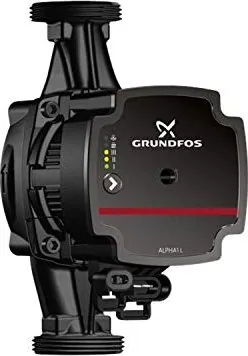
Grundfos ALPHA1 15-40 130 Manual
PDF manual · 30 Pages
English



Quick check
Incorrect answer, please try again.
Chat with your Grundfos ALPHA1 15-40 130 manual using AI
Get instant AI answers from your Grundfos ALPHA1 15-40 130 manual
Ask anything about the Grundfos ALPHA1 15-40 130. Answers come from this manual, with the pages they are based on.
Ask a Question
Do you recommend ALPHA1 15-40 130?
Yes NoFrequently Asked Questions
It supports proportional-pressure (radiator heating), constant-pressure (underfloor heating), and three fixed speed/curve settings (I, II, III). It also accepts a PWM input for external speed control and provides PWM feedback.
Is this answer helpful?
Install with the motor shaft horizontal within ±5° using the supplied gaskets; tighten fittings and ensure correct flow direction. Do not mount with a vertical motor shaft. Installation must be done per local regulations by trained personnel.
Is this answer helpful?
Yes. A low-voltage PWM signal (100–4000 Hz) on the mini superseal connector controls speed and returns feedback. Use a 3-conductor cable (input, reference, output) not exceeding 3 m. If no valid PWM is present, the pump reverts to the previously selected control mode.
Is this answer helpful?
Suitable for clean, thin, non-aggressive, non-explosive liquids (water or water/glycol up to 50% by volume). Recommended to keep domestic hot-water below 65 °C and liquid viscosity under 10 mm²/s to avoid reduced hydraulic performance.
Is this answer helpful?
For venting, set speed III and run for at least 30 minutes to remove trapped air. To deblock a seized rotor, switch off power, close valves, and use the front deblocking screw (Phillips #2) to free the shaft, then restart following safety precautions.
Is this answer helpful?
If voltage falls below ~190 VAC a low-voltage warning is sent via PWM; below ~150–160 VAC the pump may stop and show an alarm. Operation continues with reduced performance above 160 VAC but may be limited.
Is this answer helpful?
No external motor protection is required for this ECM pump, but all electrical work must comply with local codes and the pump must be connected to protective earth. Use appropriate RCDs per national regulations.
Is this answer helpful?
Advantages and Disadvantages
Advantages

- High energy efficiency (EEI ≤ 0.20) reduces operating costs.
- Multiple control modes (proportional-pressure, constant-pressure, fixed speeds) for versatile system tuning.
- Low noise (<32 dB(A)) and low standby consumption (<1 W) for quiet, economical operation.
- Front-accessible deblocking screw lets you free a seized rotor without removing the control box.
- Compact retrofit-friendly dimensions (130 mm port-to-port) and simple installer plug wiring.
Disadvantages

- Requires qualified electrician for safe electrical installation and wiring.
- Not suitable for flammable, aggressive, or particle-laden liquids (limits application range).
- Pump must be installed with horizontal motor shaft (±5°); vertical mounting not allowed.
- PWM control cable limited to 3 m, constraining remote control placement.
- Reduced performance and possible stop under low supply voltage (warns <190 VAC, stops ~150–160 VAC).
Product Specification
Rated Power
25W (230V)
Head
78.74 in
Pressure
145.04 psi
Flow Rate
7.92 gal/min
Connection
1 1/2"
Features
IPX4D
Noise Level
32dB(A)
Weight
4.85 lb
Product Description
Grundfos ALPHA1 15-40 130 Circulation Pump — Overview and Manual Insights
The Grundfos ALPHA1 15-40 130 is a compact, high-efficiency circulator pump designed for heating and domestic hot water systems. Built around an ECM (electronically commutated motor), this model combines low energy consumption, quiet operation, and flexible control options to suit radiator and underfloor systems. With port-to-port length of 130 mm and G1 connections for the 15-40 variant, it fits common retrofit and new-install applications.
Compact and versatile, the ALPHA1 15-40 130 supports multiple control modes including proportional-pressure (radiator heating), constant-pressure (underfloor heating) and three fixed speed curves (I, II, III). It can be used standalone or integrated into systems, and accepts a low-voltage PWM input for external speed commands and feedback. Factory default is radiator heating (proportional-pressure) for balanced comfort and efficiency.
Installation is straightforward when performed by trained personnel: the pump must be installed with a horizontal motor shaft (±5°), sealed with the supplied gaskets, and connected to protective earth. The installer plug and optional cable accessories simplify electrical setup; the control plug supports a 3-conductor mini superseal for PWM control. The product includes clear startup guidance — ensure the system is filled and vented, check inlet pressure requirements, and run the pump at speed III briefly to accelerate venting.
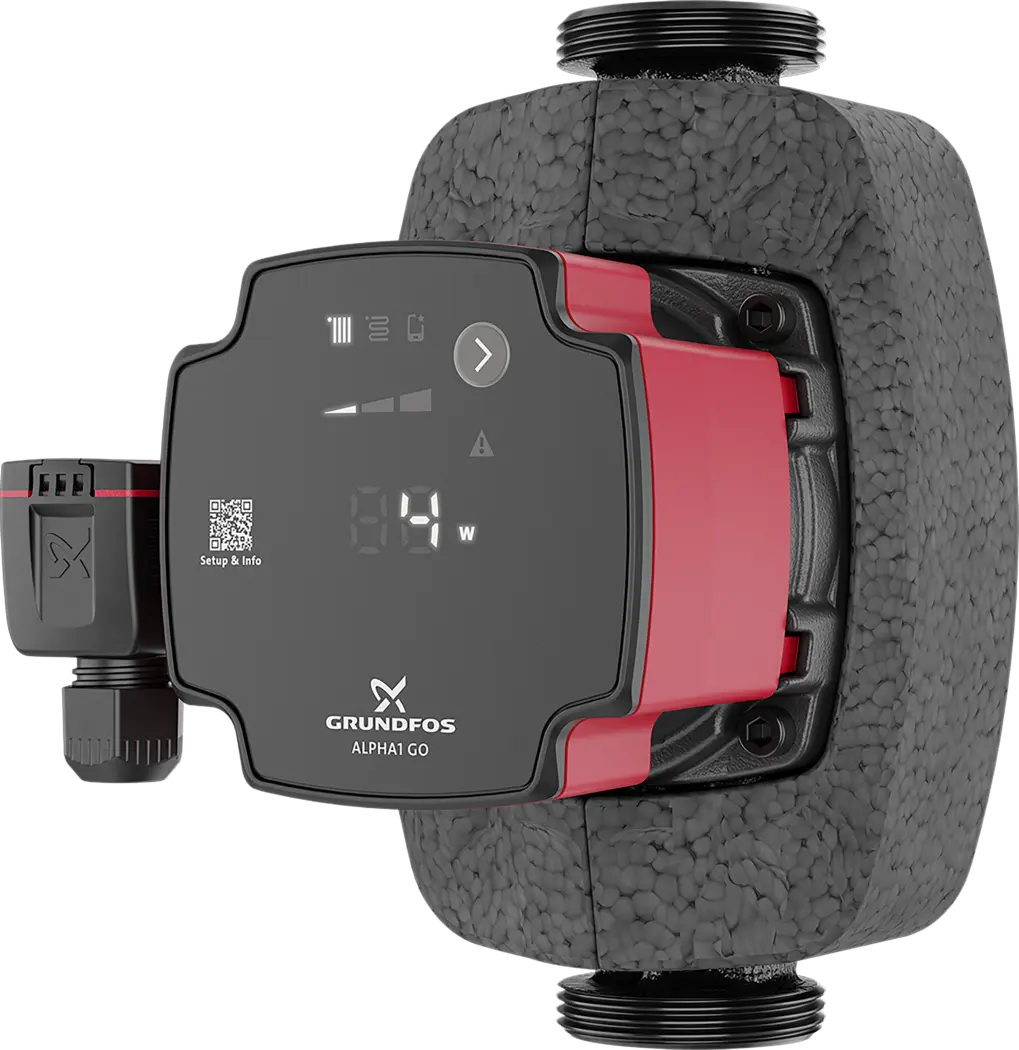
Safety and maintenance are emphasized throughout the manual. Electrical work must be carried out by qualified electricians and the pump must be isolated before servicing. The pump is self-venting via the system, and a front-accessible deblocking screw allows mechanical freeing of a seized rotor without removing the control box. Insulating shells are available as an accessory to minimize heat loss, but the control box must not be insulated.
Performance and technical notes: the ALPHA1 15-40 130 offers low standby consumption (<1 W), low sound level (<32 dB(A)), and operates from 1 x 230 V with specific reduced-voltage behavior (warns below 190 VAC, stops below ~150–160 VAC). It is suitable for clean, non-aggressive liquids and recommended for water temperatures up to typical heating limits; avoid flammable or corrosive fluids. EEI for the ALPHA1 L range is ≤ 0.20, reflecting strong energy performance.
The manual covers detailed safety statements, installation steps, electrical and mechanical assembly, control modes and PWM interface, performance curves, servicing (including dismantling and deblocking), fault finding, technical data, dimensions, accessories and disposal recommendations.
Notes
- Use protective earth and follow local regulations for electrical connections.
- Do not insulate the control box; only insulate the pump housing with approved shells.
- Keep pumped liquid non-aggressive and within recommended temperature/viscosity limits.
- For PWM control use a mini superseal cable not exceeding 3 m.
Search for 67,706 Manuals online


Type-in Brand or Model