
Ground Zero Iridium GZIW 300X-II Manual
PDF manual · 4 Pages
English



Quick check
Incorrect answer, please try again.
Chat with your Ground Zero Iridium GZIW 300X-II manual using AI
Get instant AI answers from your Ground Zero Iridium GZIW 300X-II manual
Ask anything about the Ground Zero Iridium GZIW 300X-II. Answers come from this manual, with the pages they are based on.
Ask a Question
Do you recommend Iridium GZIW 300X-II?
Yes NoFrequently Asked Questions
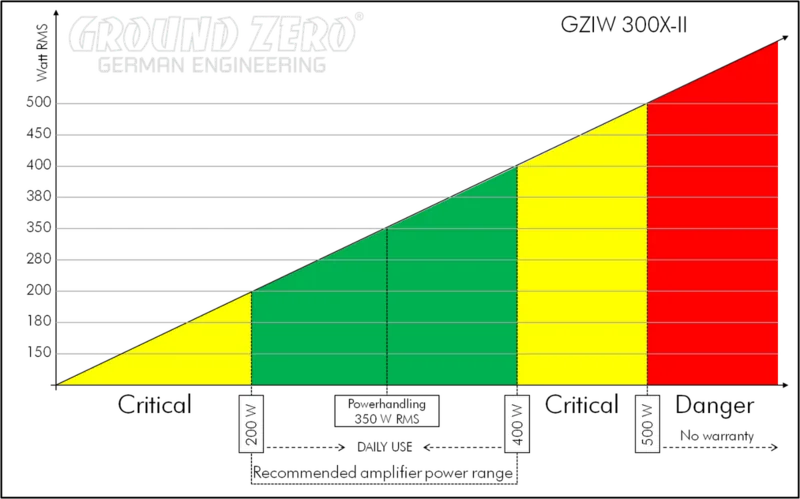
The recommended amplifier power is 200-400 W RMS at 4 Ohm. Staying in this range helps you use the subwoofer's 350 W RMS capability while maintaining control and minimizing distortion.
Is this answer helpful?
Key parameters include 4 Ohm impedance, Fs 30.7 Hz, Qts 0.57, Vas 60 liters, Le 2.26 mH, and an Xmax of 20 mm. These values are the foundation for selecting a sealed or ported enclosure and tuning to your target response.
Is this answer helpful?
Multiple approaches are supported: bass reflex (vented), a 4th order bandpass layout, and sealed enclosures. The best choice depends on whether you prefer deeper extension, louder mid-bass punch, or tighter response.
Is this answer helpful?
For the manual-style bass reflex recommendation: use 50 liters net, with 1 port of 8 cm diameter and a suggested port length of 20 cm. This targets an F3 around 32 Hz, but port length may require adjustment for your vehicle.
Is this answer helpful?
Yes. The sealed guidance includes a minimum volume around 35 liters net (Qtc about 0.94, F3 around 41 Hz). Increasing to about 50 liters net can lower Qtc to roughly 0.85 and shift F3 slightly, for a different balance of punch and extension.
Is this answer helpful?
Yes. The driver specifies high-roll rubber surround behavior and an Xmax of 20 mm. Together with the stable cone and spider design, this supports deep, controlled excursion during demanding playback.
Is this answer helpful?
Tune them. The guidance notes that enclosure recommendations are examples, and final results depend on the vehicle and your taste, especially port length. Small build differences can change airflow and resonance, so fine-tuning may be needed.
Is this answer helpful?
Advantages and Disadvantages
Advantages

- IMPP cone and Klippel-optimized design for controlled, lower-distortion bass output.
- 50 mm (2") copper round wire voice coil and 20 mm Xmax for strong low-end excursion.
- POLYCOT spider with woven-in lead wires for durable, stable cone movement.
- Resonance-free steel basket to improve structural rigidity during high output.
- High-roll rubber surround designed for long-throw performance.
Disadvantages

- Rated for 4 Ohm, limiting compatibility with some amplifier channel configurations.
- Best results depend on enclosure tuning, especially port length in vented designs.
- SPL rating is 88 dB (1 W / 1 m), so power quality and tuning affect perceived loudness.
- Recommended amp range (200-400 W RMS) means undersized amps may limit performance.
Product Specification
Type
Subwoofer
Amplification
passive
Woofer
12 in
Power
350 W RMS
Impedance
4 ohm
Sensitivity
88 dB
Mounting Depth
5.87 in
Product Description
Ground Zero Iridium GZIW 300X-II Subwoofer (4 Ohm) - Built for Deep, Controlled Bass
If you want a powerful upgrade that can keep its composure under load, the Ground Zero Iridium GZIW 300X-II is designed to deliver clean, high-impact low end. This description pairs well with the Ground Zero Iridium GZIW 300X-II Manual, especially when you are selecting the right enclosure style and tuning details for your vehicle.
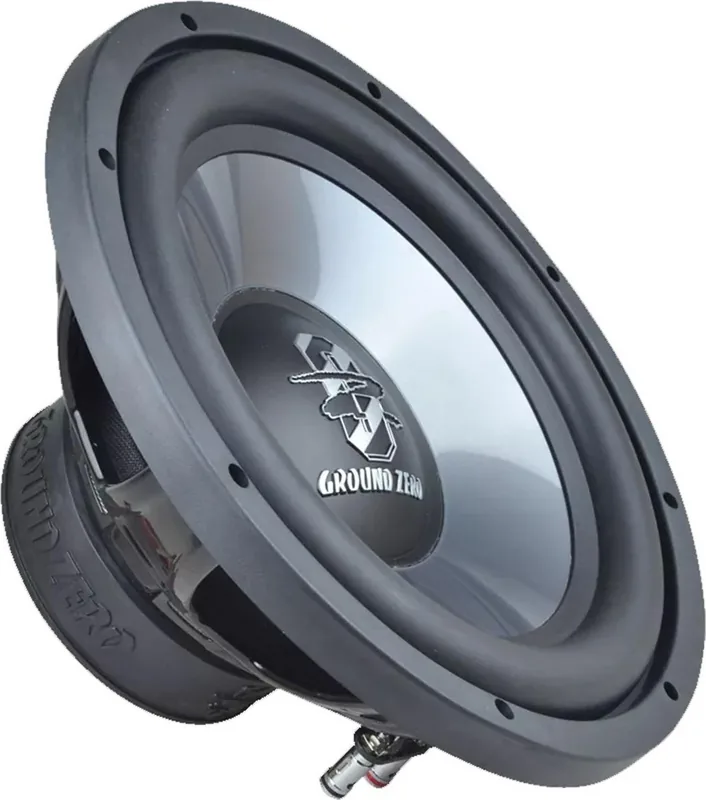
The driver features a stable IMPP cone for consistent excursion control and a POLYCOT spider with woven-in lead wires to support durability and smooth movement. A 50 mm (2") copper round wire voice coil and a long-excursion high-roll rubber surround help the subwoofer handle serious dynamics without losing control. Add the resonance-free steel basket and you get a solid platform that stays rigid even when the bass gets aggressive.
From a performance standpoint, the GZIW 300X-II is engineered for musical pressure: with an Xmax of 20 mm (0.79") and a RMS power rating of 350 W, it is intended to be driven by a quality amplifier in the recommended 200-400 W RMS range at 4 Ohm. Rated efficiency is 88 dB (1 W / 1 m), while Thiele-Small parameters like Fs 30.7 Hz and Qts 0.57 indicate a tuning-friendly character for modern bass setups.
Tuning and enclosure recommendations
The manual-style guidance includes multiple viable enclosure approaches, and the final result depends on your car and personal sound preferences, especially port length. You can build a bass reflex (vented) system, a 4th order bandpass layout, or a sealed enclosure depending on whether you want deeper extension, stronger mid-bass presence, or tighter response.
- Bass reflex (vented): 50 liters net, port 1 x 8 cm, port length 20 cm, target F3 around 32 Hz.
- 4th order bandpass: sealed 20 liters net plus vented 35 liters net, port 1 x 10 cm, port length 11 cm, target Fb around 61 Hz.
- Sealed options: minimum 35 liters net (Qtc about 0.94) with F3 around 41 Hz, or up to 50 liters net (Qtc about 0.85) with F3 around 39 Hz.
Notes on setup and reliability
Use a proper clamp terminal connection and wire confidently for your amplifier output. Also keep in mind warranty coverage follows local distribution terms, and returns are typically handled through authorized channels with original packaging and documentation.
Key benefits (high-impact results)
- Stable IMPP cone design for controlled excursion and reliable output under RMS loading.
- 50 mm copper voice coil and 20 mm Xmax for strong, deep bass with headroom.
- Resonance-free steel basket for tighter mechanical stability and cleaner sound.
- POLYCOT spider with woven-in leads to support long-term movement and durability.
- Klippel-optimized performance approach aimed at reducing distortion.
Key considerations (setup realities)
- Requires a matched amplifier: 200-400 W RMS at 4 Ohm for best real-world results.
- Port length and enclosure volume tuning strongly affect the final frequency response.
- Sensitivity is 88 dB, so amplifier quality and tuning matter for maximum impact.
- Effective tuning may differ by vehicle cabin size, mounting depth, and build accuracy.
Search for 67,706 Manuals online


Type-in Brand or Model