
Ground Zero Competition GZCT 3000X Manual
PDF manual · 2 Pages
English



Quick check
Incorrect answer, please try again.
Chat with your Ground Zero Competition GZCT 3000X manual using AI
Get instant AI answers from your Ground Zero Competition GZCT 3000X manual
Ask anything about the Ground Zero Competition GZCT 3000X. Answers come from this manual, with the pages they are based on.
Ask a Question
Do you recommend Competition GZCT 3000X?
Yes NoFrequently Asked Questions
The GZCT 3000X is specified as a 4 ohm compression tweeter. When designing your crossover and choosing an amplifier, make sure your load and crossover topology are compatible with a 4 ohm tweeter.
Is this answer helpful?
The listed on-axis frequency response is 4 - 25 kHz. In practice, you will still want to use an appropriate crossover frequency and slope so the tweeter operates where it performs best and stays protected.
Is this answer helpful?
The specifications list 40 W RMS and 120 W max. RMS is the continuous target, while the max rating is for short-term peaks. Keep crossover settings and volume in check to avoid exceeding the safe operating region.
Is this answer helpful?
The published sensitivity is 105 dB measured at 1 Watt at 1 meter. High sensitivity can help the tweeter stay crisp and present without requiring a large amount of amplifier power.
Is this answer helpful?
The GZCT 3000X is specified with 40 degree dispersion. This can improve on-axis focus, but it also means correct aiming toward the listening position is important for a balanced top end.
Is this answer helpful?
The mounting diameter is listed as 90 mm, and the mounting depth is 66 mm. Plan your baffle cutout and clearance carefully to avoid installation problems.
Is this answer helpful?
Warranty coverage is handled through Ground Zero local distribution partners, following their terms and conditions. Returns typically require prior agreement and the original packaging, and you should include proof of purchase plus a description of the fault.
Is this answer helpful?
Advantages and Disadvantages
Advantages

- 105 dB sensitivity (1 W / 1 m) for efficient, lively high-frequency output
- Published on-axis frequency response of 4 - 25 kHz for detailed treble performance
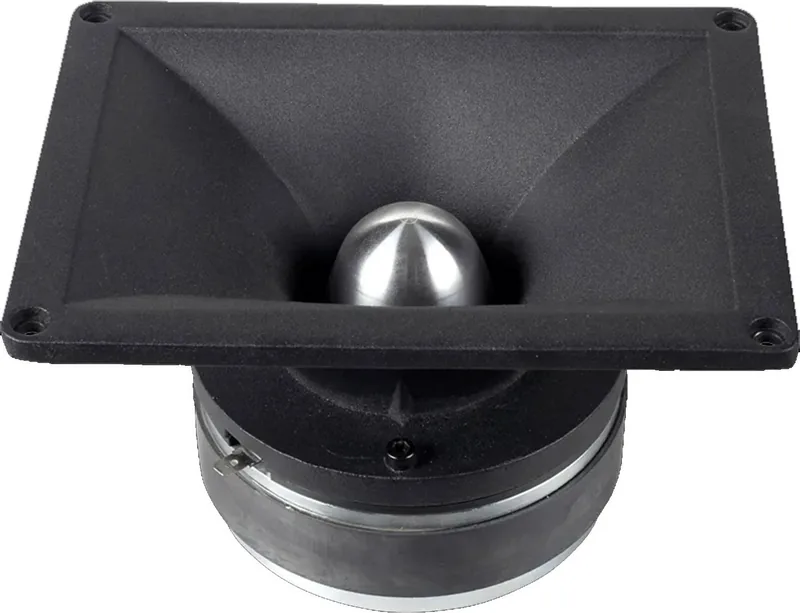
- Aluminum dome, cast baffle, and competition-style front elements for a rigid, focused sound
- 38 mm (1.5") copper-clad aluminum flat wire voice coil for strong power transfer
- Defined mechanical specs (90 mm mount diameter, 66 mm depth) for planned installations
Disadvantages

- 4 ohm impedance requires an amplifier and crossover section suited to 4 ohm loads
- 40 degree dispersion can make off-axis tuning and placement more critical
- Mounting depth of 66 mm may limit fitment in shallow baffles
- Power ratings (40 W RMS, 120 W max.) require responsible crossover and volume control
- Best results depend on correct tweeter alignment and system tuning
Product Specification
Type
Tweeter
Amplification
passive
Tweeter
1x 1.5"/1.50"
Midrange speaker
no
Frequency range
4kHz-25kHz
Power
40W RMS, 120W Peak
Impedance
4Ω
Sensitivity
105dB
Mounting depth
2.60 in
Mounting diameter
3.54 in
Product Description
Ground Zero Competition GZCT 3000X - Compression Tweeter for High-Impact Detail
The Ground Zero Competition GZCT 3000X Manual highlights a competition-focused compression tweeter designed to bring sharp, controlled high-frequency presence to demanding audio setups. Built around an aluminum-dome approach with a competition-style acoustic path, the GZCT 3000X is aimed at listeners who want clarity, punch, and strong on-axis performance.
What makes it a competition series tweeter
This model uses an aluminum construction theme throughout, including an aluminum dome and an aluminum cast baffle with a bullet-style front element. The goal is a rigid, lightweight front assembly that helps deliver fast transient response and precise articulation at higher frequencies.
At its core is a 38 mm (1.5") copper-clad aluminum flat wire voice coil, paired with a ferrite magnet (15 oz). That combination supports efficient energy transfer, which is reflected in the published sensitivity rating of 105 dB (1 W / 1 m). For system builders, it is a tweeter that can stay lively without demanding excessive power, assuming your crossover and gain structure are tuned correctly.
Frequency coverage and aiming
The specification sheet lists a frequency response of 4 - 25 kHz on-axis, with a 40 degree dispersion. That narrower beam pattern can be an advantage when you want to focus treble energy toward the listening position, but it also means placement and crossover alignment matter for balanced imaging.
Key specifications at a glance
- Model: GZCT 3000X
- Impedance: 4 ohm
- Frequency response: 4 - 25 kHz
- Sensitivity: 105 dB (1 W / 1 m)
- Power: 40 W RMS, 120 W max.
- Mounting: 90 mm diameter, 66 mm depth
- Total height: 69 mm
Key results
- High on-axis detail with a published 4 - 25 kHz response, making it well-suited for upper-mid and treble reproduction.
- Strong efficiency at 105 dB (1 W / 1 m), which can simplify matching with typical amplifiers and crossovers.
- Competition-oriented projection with 40 degree dispersion, helping treble focus toward the listener.
- Proper power handling for spirited systems: 40 W RMS and 120 W max.
- Fitment is clearly defined with 90 mm mounting diameter and 66 mm mounting depth.
Pros and cons (based on the listed specs)
Pros
- High sensitivity for vivid treble presence (105 dB)
- Wide treble band coverage for crisp detail (4 - 25 kHz)
- Competition-style aluminum build for rigid front behavior
- Reasonable RMS power rating for demanding listening (40 W)
- Defined mounting dimensions for planned installs
Cons
- 4 ohm impedance requires compatible amplification
- 40 degree dispersion can sound uneven if not aimed correctly
- 66 mm mounting depth demands clearance in many baffles
- Power limits call for careful crossover tuning to avoid overloading
Notes on warranty and returns
Warranty coverage follows the legal framework, typically handled through local distribution partners. Returns generally require prior agreement and the original packaging, and proof of purchase plus a clear fault description. Warranty exclusions include defects from overload, improper handling, or misuse related to competitions.
Search for 67,706 Manuals online


Type-in Brand or Model