
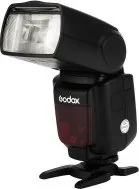
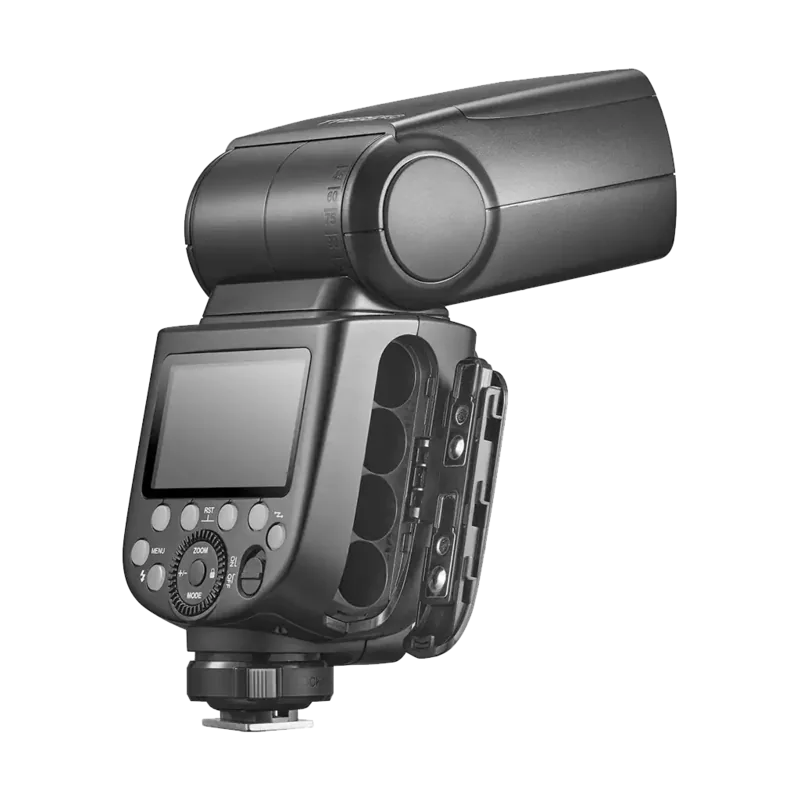
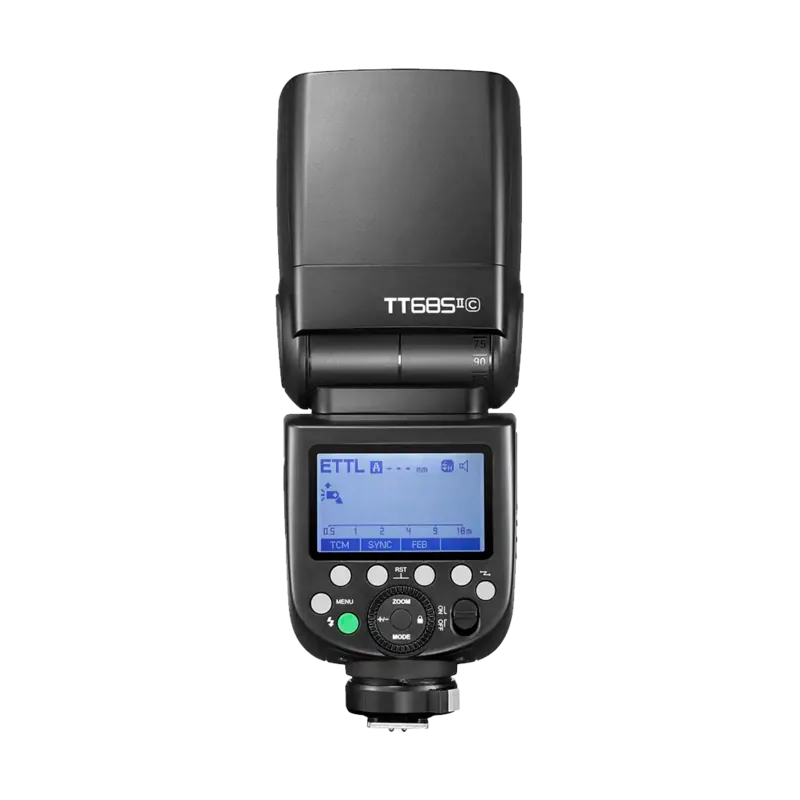
Godox TT685C Manual
PDF manual · 22 Pages
English



Quick check
Incorrect answer, please try again.
Chat with your Godox TT685C manual using AI
Get instant AI answers from your Godox TT685C manual
Ask anything about the Godox TT685C. Answers come from this manual, with the pages they are based on.
TT685C Maintenance Schedule
After 10 consecutive stroboscopic flashes, allow the camera flash to rest for at least 15 minutes to avoid overheating and deteriorating the flash head.
If you fire the modeling flash 10 consecutive times, allow at least 10 minutes break for the camera flash to avoid overheating and deteriorating the flash head.
Do not fire more than 30 continuous flashes in fast succession at 1/1 full power. After 30 flashes, allow a rest time of at least 10 minutes.
Avoid sudden impacts and dedust the product regularly.
Ask a Question
Do you recommend TT685C?
Yes NoFrequently Asked Questions
It is designed for Canon EOS cameras and supports E-TTL II autoflash. It works best with compatible Canon bodies that can communicate through the hot shoe and use flash features like exposure compensation and sync control.
Is this answer helpful?
Yes. It supports both 2.4GHz radio wireless and optical wireless operation. You can use it as a master or slave unit, which makes it useful for off-camera portraits, product shots, and multi-light setups.
Is this answer helpful?
Yes. High-speed sync is supported up to 1/8000s, which is helpful for bright daylight portraits or when you want a wider aperture without overexposing the image.
Is this answer helpful?
The flash uses four AA batteries. Ni-MH rechargeable batteries are recommended for better recycle times and more consistent performance, though alkaline batteries can also be used.
Is this answer helpful?
Yes. The head can swivel and tilt for bounce flash, which helps soften shadows and create more natural-looking light. It also supports a wide-angle panel for broader coverage.
Is this answer helpful?
The flash includes over-temperature protection, auto power off, low-battery alerts, and error prompts. These features help protect the unit and make troubleshooting easier during longer shooting sessions.
Is this answer helpful?
Advantages and Disadvantages
Advantages

- Canon E-TTL II support makes exposure handling quick and reliable in changing light.
- 2.4GHz wireless control enables master/slave setups and flexible off-camera lighting.
- HSS up to 1/8000s, manual power control, and multi-flash modes expand creative options.
- Bounce head, wide panel, and AF assist beam improve real-world shooting versatility.
Disadvantages

- Wireless setup can take time to learn, especially for users new to flash groups and channels.
- Optical wireless mode is shorter-range and more easily affected by obstacles and ambient light.
- Repeated full-power or stroboscopic use can trigger heat protection and slow recycle times.
- AA batteries are convenient, but performance depends heavily on battery quality and type.
Product Specification
Guide Number
196.85 (ISO 100, 7.87 in)
Focal Length
0.79-7.87 in
Wide-angle Focal Length
0.55 in
AF Assist Light
yes
Power Supply
AA Battery
Special Features
Wireless, Slave Mode
Dimensions
2.99x7.48x2.52in (WxHxD)
Weight
0.90 lb (without battery)
Product Description
Godox TT685C for Canon: A Versatile Speedlite for Creative Lighting
The Godox TT685C for Canon is a practical flash for photographers who want speed, control, and dependable TTL performance in one compact unit. Designed for Canon EOS cameras, it supports E-TTL II autoflash, making everyday shooting easier when light changes quickly. Instead of constantly adjusting settings by hand, you can rely on the flash to help deliver balanced exposure for portraits, events, and fast-paced scenes.
One of its strongest points is flexibility. The flash offers a powerful guide number of 60 and a zoom range from 20mm to 200mm, so it can adapt to both wide scenes and tighter telephoto work. Manual power control is available from full output down to 1/128, while high-speed sync up to 1/8000s opens the door to brighter outdoor portraits and shallow depth-of-field shots. It also includes features such as flash exposure compensation, exposure bracketing, flash exposure lock, second-curtain sync, and stroboscopic flash for more advanced lighting control.
The TT685C is also built with wireless use in mind. Its 2.4GHz radio system supports master and slave operation, and it can work in multi-group setups for more elaborate lighting arrangements. For photographers learning lighting, this makes the unit a strong bridge between simple on-camera flash and more serious off-camera setups. Optical wireless support, sync triggering, and compatibility with accessories like the X1C trigger or FT-16S controller add even more options.
Practical design details matter too. The flash head tilts and rotates for bounce lighting, while the built-in wide panel expands coverage for broader lenses. An autofocus assist beam helps in low light, and the dot-matrix LCD makes changes easier to read. Add in firmware upgrade support and built-in protection features, and you get a flash that feels ready for long-term use.
If you are comparing tools and reading the Godox TT685C for Canon Manual, the overall picture is clear: this is a feature-rich speedlite for photographers who want reliable Canon TTL performance with room to grow.
Notes
- Best suited for Canon EOS users who want TTL convenience plus manual control.
- Great for bounce flash, off-camera lighting, and mixed indoor/outdoor shooting.
- Watch heat limits during rapid firing to protect the flash head.
- Matching channels and wireless IDs is important for stable remote operation.
Search for 67,706 Manuals online


Type-in Brand or Model