
Ginlong Solis S6-GR1P(0.6-3.6)K-M Manual
PDF manual · 30 Pages
English



Quick check
Incorrect answer, please try again.
Chat with your Ginlong Solis S6-GR1P(0.6-3.6)K-M manual using AI
Get instant AI answers from your Ginlong Solis S6-GR1P(0.6-3.6)K-M manual
Ask anything about the Ginlong Solis S6-GR1P(0.6-3.6)K-M. Answers come from this manual, with the pages they are based on.
S6-GR1P(0.6-3.6)K-M Maintenance Schedule
Remove dust with a soft brush to help heat dissipation and extend life. Turn off unit and let cool before cleaning.
Wipe dirty displays with a damp cloth for readability. Do not use solvents or abrasive materials.
Ask a Question
Do you recommend S6-GR1P(0.6-3.6)K-M?
Yes NoFrequently Asked Questions
The Solis S6-GR1P family covers models from 0.6 kW up to 3.6 kW (S6-GR1P0.6K-M, 0.7K, 1K, 1.5K, 2K, 2.5K, 3K, 3.6K), with the 0.6 kW model specifically tailored for the German market.
Is this answer helpful?
To start: switch the grid AC main ON first, then turn the DC switch ON. The inverter will initialize and begin generating. To stop: set Grid Off in Advanced Settings, turn AC main OFF, wait ~30s for capacitors to discharge, then turn the DC switch OFF and wait five minutes before opening the cabinet.
Is this answer helpful?
Yes. The inverter supports Export Power Management via a connected smart meter or CT sensor. Modes include Meter in Grid, Meter in Load, Consumption Monitor, and Current Sensor. Backflow power limits and failsafe behavior can be configured in the Advanced/EPM menus.
Is this answer helpful?
Safety features include integrated DC switch, overcurrent protection requirements, warning for hot surfaces, AFCI arc-fault detection for DC arcs, and password-protected advanced settings. The manual emphasizes following correct wiring and shutdown procedures to avoid electric shock or fire.
Is this answer helpful?
Maintenance is minimal: clean dust from heatsinks with a soft brush and wipe LCD/LED covers with a damp cloth when necessary. Never open the inverter while energized; internal servicing, firmware updates, and advanced calibrations must be performed by qualified technicians.
Is this answer helpful?
The Solis S6 supports many regional grid codes selectable in the Advanced Settings menu (e.g., VDE, EN50549, G98/G99, UL variants, C10/11, EN50438, and user-def options). Choose the correct code per local distribution requirements.
Is this answer helpful?
Standard RS485 is available; optional add-ons include Wi‑Fi, GPRS and USB (market-dependent). Solis monitoring devices permit web/mobile monitoring and integration with EPM features when meters or CT sensors are connected.
Is this answer helpful?
Advantages and Disadvantages
Advantages

- High peak efficiencies (mid-to-high 90s) and transformerless design for efficient residential PV conversion.
- Integrated DRM/backflow control and flexible EPM support (smart meter or CT) for export management and zero-injection setups.
- Built-in AFCI arc-fault detection enhances DC-circuit safety and reduces fire risk.
- Password-protected advanced settings and comprehensive diagnostics (daily/monthly/yearly logs, alarms) facilitate commissioning and troubleshooting.
- Compact, IP66-rated housing with easy quick-connect terminals and natural convection cooling for simple wall-mounted installation.
Disadvantages

- Advanced configuration options require trained technicians; wrong settings can limit performance or inhibit operation.
- Some functions (AFCI sensitivity, user-def grid limits) should not be altered by end users to avoid false alarms or noncompliance.
- Disconnecting DC circuits incorrectly can cause arcing; strict shutdown procedure required to avoid damage.
- Optional communications (Wi‑Fi/GPRS) and meters/sensors are additional purchases to unlock full functionality.
- Limited serviceable parts; internal servicing and firmware updates are technician-only tasks, potentially increasing maintenance dependency.
Product Specification
Note
Prices partly include 0% VAT tax rates for AT and DE
Type
Solar inverter, without transformer, passive
Number of MPP trackers
1
Output Phases
1-phase
Input
MC4
Output
Terminals
Interfaces
RS-485
Protection Class
IP66
Ambient Temperature
-13F to +140F
Dimensions
12.20x14.69x6.30in (WxHxD)
Product Description
Ginlong Solis S6-GR1P(0.6-3.6)K-M Manual
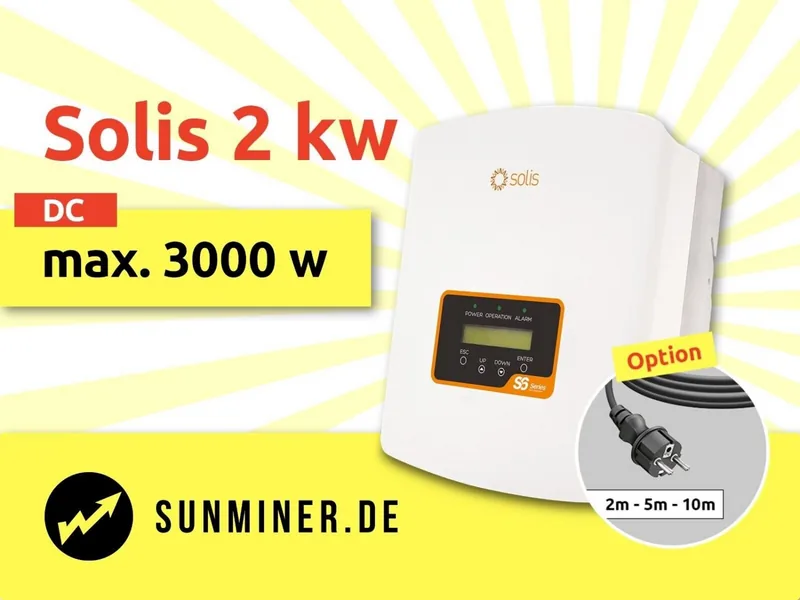
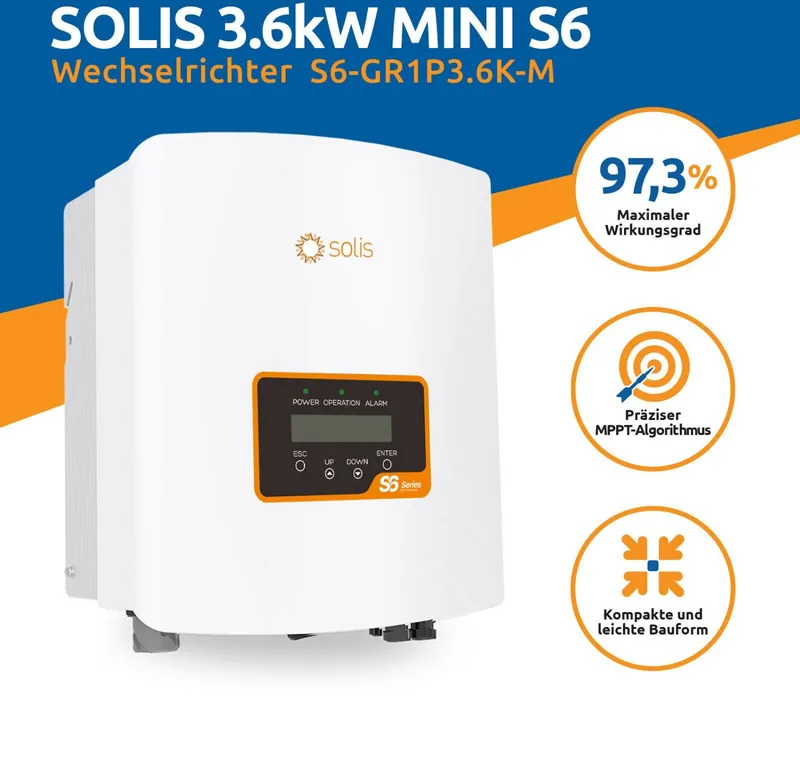
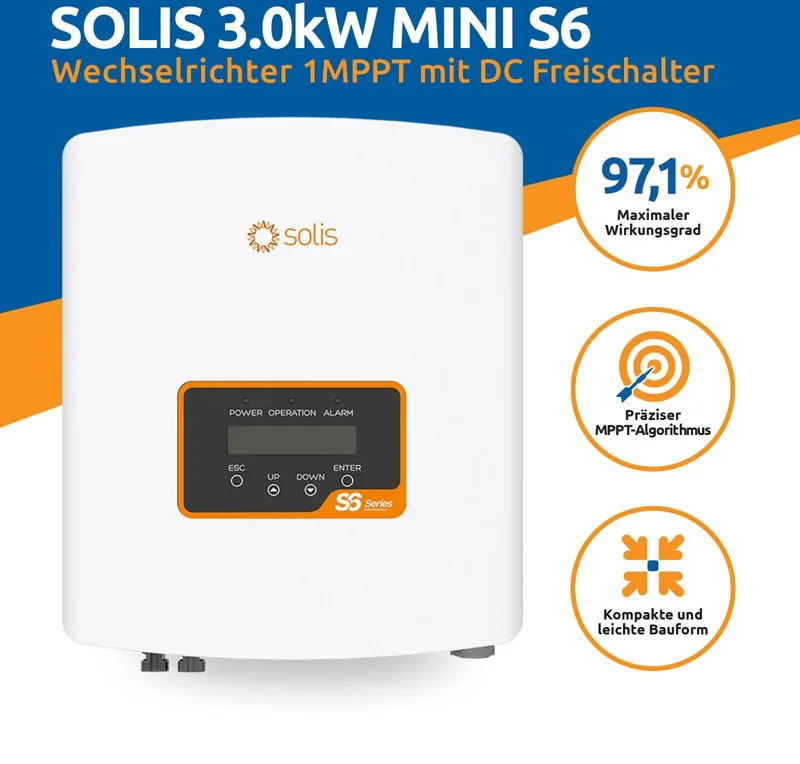
The Ginlong Solis S6-GR1P(0.6-3.6)K-M is a compact single-phase grid-tied inverter family designed for residential and small commercial PV systems. Built for reliability and smart-grid compatibility, these inverters support models from 0.6 kW through 3.6 kW and incorporate features such as integrated DC switches, DRM/backflow control, AFCI arc-fault protection, and optional communications (Wi‑Fi/GPRS/RS485). They are engineered for easy wall mounting, natural convection cooling, and high efficiency across varied operating conditions.
Key features and practical use
The S6 series offers a clear front-panel LCD and LED indicators for instant operational feedback—status, power, alarms, and historical energy statistics. A four-button keypad gives installers and technicians direct access to menus for information, settings, advanced diagnostics, and grid-standard selection. Advanced menus (password protected) expose detailed technician options including grid-code selection, power control, export management (EPM) with meter or CT integration, AFCI configuration, firmware updates, and energy calibration.
Installation is straightforward with quick-connect terminals for DC and AC, a supplied mounting bracket, and clear clearance and polarity guidance. The inverter accepts typical PV cabling and MC4 connectors, and supports multiple grid standards (VDE, EN, UL, G98/G99, EN50549 and others) via the user-definable standard menu. For export-limited systems, the built-in EPM supports smart meters or CT sensors to achieve zero export or set backflow limits, with failsafe options to halt generation if monitoring is lost.
Safety and maintenance are emphasized: the manual highlights risks of electric shock, hot surfaces, overcurrent protection requirements, correct shutdown/startup sequence, and disposal. AFCI functionality helps detect DC arc faults and safely shut down generation to reduce fire risk. Routine maintenance is minimal—periodic cleaning of heatsinks and the exterior—while most advanced tasks are reserved for qualified service personnel.
Performance and compliance are strong points: high peak efficiencies (mid-to-high 90s depending on model), transformerless topology, low THD, and wide operating ambient range. The product line supports optional monitoring additions and provides technician-level diagnostics for alarms, daily/monthly/yearly energy logs, and communication data to simplify troubleshooting and commissioning.
Notes:
- Models cover 0.6 kW to 3.6 kW variants; the 0.6 kW model is tailored for German grid requirements.
- Password-protected advanced menus are for qualified technicians; improper changes can disable functions or reduce output.
- Follow exact start/stop sequence to avoid damage: AC on first, then DC on to start; reverse to stop.
Search for 67,732 Manuals online


Type-in Brand or Model