
Ginlong Solis RHI-3P(5-10)K-HVES-5G Manual
PDF manual · 29 Pages
English



Quick check
Incorrect answer, please try again.
Chat with your Ginlong Solis RHI-3P(5-10)K-HVES-5G manual using AI
Get instant AI answers from your Ginlong Solis RHI-3P(5-10)K-HVES-5G manual
Ask anything about the Ginlong Solis RHI-3P(5-10)K-HVES-5G. Answers come from this manual, with the pages they are based on.
Ask a Question
Do you recommend RHI-3P(5-10)K-HVES-5G?
Yes NoFrequently Asked Questions
It is designed for three-phase residential solar systems that use battery storage. It converts PV energy for household use, stores surplus energy in a compatible high-voltage lithium battery, manages grid interaction, and can supply selected backup loads.
Is this answer helpful?
The range includes RHI-3P5K-HVES-5G, RHI-3P6K-HVES-5G, RHI-3P8K-HVES-5G, and RHI-3P10K-HVES-5G models. Their nominal AC output ratings are 5 kW, 6 kW, 8 kW, and 10 kW respectively.
Is this answer helpful?
Yes. The dedicated backup output can transfer in less than 40 ms. Backup circuits must be planned and wired correctly by a qualified installer. The backup output must not be operated in parallel with other AC backup sources.
Is this answer helpful?
The inverter supports high-voltage lithium-ion batteries with a DC voltage range of 160 to 600 V. Battery communication is available through CAN and RS485. Compatibility and battery settings must be confirmed before installation.
Is this answer helpful?
Yes. The inverter supports export power management when connected to a three-phase meter. Installers can enable export control, set an allowed export level, and configure a fail-safe response for loss of meter communication.
Is this answer helpful?
All models support up to 1000 V DC PV input and include two MPPT trackers. Recommended maximum PV power ranges from 8 kW for the 5 kW model to 16 kW for the 10 kW model, depending on the variant.
Is this answer helpful?
Advantages and Disadvantages
Advantages

- Four power options from 5 kW to 10 kW support different three-phase residential energy demands.
- Hybrid design combines PV generation, high-voltage lithium battery storage, grid connection, and backup supply.
- Fast backup switching of less than 40 ms helps maintain power to selected loads during grid outages.
- Up to 98.4% solar conversion efficiency and 99.9% MPPT efficiency support effective energy harvesting.
- IP65 enclosure, natural cooling, and low noise below 30 dB(A) suit many residential installations.
Disadvantages

- Installation and advanced configuration require qualified personnel and compliance with local electrical rules.
- Only high-voltage lithium-ion batteries within the 160 to 600 V DC range are supported.
- The backup output is not intended for parallel operation with other AC backup sources.
- Export limiting depends on correct installation and reliable communication with a three-phase meter.
- Direct sunlight, inadequate ventilation, and high ambient temperatures can reduce output performance.
Product Specification
Note
Prices partly include 0% VAT rates for AT and DE
Type
Transformerless, passive hybrid inverter
Input voltage
160-1,000 V direct current (DC)
MPP voltage range
200-850 V direct current (DC)
Number of MPP trackers
2
Output phases
3-phase
Efficiency
98.4% max., 97.7% etaEU
Input
MC4
Output
Terminals
Interfaces
RS-485
Ingress protection
IP65
Ambient temperature
-13 to +140 degrees F
Dimensions
21.06 x 17.91 x 7.28 in (W x H x D)
Weight
55.34 lb
Product Description
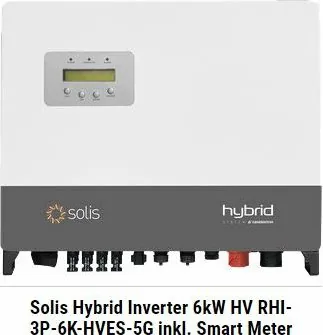
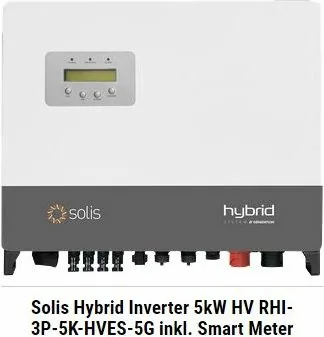
Ginlong Solis RHI-3P(5-10)K-HVES-5G Manual: Hybrid Energy Storage for Three-Phase Homes
The Ginlong Solis RHI-3P(5-10)K-HVES-5G is a three-phase hybrid inverter family designed for residential solar installations that combine photovoltaic generation, battery storage, grid connection, and backup power. Available in 5 kW, 6 kW, 8 kW, and 10 kW ratings, these units help households increase solar self-consumption by storing surplus daytime energy for use later.
A key advantage of this range is its flexible operating capability. It can work in grid-connected systems and can support off-grid operation when the AC grid connection is physically isolated. The dedicated backup output switches in less than 40 ms, helping selected household circuits receive continuity of supply during a grid interruption. Backup capacity varies by model, with peak apparent output available for short-duration demand.
The inverter supports high-voltage lithium-ion batteries across a 160 to 600 V DC range. CAN and RS485 communications enable battery management system integration, while compatible battery settings support controlled charging, discharging, state-of-charge protection, and battery wake functions. Users can also select automatic self-consumption behavior, scheduled charge and discharge periods, or off-grid operation according to the system design.
Solar input handling is equally capable. The series uses two MPPT trackers, supports up to 1000 V DC input, and reaches a quoted MPPT efficiency of 99.9%. Depending on the model, recommended PV array capacity reaches 16 kW. This makes the range suitable for systems with multiple roof orientations or arrays that need independent tracking. Maximum solar conversion efficiency is rated at 98.4%, while battery charge and discharge efficiency is rated at 97.5%.
For monitoring and control, the front LCD and four-button keypad provide access to live PV, grid, battery, backup, and meter readings. Energy reports cover daily, monthly, yearly, and total production, as well as battery charging and meter import-export values. An integrated three-phase meter function supports export power control, allowing installers to set an export limit and enable a fail-safe response if meter communication is lost.
Installation and Protection Notes
The IP65 enclosure, natural-convection cooling, and operating range of -25 C to +60 C support outdoor or sheltered installations where local conditions allow. The unit should be mounted vertically on a strong wall, away from direct sun, flammable materials, and restricted airflow. Professional installation is essential because PV, battery, grid, backup, and communication wiring must meet local electrical rules.
Note: Battery compatibility, grid standards, advanced settings, and protection parameters should be configured by qualified personnel. Do not operate backup outputs in parallel with other AC backup supplies.
The Ginlong Solis RHI-3P(5-10)K-HVES-5G combines solar conversion, storage management, export control, and fast backup switching in one compact platform for energy-conscious three-phase homes.
Search for 67,732 Manuals online


Type-in Brand or Model