
Gert Board Manual
PDF manual · 50 Pages
English



Quick check
Incorrect answer, please try again.
Chat with your Gert Board manual using AI
Get instant AI answers from your Gert Board manual
Ask anything about the Gert Board. Answers come from this manual, with the pages they are based on.
Ask a Question
Do you recommend Board?
Yes No
Ruth Owen
8 months ago
Is there a newer edition of this Raspberry Pi book available?

Manual.ly
8 months ago
Yes, there is a newer edition available. Customer feedback indicates that a newer version is now available at the same price. While the current book covers essential topics like Linux configuration and GPIO programming for beginners and advanced users, the newer edition may contain updated information. We recommend checking for the latest version to ensure you have the most current guide for installation and setup.
Kenna Crist
6 months ago
Is the older edition of this book still relevant, or should I wait for the newer version?
Manual.ly
6 months ago
While the content is excellent and covers everything from installation to GPIO programming, we recommend purchasing the latest edition. It offers the same price but includes updated information on current Raspberry Pi models and software versions.
Lola Stewart
4 months ago
Does this guide cover basic Linux setup and GPIO programming for beginners?
Frequently Asked Questions
It is a GPIO expansion board for the Raspberry Pi that adds components like motor controllers, A/D converters, and microcontrollers to enhance hardware interfacing capabilities.
Is this answer helpful?
Yes, but you must account for differences in GPIO pin definitions between revision 1 and revision 2 boards to ensure correct connections.
Is this answer helpful?
You can run the provided motor test programs in C or Python which guide you through connecting wires and configuring PWM settings to spin the motor.
Is this answer helpful?
The board supports testing via C code for direct hardware access and Python scripts using libraries like RPi.GPIO and WiringPi for easier development.
Is this answer helpful?
Yes, while the board handles logic, the motor controller requires an external power source up to 18V to drive the motor safely and effectively.
Is this answer helpful?
They connect via the SPI bus using specific GPIO pins (7 through 11) which must be configured with alternative functions and linked via jumpers.
Is this answer helpful?
Advantages and Disadvantages
Advantages

- Extensive hardware integration including motor control and A/D-D/A conversion
- Comprehensive test programs available in both C and Python languages
- Clear labeling and detailed schematics simplify complex wiring tasks
- Supports multiple Raspberry Pi revisions with updated GPIO mappings
- Modular design allows flexible interconnection of functional blocks
Disadvantages

- Requires careful jumper configuration to avoid signal conflicts
- Some advanced features like hardware PWM need specific library installations
- GPIO pin numbering changes between Raspberry Pi versions cause confusion
- External power supplies are needed for high voltage motor operations
- Initial setup requires knowledge of command line interface usage
Product Specification
Platform
Raspberry Pi
Format
N/A
Manufacturer
Fen Logic
Function
Multi-I/O Board, Motor Control
Connection
GPIO (17-Pin), Atmel ATmega328 MCU
Power Supply
via Host
External Connectors
12x Buffered I/O, 6x Open Collector Output, 28-Pin GPIO, 2x DAC (8-12bit), 2x ADC (10bit), 1x Motor Control (4x Screw Terminals)
Wireless
N/A
LAN
N/A
Features
3x Buttons
Package Contents
1x Board, 10x Connection Cables, 16x Jumpers
Product Description
Discover the Power of the Gert Board Manual
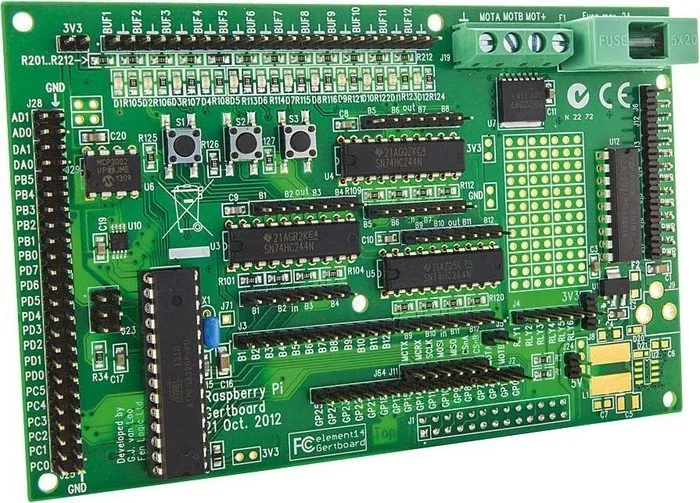
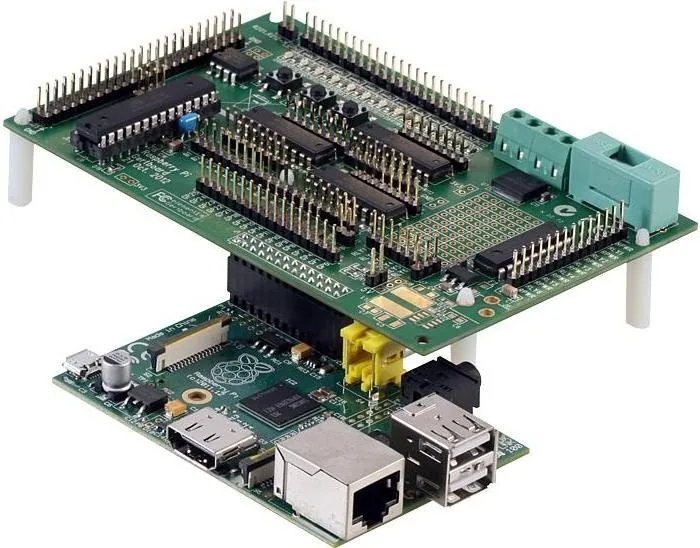
The Gert Board stands as a remarkable GPIO expansion board designed specifically for the Raspberry Pi computer. It serves as a versatile bridge between digital logic and the physical world, offering a rich array of components that empower hobbyists and engineers alike. This manual guides you through the intricate capabilities of the board, which includes switches, LEDs, A/D and D/A converters, a motor controller, and an Atmel AVR microcontroller.
One of the standout features of the Gert Board is its modular design. The various functional blocks can be interconnected using header pins, allowing for a wide range of custom configurations. Whether you are interested in controlling motors with precise speed adjustments via PWM or converting analog signals to digital data, this board provides the necessary hardware foundation. The included test programs, available in both C and Python, allow users to explore these functions deeply without needing to write code from scratch.
Understanding the layout is crucial for success. The board features clear labeling for every component, from the ICs like the Atmel microcontroller to the specific I/O ports. The manual details how to configure buffered inputs and outputs using jumpers, ensuring that signals flow correctly between the Raspberry Pi and external devices. It also explains the nuances of GPIO pin mapping across different Raspberry Pi revisions, preventing common connection errors.
For those looking to expand their projects, the open-collector drivers offer a safe way to control high-voltage or high-current devices using an external power supply. The motor controller supports brushed DC motors up to 18V and 2A, making it suitable for robotics applications. Furthermore, the integrated A/D and D/A converters enable interaction with sensors and actuators that operate on analog signals, bridging the gap between the digital brain of the Raspberry Pi and the analog environment.
The documentation emphasizes practical testing. Each section of the manual walks you through setting up specific tests, such as reading pushbuttons, blinking LEDs, or driving a motor at varying speeds. By following the provided schematics and wiring diagrams, users can confidently build complex circuits. The availability of source code for these tests encourages learning and modification, fostering a deeper understanding of embedded systems programming.
Search for 67,706 Manuals online


Type-in Brand or Model
Hans Muller
6 months ago
Is this the latest edition of the Raspberry Pi book or should I look for a newer version?
Manual.ly
6 months ago
Our team notes that customer reviews indicate this might be an older edition. A newer version is currently available at the same price. We strongly suggest verifying the publication date or edition number before purchasing to ensure you receive the most up-to-date programming instructions and project guides.