
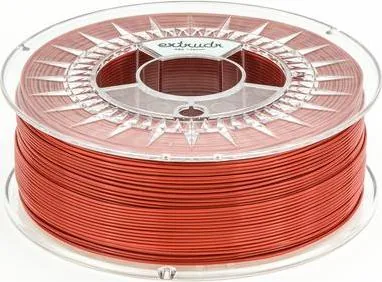
extrudr ABS Manual
PDF manual · 4 Pages
English



Quick check
Incorrect answer, please try again.
Chat with your extrudr ABS manual using AI
Get instant AI answers from your extrudr ABS manual
Ask anything about the extrudr ABS. Answers come from this manual, with the pages they are based on.
Ask a Question
Do you recommend ABS?
Yes NoFrequently Asked Questions
extrudr ABS prints well within a 150–210°C melting range; typical nozzle temperatures fall in the upper portion of that range depending on printer and part. Use a heated bed and consider an enclosure for large or warp-prone prints.
Is this answer helpful?
Store in a cool, dry place away from UV and ignition sources. Keep the spool sealed or in a desiccant-filled bag to prevent moisture uptake, which can cause bubbling, poor layer adhesion, and surface defects during printing.
Is this answer helpful?
extrudr ABS is not classified as hazardous under common transport regulations (ADR, IATA, IMDG). For disposal, minimize waste and seek recycling options where available; follow local regulations for polymer waste management.
Is this answer helpful?
Ensure good ventilation to reduce inhalation of fumes, avoid contact with molten filament, use heat-resistant gloves and eye protection as needed, and wear a particle-filtering mask if dust is present. Keep ignition sources away from filament and storage areas.
Is this answer helpful?
Thermal decomposition above ~250°C can produce carbon monoxide, carbon dioxide, aldehydes, acetic acid, tetrahydrofuran, and low-molecular weight oligomers. Maintain proper temperatures and ventilation to minimize exposure.
Is this answer helpful?
Yes. extrudr ABS takes sanding well and can be chemically smoothed with solvents like acetone for improved surface finish. Use appropriate PPE and ventilation when sanding or using solvents to avoid dust and vapor exposure.
Is this answer helpful?
Advantages and Disadvantages
Advantages

- High strength and impact resistance suitable for functional parts.
- Stable extrusion with typical melt range of 150–210°C for standard printers.
- Good post-processing: sanding and acetone smoothing possible.
- Not classified as hazardous for transport, simplifying logistics.
- Contains antioxidants/lubricants to improve filament runnability and shelf life.
Disadvantages

- Emits irritating fumes and decomposition products above 250°C—requires ventilation.
- Sensitive to moisture and UV; must be stored sealed to prevent degradation.
- Can generate dust that irritates eyes, skin, and respiratory tract.
- Requires heated bed/enclosure for best print results, increasing setup needs.
- Risk of thermal decomposition and hazardous gases if overheated or burned.
Product Specification
Packaging
Filament Spool
Type
ABS
Suitability
universal
Printing Temperature
374-446°F
Melting Temperature
356-392°F
Heatbed Recommendation
140-230°F
Shrinkage
0.4%
Melt Flow Index
1.55oz/10min
Impact Strength
22.02BTU/ft2
Elongation at Break
30%
Modulus of Elasticity
311,831psi
Tensile Strength
6,164psi
Dimensional Stability
201.2°F
Density
65.55lb/ft3
Special Features
weather-resistant
Product Description
extrudr ABS, 3D-Druck Filament Manual
extrudr ABS is a professional-grade ABS (Acrylonitrile-Butadiene-Styrene) filament formulated for reliable 3D printing. Designed for hobbyists and industrial users alike, this filament balances strength, heat resistance, and ease of use. With a density around 1.05 g/cm³ and a melting range of roughly 150–210°C, extrudr ABS delivers consistent extrusion and dimensional stability for parts that require toughness and moderate heat tolerance.
The material composition is largely ABS (≈98%) with small amounts of antioxidants and lubricants to improve processing and filament runnability. It is stable under recommended storage conditions but can decompose at temperatures above 250°C, releasing combustion products such as carbon monoxide, carbon dioxide, aldehydes and low-molecular oligomers—so careful temperature control and ventilation during printing are important. The filament is not classified as hazardous for transport and presents no known ecological hazards due to low water solubility.
Practical handling notes: store extrudr ABS in a cool, dry place away from UV and ignition sources; keep spools sealed to avoid moisture uptake which can affect print quality. During printing, avoid overheating and ensure adequate ventilation to minimize inhalation of fumes. Use heat-resistant gloves when handling molten material and protective eyewear and masks if dust or filament fragments are present.
Printers will appreciate extrudr ABS for parts needing impact resistance and post-processing (sanding, acetone smoothing). It responds well to common ABS print settings: heated bed, enclosure recommended for larger prints, and nozzle temperatures within the specified melting range. Prevent electrostatic charge by grounding equipment and limit dust generation during handling.
Notes
- Recommended storage: cool, dry, sealed packaging away from UV and heat.
- Use appropriate PPE when handling dust, hot filament, or during post-processing.
- Recycle waste where possible; minimize waste generation.
Search for 67,706 Manuals online


Type-in Brand or Model