
element14 EnOcean Pi 868 Manual
PDF manual · 28 Pages
English



Quick check
Incorrect answer, please try again.
Chat with your element14 EnOcean Pi 868 manual using AI
Get instant AI answers from your element14 EnOcean Pi 868 manual
Ask anything about the element14 EnOcean Pi 868. Answers come from this manual, with the pages they are based on.
Ask a Question
Do you recommend EnOcean Pi 868?
Yes NoFrequently Asked Questions
The TCM-based gateway family covers 868.300 MHz (Europe), 315.000 MHz, and 902.875 MHz variants. Use the appropriate module for your region and ensure the chosen antenna and approvals match regional regulations.
Is this answer helpful?
The gateway can act as a postmaster with up to 20 mailboxes for Smart Ack-enabled sensors. It stores mailboxes in flash so learned devices persist through resets. Care must be taken that only continuously powered modules serve as postmasters to maintain Smart Ack functionality.
Is this answer helpful?
The module uses a UART serial interface implementing EnOcean Serial Protocol V3 (ESP3) at a nominal 58.8 kbps. ESP3 commands allow transparent radio traffic, configuration of repeaters, filters, memory access, Smart Ack, and remote management.
Is this answer helpful?
Use approved antennas (whip, helical or specified chip) with the correct ground plane, maintain a 10 mm keep-out around the antenna, provide full ground beneath the module, keep I/O traces short, and add proper matching for chip antennas. Follow the manual’s footprint and decoupling recommendations.
Is this answer helpful?
Yes. For FCC/IC limited modular approvals, OEMs must meet labeling, user-access limitations, duty-cycle/timing rules, and may need to sign EnOcean’s OEM agreement. CE/R&TTE requires final product compliance and a Declaration of Conformity; duty-cycle limits apply for 868.3 MHz.
Is this answer helpful?
Supply 2.6–3.5 V to VDD, keep ripple under ~10 mVpp, place a 22 µF ceramic decoupling capacitor near VDD, use a 470 nH ferrite/coil in the supply, tie all GND pins with many vias, and avoid loops. Observe IOVDD/DVDD rules to prevent currents when DVDD is 0 V.
Is this answer helpful?
Solder per IPC/JEDEC J-STD-020C. Modules are MSL4 with a 72 h floor life and may be soldered only once. If floor life is exceeded, follow J-STD-033B bake procedures. Store in moisture-proof packaging and solder within six months of delivery.
Is this answer helpful?
Advantages and Disadvantages
Advantages

- Seamless Raspberry Pi integration with ESP3 serial support for EnOcean devices.
- Supports Smart Acknowledge postmaster functionality for reliable sensor control.
- Configurable 1- or 2-level repeater improves coverage in complex environments.
- Small SMD transceiver with options for whip, helical, or approved chip antennas.
- Clear power and layout guidance to maximize RF performance and reduce interference.
Disadvantages

- Requires careful PCB layout, ground plane and antenna keep-out to avoid performance loss.
- Certain antenna types or frequency variants need additional FCC/IC approvals or agreements.
- IOVDD must never exceed VDD; miswiring or improper sequencing can cause malfunction.
- Not suitable for continuous streaming data—designed for short packet control signals only.
- Modules are single-solder-use (MSL4) and must be handled/stored per strict moisture rules.
Product Specification
Platform
Raspberry Pi
Format
N/A
Manufacturer
element14
Function
Radio Module (EnOcean 868)
Connectivity
Platform GPIO Port
External Ports
N/A
Wireless
EnOcean (868MHz)
LAN
N/A
Supported Standards
EnOcean (868MHz)
Package Contents
1x Board
Product Description
element14 EnOcean Pi 868 Gateway — element14 EnOcean Pi 868 Gateway Manual
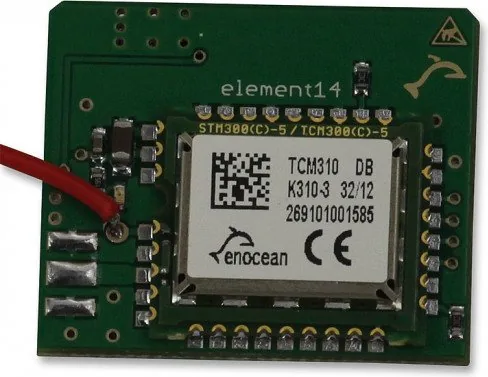
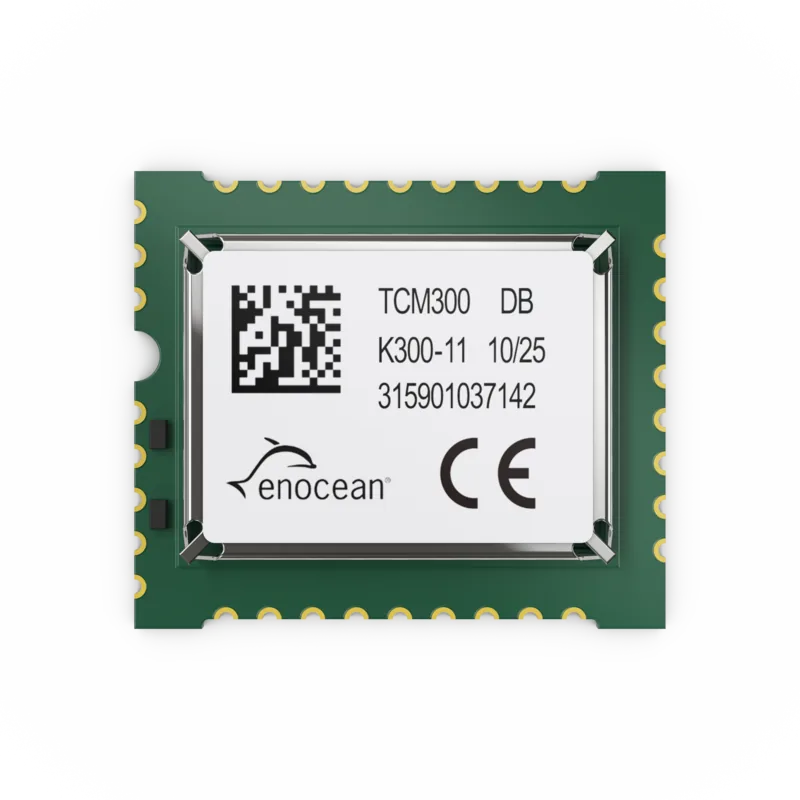
The element14 EnOcean Pi 868 Gateway delivers a compact, Raspberry Pi–compatible bridge for integrating EnOcean wireless sensors and actuators into home and building automation projects. Built around the EnOcean TCM transceiver family, this gateway supports the 868.3 MHz ISM band and provides a bi-directional radio channel plus a serial interface to a host processor, making it simple to forward EnOcean ESP3 telegrams to a Raspberry Pi or other controller.
Designed for reliable low-power wireless control, the gateway leverages EnOcean features such as Smart Acknowledge (postmaster mailboxes) and configurable repeater functionality. The module handles transparent radio traffic, remote management messages up to 256 bytes, and a set of ESP3 commands for configuration — including filters, repeater levels, memory access, and Smart Ack learn/postmaster controls. It is ideal for systems that require short packetized control messages (switches, sensors, actuators) rather than continuous streaming data.
Hardware highlights include a small SMD-mount transceiver module with dedicated pads for RF whip or 50-ohm antenna connection, regulated digital supplies (VDD, DVDD, IOVDD), and UART lines for ESP3 communications. Power design guidance emphasizes a stable 2.6–3.5 V supply, low ripple, decoupling (22 µF ceramic) and a series ferrite/coil in the VDD line to preserve radio performance. Layout and grounding are critical: full ground planes beneath the module, cleared keep-out areas above the antenna region, and short I/O traces yield consistent range and immunity.
Antenna options supported include external whip, helical, or approved chip antennas (with matching circuits where required). Range depends on environment: line-of-sight tens of meters up to ~100 m in halls, but heavy attenuation through concrete or metal. Regulatory approvals and constraints vary by frequency and antenna choice: the 868.3 MHz module benefits from CE/R&TTE rules and duty-cycle limits, while 315 MHz and 902.875 MHz variants require FCC/IC approvals or limited modular approval and mandated antenna choices.
Whether you’re building a Pi-based gateway for battery-free switches, environmental sensors, or actuator control, the element14 EnOcean Pi 868 Gateway manual-guided approach ensures correct electrical, RF and mechanical integration for stable operation and regulatory compliance.
Notes
- Use only approved antennas and follow duty-cycle/regulatory limits for your region.
- Keep IOVDD ≤ VDD; avoid applying voltages to UART pins if DVDD is 0 V.
- Store and solder modules per MSL4/J-STD-020C guidance; modules are soldered once.
Search for 67,706 Manuals online


Type-in Brand or Model
Marta Schmidt
8 months ago
How difficult is it to set up the EnOcean Pi radio module with a Raspberry Pi and FHEM to control EnOcean actuators?
Manual.ly
8 months ago
The initial setup can be a bit tricky, especially if you are new to EnOcean and FHEM. However, most users manage to get it working by following the available online instructions, taking a little time for testing, and tuning the configuration until the pairing is successful. Once the module is properly configured, you can reliably control EnOcean actuators through your FHEM web interfaces. If you run into issues, re-check the module settings and your actor pairing steps, since those are usually the main causes of delays at the beginning.