
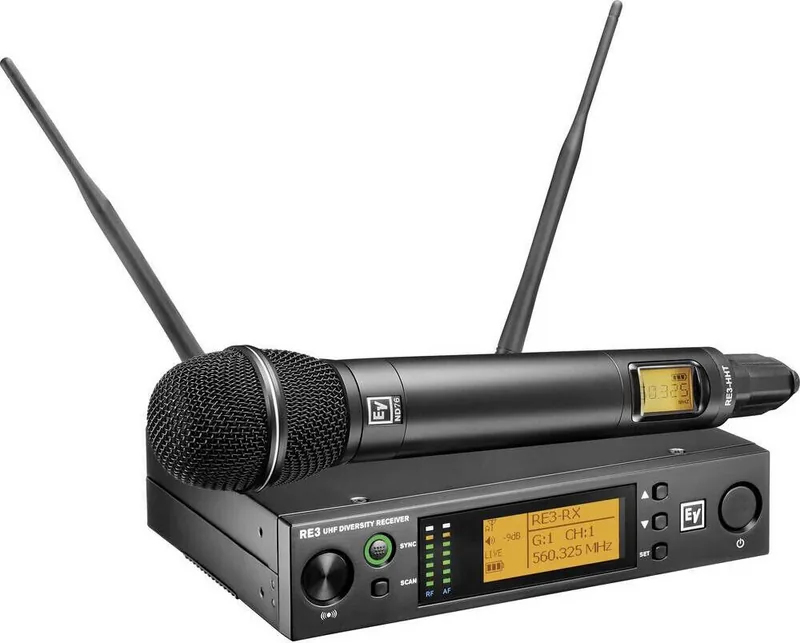
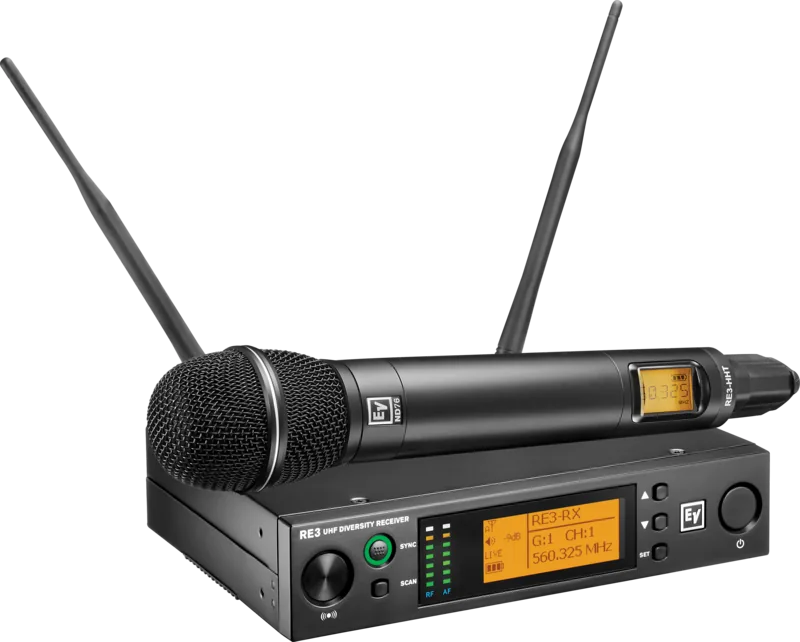
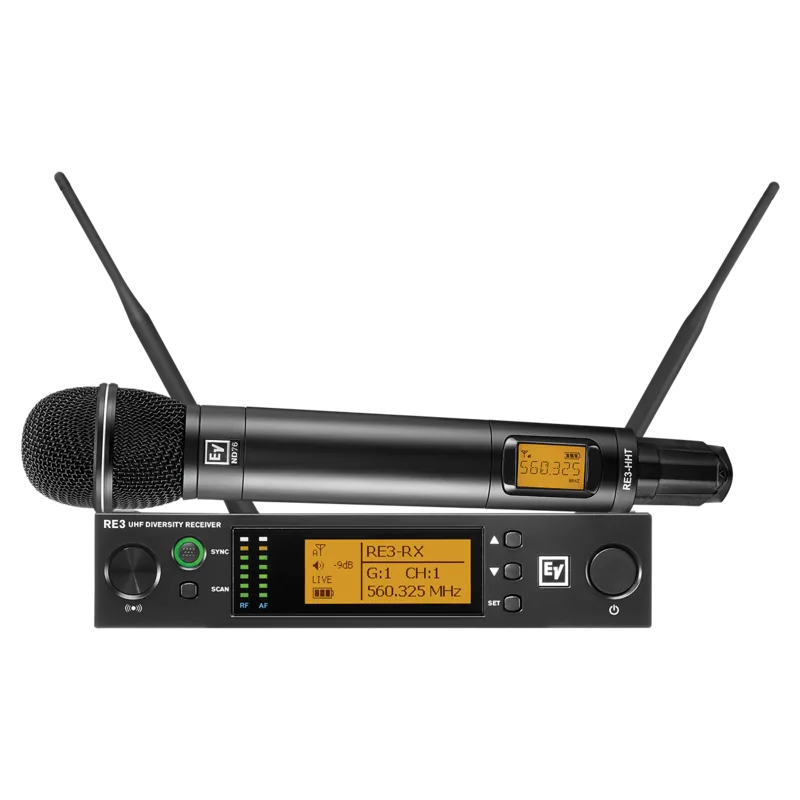
Electro-Voice RE3-ND76 Manual
PDF manual · 72 Pages
English



Quick check
Incorrect answer, please try again.
Chat with your Electro-Voice RE3-ND76 manual using AI
Get instant AI answers from your Electro-Voice RE3-ND76 manual
Ask anything about the Electro-Voice RE3-ND76. Answers come from this manual, with the pages they are based on.
Ask a Question
Do you recommend RE3-ND76?
Yes NoFrequently Asked Questions
Wireless RF can shift unpredictably. Another transmitter in the venue or electronics near the antennas may activate later. Turn off the RE3 transmitter, observe the receiver RF meter, then rescan for open frequencies and resync the transmitter to the new receiver data.
Is this answer helpful?
Common causes are competing signals, squelch set too high, antenna placement, poor or incorrect 50-ohm BNC cabling, or transmitter power set too low. Check RF meter behavior with the transmitter off, then rescan, adjust squelch, reposition antennas away from reflective/grounding surfaces, and confirm cabling quality.
Is this answer helpful?
UHF spectrum is shared with TV broadcasters and can vary by geography. A full scan searches the tuning bandwidth to find frequencies with less competing RF. If your band is crowded, selecting a different RE3 frequency band variant for your location can dramatically improve open-channel availability.
Is this answer helpful?
RE3 frequency groups are designed to be intermodulation-free through coordination. Custom manual grouping can accidentally create intermodulation products. For best results, use RE3 factory groups and coordinated group/channel assignments and then sync each transmitter to its matched receiver settings.
Is this answer helpful?
It depends on frequency band matching. A RE3 set is preconfigured with a matched transmitter and receiver in the same frequency band. If the added transmitter is not in the same band, it will not sync properly. Also, if you plan to use two transmitters at the same time with one receiver, that is not supported.
Is this answer helpful?
Yes for compatible input devices. Legacy Electro-Voice bodypack transmitter input devices with 4-pin mini connectors are compatible with RE3.
Is this answer helpful?
Choose the appropriate frequency band(s) for your region, then rack-mount the receivers using RMK2 kits. Use AASP active antenna splitters to cascade signals from antennas to multiple receivers, and pair with suitable log periodic antennas (PLPA passive or ALPA active) based on coverage and cable run length. Use low-loss coax cables sized for the distance.
Is this answer helpful?
Advantages and Disadvantages
Advantages

- Fast scanning and group/channel selection help locate clear UHF frequencies in real venues.
- Reliable transmitter-receiver pairing via sync ports and confirmed LED status indicators.
- Clear AF and RF metering supports correct transmitter sensitivity and stable reception.
- Diversity receiver design improves robustness against typical wireless dropouts.
- Multi-channel system approach (shared band and group rules) reduces intermodulation interference.
Disadvantages

- RF performance depends heavily on antenna placement, orientation, and proper cabling.
- Using multiple transmitters on the same frequency can immediately cause interference.
- Manually created frequency schemes can increase the risk of intermodulation artifacts.
- Operating without required licenses or band compliance can create legal and spectrum issues.
- Incorrect squelch settings may reduce range and affect audio stability.
Product Specification
Type
Microphone system (Handheld transmitter)
Channels
32
Consisting of
Receiver (RE3-RX), Handheld transmitter (RE3-HHT)
Product Description
Electro-Voice RE3-ND76 Wireless Set: UHF Clarity You Can Set Up Fast
The Electro-Voice RE3-ND76 Manual centers on a UHF wireless microphone system built for dependable performance in real-world RF conditions. RE3 uses UHF frequencies and is designed to help presenters and production teams quickly find usable spectrum, lock transmitter and receiver settings together, and maintain stable audio during live events.
What the RE3-ND76 is designed to do
The RE3-ND76 family is a handheld set paired with an ND76 microphone head. Depending on the frequency variant, you get a matched receiver plus a handheld transmitter with batteries and the corresponding microphone head. The system is meant for both portable productions and fixed installations, with rack-mount support for the receiver and straightforward operation for the performer.
Setup highlights that matter
A successful install starts with antenna placement and scanning. The receiver guides you to scan for open channels, then choose a group and channel that best fits your environment. Once selected, you sync the transmitter to the receiver using the dedicated sync ports, with a direct line of sight and the recommended short distance for reliable pairing.
Signal quality is supported by clear on-screen meters (AF for audio level, RF for radio strength) and receiver controls like squelch, volume, and antenna power. Best practice emphasizes avoiding transmitter conflicts (never run multiple transmitters on the same frequency at the same time), using frequency groups that are intermodulation-free, and resyncing when receiver microphone configuration settings change.
Built for stability during performances
RE3 includes features aimed at reducing on-the-fly headaches: keylock to prevent accidental setting changes, a sync-confirmation LED on the receiver and transmitters, optional adjustable transmitter power (where supported), and compatibility with a broad set of RE3 accessories for multi-channel systems.
Key results (quick takeaways)
- Uses frequency scanning plus group/channel coordination to help avoid interference from crowded UHF environments.
- Sync workflow links transmitter settings to the receiver for consistent operation with minimal guesswork.
- AF and RF metering, plus transmitter sensitivity guidance, supports clean audio without constant clipping.
- Multi-channel operation relies on correct frequency-band and group rules to reduce intermodulation.
Notes
Always follow local licensing and spectrum regulations for your selected frequency band. For batteries, use the specified AA alkaline or NiMH rechargeable options, match polarity carefully, and remove depleted cells promptly. If RF issues appear during a show, rescanning and selecting a new clear frequency is a primary fix.
Search for 67,706 Manuals online


Type-in Brand or Model