
Einhell CC-BC 10 E Manual
PDF manual · 72 Pages
English



Quick check
Incorrect answer, please try again.
Chat with your Einhell CC-BC 10 E manual using AI
Get instant AI answers from your Einhell CC-BC 10 E manual
Ask anything about the Einhell CC-BC 10 E. Answers come from this manual, with the pages they are based on.
CC-BC 10 E Maintenance Schedule
Check the acid level approximately every 4 weeks and top up with distilled water if necessary.
We recommend cleaning the device immediately after each use to keep safety devices, air vents, and housing free of dust and dirt.
Clean the equipment regularly with a moist cloth and soft soap. Do not use cleaning agents or solvents.
Clean any corrosion from the charging terminals during storage or maintenance.
Free maintenance reminders
Timed to your purchase date. Always free, unsubscribe anytime.
Ask a Question
Do you recommend CC-BC 10 E?
Yes NoFrequently Asked Questions
It is made for 12V lead-acid starter batteries, both maintenance-free and non-maintenance-free types. It is not suitable for AGM or lead gel batteries, so battery compatibility should be checked before use.
Is this answer helpful?
Yes. It is an automatic charger that manages charging on its own and limits the charging voltage to help reduce gassing. This makes it useful for longer charging sessions and battery maintenance.
Is this answer helpful?
Yes, but the battery should preferably be disconnected from the vehicle’s electrical system before charging. This helps reduce the risk of voltage spikes affecting sensitive electronic components.
Is this answer helpful?
The charger includes a charging current indicator, and the charging current gradually drops as the battery fills up. Exact charge status can also be assessed by measuring acid density on suitable batteries.
Is this answer helpful?
Charging time depends on battery capacity and how discharged the battery is. The manual provides a simple formula for estimating time, but the actual result varies based on battery condition and size.
Is this answer helpful?
Yes. It includes a flat fuse for polarity reversal and short-circuit protection, plus thermal overload protection that pauses charging if the unit gets too hot.
Is this answer helpful?
It should be used only in dry indoor rooms. After use, store it in a dry place and keep the clamps clean and free from corrosion.
Is this answer helpful?
Advantages and Disadvantages
Advantages

- Automatic charging reduces supervision and helps protect the battery during long charging sessions.
- Works with a wide 5-200 Ah battery range, covering many common 12V starter batteries.
- Built-in fuse and overload protection improve safety against short circuits and polarity mistakes.
- Clear charging current indicator makes basic monitoring simple for everyday users.
Disadvantages

- Not suitable for AGM or lead gel batteries, which limits compatibility with some modern vehicles.
- Designed only for dry indoor use, so it is less flexible in workshop or outdoor settings.
- Not intended for commercial, trade, or industrial applications.
- Charging may require battery disconnection from the vehicle, which can be inconvenient in some cases.
Product Specification
Battery voltage
12V
Max. charging current
10A
Battery capacity
5-200Ah
Display
Pointer
Color
red, black
Dimensions
7.56x4.96x8.35in (WxHxD)
Weight
6.09lb
Product Description
Einhell CC-BC 10 E: A Compact Charger for 12V Lead-Acid Batteries
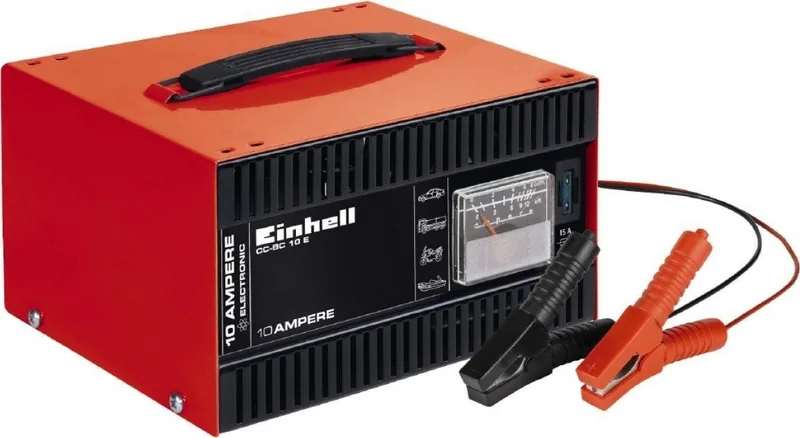
The Einhell CC-BC 10 E is built for drivers, DIY users, and anyone who wants a straightforward way to keep a 12V starter battery in good shape. It is designed for non-maintenance-free and maintenance-free lead-acid batteries used in vehicles, making it a practical everyday charger rather than a complicated workshop tool. If you are searching for the Einhell CC-BC 10 E Manual, the main idea is simple: this charger focuses on safe, automatic battery charging with minimal hassle.
One of its biggest strengths is automatic charging. The device limits charging voltage to 14.1 V, which helps reduce gassing and makes it suitable for long-term charging or battery maintenance. That is especially useful for batteries that sit unused for longer periods, such as in seasonal vehicles, boats, or lawn mowers. In practice, this means the charger can do its job without constant supervision once it is connected correctly.
The CC-BC 10 E also offers a clear and easy-to-read charging current indicator, so you can keep an eye on the charging process. Its 15A flat fuse and overload protection add a useful layer of safety, helping protect both the charger and the battery from common problems like short circuits or incorrect polarity. The housing includes a carry handle, which makes it easy to move and store when not in use.
With a battery capacity range of 5 to 200 Ah, the charger covers a wide variety of common automotive batteries. The charging time depends on the battery state and capacity, but the manual gives a simple formula to estimate it. For many users, that kind of guidance is valuable because it turns battery charging into a predictable routine instead of guesswork.
There are, however, a few limits to keep in mind. This model is not intended for lead gel or AGM batteries, and it should only be used in dry indoor spaces. It is also not designed for commercial or industrial use. For home users who need dependable charging for standard 12V lead-acid batteries, though, it strikes a strong balance between usability, protection, and value.
Notes
- Disconnect the battery from the vehicle’s electrical system before charging when possible.
- Ensure good ventilation during charging, as gas can form.
- Check polarity carefully before connecting the clamps.
- Store the charger in a dry place after use.
Search for 67,706 Manuals online


Type-in Brand or Model
Jarno Leone
9 months ago
Can I use this charger if I live in an apartment (no access to power from the street)? Does it need to be plugged into a wall outlet?
Manual.ly
9 months ago
Yes. This type of battery charger requires a mains power connection (typically a 230 V wall outlet) to operate. It cannot charge from your car battery alone and it also needs an electrical socket nearby, so charging from the street without access to a power outlet is not possible. If you charge at home, use a properly rated, safety-approved extension cable to reach a nearby outlet (do not use damaged cables). Alternatively, you can use a suitable power source like a generator, as long as it is compatible and used according to safety rules. Make sure the charger is used in a dry, ventilated area.