Manual.ly Logo

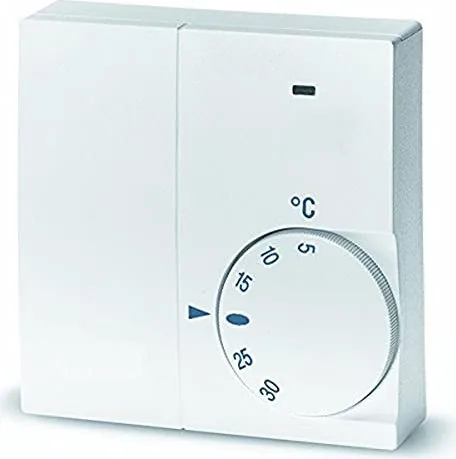
Eberle Instat 868-r1o Manual

5.0 · 3 Ratings

PDF manual · 4 Pages

English

M: OA-GPT-54-NAN
page

/ 4

Loading...
358d3453e9c3657500750d2789b5bc5061dc page 2
Installation and
Operating Instructions
Radio Thermostat
.
-r1o / -r1h
U 468 931 003 364-6
1 Application
2 Features
3 Function description
3.1 Control mode
3.2 Function of indicator lamp
3.3 Battery change
4 Installation
5 Commissioning
5.1 Performance testing
5.2 Replacement of a receiver without re-learning
of transmitters
6 Technical data
7 Short form operating instructions
8 Application examples
9 Dimensions
Subject to change without notice
Note:
In some rare cases it may not be possible to esta-
blish a permanent radio link between the radio
transmitter and the radio receiver.
We therefore recommend that the reliability in ope-
ration at the specific location should be checked.
In order to establish bigger transmission distances
(up to 90m) or in case of critical locations, the RF
repeater INSTAT 868-rep can be used.
1 Application
The electronic INSTAT 868-r1… room temperature con-
troller (radio transmitter) may be used to control the
room temperature see fig 8.:
It is designed to provide control for
• oil and gas hot-water heating systems
• actuators for radiator heating
• electric floor or direct heating
• circulating pumps
An INSTAT 868-a…radio receiver is required for oper -
ation.
2 Features
• No controller wiring-up required
• Very simple operation by means of adjustment knob
• a transmitter can control any number of receivers
• self-learning address setting
• Easy replacement of a receiver without re-learning of
transmitters
• transmitter suitable for all INSTAT 868-a… receivers
• power supply via 2 commercially available batteries
• Housing: pure white in the new EBERLE 2000 design
3 Function description
The INSTAT 868-r1… room temperature controller de-
tects an actuating signal independently of a variable set
temperature. This signal is transferred to a radio recei-
ver by radio data transmission (INSTAT 868-a…). The fi-
nal control elements for heating and cooling applicati-
ons are switched by means of this receiver (230 V). The-
re are plans to use the transmitting frequency used all
over Europe for that type of application.
The transmitting power is very low. It is far below the po-
wer of a mobile telephone. Moreover, the trans mitter is
activated only every 10 min.
The transmission quality is enhanced by employing spe-
cial test procedures and repeating transmissions. Trans-
mitter and receiver are tuned to each other by making
use of the “learning mode”.
3.1 Control mode
Fuzzy mode with PWM:
This mode is very similar to a continuous-action control.
It is particularly suitable for electrothermal actuators, el-
ectric heaters and pumps.
The controlled variable calculated from the difference
between set and actual temperature is displayed as a va-
riable pulse-pause-ratio (pulse width modulation =
PWM).
The sum of pulse and pause times is constant and equals
10 min. In the case of larger temperature differentials,
the controller switches permanently on or off.
The control algorithm used attempts to keep the room
Pulse-Pause-Ratio
Behaviour of Puls-Pause-Ratio
according to Temperature
100%
continuously on
control value
0%
continuously off
Output signal
10 min 10 min 10 min 10 min
Setpoint Temperature
temperature constant without taking account of the
switching differential. For that purpose it is necessary
that heat be called (however, to a lesser extent) even if
the set temperature has already been reached.
3.2 Function of indicator lamp
The following functions are indicated by means of this
lamp:
Learning mode is lit during the learning mode
Battery weak short flash every 15 sec.
After reset short flash
(sign of proper functioning)
3.3 Battery change
If the indicator lamp lights up briefly every 15 sec., the
batteries must be changed within the next few days (un-
der the hinged lid).
Observe correct polarity.
Please use the type of battery specified under section 6.
“Technical data”. The quality of the battery determines
its life.
Following a replacement of batteries, the controller will
continue to operate.
4 Installation
The temperature sensor can be arranged within the
room where it is considered best by the user. How ever,
for perfect temperature control it is reasonable to ar-
range the sensor at a position which:
– is easily accessible for operation
– is free from curtains, cupboards, shelves etc.
– enables free air circulation
– is free from direct sun radiation
– is free from draughts (e.g. opening of windows and
doors)
– is not affected directly by the source of heat
– is not located on an external wall
– is located approx. 1,5 m above floor level
– permits safe radio transmission
– is not in the vicinity of e. g. a radio receiver, a tele-
vision set or a radio transmitter
– is not in the vicinity of metal parts e. g. metal doors,
metal cupboards, mirrors or steelreinforced con-
crete
– if unsure, check radio transmission before installa-
tion (see receiver instructions, section “Radio ran-
ge test”), look for suitable position if necessary.
Installation is to be carried out in the following
sequence:
• remove temperature adjustment knob
• loosen retaining screw
• remove housing top
5 Commissioning
Upon installation, a connection must be made between
controller (transmitter) and receiver. For application ex-
amples, see receiver instructions.
To do so, proceed as follows:
1. Activate “learning mode” on the receiver (see there).
2. Activate “learning mode” on the transmitter as follo-
ws (below lid):
a) Hold the ì-button depressed.
b) Briefly press the reset button.
c) When the indicator lamp lights up, release the ì-
button. When the connection has been succes-
sfully made, the indicator lamp automatically ex-
tinguishes (after approx. <1 min.).
d) Press the reset button on the transmitter. This
will terminate the “learning mode” and the indi-
cator lamp will extinguish.
Note:
Activating learning mode will create a new address, all
revceivers linked to that transmitter need to be re-lear-
ned. Easy replacement of a receiver see 5.2
The transmitter exits the learning mode after 10 min.
The temperature controller is now ready for operation.
When testing the radio transmission, please observe
also the relevant receiver instructions.
5.1 Performance testing
After pressing the reset button, the transmitter changes
to testing mode for 15 sec. If the link is corect, the lamp
on the receiver will blink.
In the case of inexplicable malfunctions, the reset but-
ton should be pressed.
Manual activation of receiver output
Switching on:
Set a temperature of 30°C, wait approx. 30 sec.
Switching off:
Set a temperature of 5°C, wait approx. 30 sec.
5.2 Replacement of a receiver without re-learning
of transmitters
The method described here offers the benefit, that the
actually used address will be continued to be used.
Only the replaced receiver needs to be re-learned.
To do so, proceed as follows:
1. Activate “learning mode” on the receiver (see there).
2. Activate “learning mode” on the transmitter as follo-
ws (below lid):
a) Hold ì button depressed for > 8 Sec.
b) When the indicator lamp lights up, release the button.
When the connection has been successfully made, the
indicator lamp automatically extinguishes (after <1
min.).
c) Press the reset button on the transmitter. This will
terminate the “learning mode” and the indicator
lamp will extinguish.
6 Technical data
Order No. INSTAT 868-r1o / INSTAT 868-r1h
EDP No. 0536 11… / 0536 12...
Temperature setting range
INSTAT 868-r1o 5…30°C
INSTAT 868-r1h 17…24°C
Operating voltage battery: 2 microcells
alkaline (LR03), 2 x 1,5 V = 3 V
Battery lifetime approx. 3 years
Control mode fuzzy logic with PWM
PWM cycle time approx. 10 min.
(sum of on and off times)
Measurement interval approx. 10 min.
Indicator lamp see 3.2
Function of indicator lamp
Temperature sensor in the controller
Carrier frequency 868,95 MHz
Modulation mode FM
Antenna internal
Transmission interval <10 min.
(radio data transmision several times)
Typical range is 100 m free air or
1 ceilings or 3 walls respectively
Degree of protection IP 30 / insulated (moisture
provided by enclosure condensation not permitted)
Class of protection III
Software class A
Software version
INSTAT 868-r1o = 001574000000,
INSTAT 868-r1h = 001576000000
Maximum radiated power 4 dBm (2.5 mW)
Degree of pollution 2
Operating temperature –25…40°C
Storage temperature –25…70°C
Brinell test temperature 75 ± 2°C
Range narrowing in adjustment knob
Weight (without battery) approx. 100 g
Energy class IV = 2 %
(acc. EU 811/2013, 812/2013, 813/2013, 814/2013)
8 Application examples
One transmitter
controls one
receiver
9 Dimensions
7 Short form operating instructions
See
Preparatory work • Insert battery
4 • Install controller
Make radio link 5 1. Hold ì button depressed
2. Briefly press reset button
3. When indicator lamp lights up, release ì button
4. When the radio link has been succesfully made,
(when the lamp went out at the receiver)
press reset button
Switch receiver output 5.1
– output ON • set a temperature of 30 °C, wait for 30 sec.
– output OFF • set a temperature of 5 °C, wait for 30 sec.
Replacement of a receiver without
re-learning of transmitters 5.2 1. Hold ì button depressed for > 8 Sec
2. When indicator lamp lights up, release button
When the radio link has been succesfully made
(When the lamp went out at the receiver).
3. Press reset button.
Check for correct operation Press reset key › LED lights up briefly
› receiver switches 3 times shortly on
This thermostat can be used in all EU and EFTA
countries.
The manufacturer herewith declares that the
device complies with the basic requirements and
all other relevant regulations of the RED
(2014/53/EU) directive.
The declaration of conformity can be downloa-
ded from „www.funk868MHz.de“.
Recycling
Batteries, rechargeable or not, should not
be disposed in to ordinary household
waste. They have to be recycled properly to
protect the environment and cut down the
waste of precious ressources. Your local
waste management authority will upply you with the
details concerning the proper disposal of batteries.
This product should not be disposed of with household
waste. Please recycle the products where facilities for
electronic waste exist. Check with your local authorities
for recycling advice.

Chat with your Eberle Instat 868-r1o manual using AI

Get instant AI answers from your Eberle Instat 868-r1o manual

Ask anything about the Eberle Instat 868-r1o. Answers come from this manual, with the pages they are based on.

Ask a Question

0/1000

Do you recommend Instat 868-r1o?

Yes No
0
User Pic

Sofia Klein

10 months ago

How fast is shipping and is the ordering process really straightforward?

0
User Pic

Manual.ly

10 months ago

Based on customer feedback, orders are processed quickly and shipping is fast and uncomplicated. Customers reported smooth ordering, reliable delivery timelines, and clear product information in the listing. If you place your order, you can expect a straightforward checkout and efficient fulfillment from the seller side. For the most accurate delivery estimate for your location, check the shipping details shown during checkout (or in the order confirmation email), since times can vary by destination and carrier.

M: OA-GPT-5-NAN
M: OA-GPT-5-NAN

Frequently Asked Questions

A

It is a wireless room thermostat for controlling room temperature in heating and cooling systems. It can be used with oil and gas heating, radiator actuators, electric floor heating, direct heating, and circulating pumps.

Is this answer helpful?

A

No, the thermostat itself does not need controller wiring. It communicates by radio with a compatible receiver, which helps simplify installation and reduce cable work.

Is this answer helpful?

A

It works with receivers from the INSTAT 868-a family. A receiver is required for operation because the thermostat only sends the control signal wirelessly.

Is this answer helpful?

A

It uses fuzzy logic with PWM. This means the output is adjusted in pulse and pause intervals to keep the room temperature as stable as possible, rather than switching abruptly.

Is this answer helpful?

A

The indicator lamp flashes briefly every 15 seconds when the batteries are weak. That is the signal to replace them soon, usually within the next few days.

Is this answer helpful?

A

Yes. One transmitter can control multiple receivers, which is useful for larger or multi-zone heating setups. All connected receivers must be paired correctly.

Is this answer helpful?

A

Choose a location with free air circulation, away from sunlight, drafts, metal objects, and direct heat sources. It is also wise to test radio reception at the planned mounting point before final installation.

Is this answer helpful?

M: OA-GPT-54-NAN

Advantages and Disadvantages

Advantages

  • Wireless setup removes the need for controller cabling and keeps installation flexible.
  • Simple one-knob operation makes everyday temperature changes easy.
  • Learning mode supports pairing, self-learning addresses, and receiver replacement.
  • Fuzzy PWM control helps maintain a steadier room temperature.
  • Works with multiple heating and pump applications across the INSTAT 868 system.
VS

Disadvantages

  • A compatible INSTAT 868-a receiver is required before the thermostat can operate.
  • Radio range can be reduced by walls, metal parts, or poor placement.
  • Battery power means periodic replacement is necessary.
  • Changing the transmitter address can require re-learning of linked receivers.
M: OA-GPT-54-NAN

Product Specification

Type

Sensor, Actuator

Standard

Wireless bus (868MHz)

Function

Heating control, Thermostat, Temperature

Special features

IP30, battery-powered (2x AA)

M: OA-GPT-54-NAN

Product Description

Eberle Instat 868-r1o Wireless Room Thermostat: Smart Comfort Without the Cable Clutter

The Eberle Instat 868-r1o wireless room thermostat is built for one thing above all: reliable room-by-room temperature control with minimal installation effort. If you have ever wanted a cleaner heating setup without running control wires through walls, this compact radio thermostat offers a practical and modern solution. It works as a transmitter in the INSTAT 868 system and communicates with a compatible receiver to regulate heating or cooling equipment.

What makes the Eberle Instat 868-r1o wireless room thermostat Manual worth a closer look is the balance between simplicity and control. Operation is refreshingly straightforward thanks to a single adjustment knob, while the device still uses fuzzy logic with PWM to keep temperatures steady and responsive. That means it can suit radiators, electric floor heating, direct heating systems, and circulating pumps, making it flexible for different indoor climates.

Another strong point is its wireless design. The thermostat does not need controller wiring, and one transmitter can manage multiple receivers. Pairing is handled through a learning mode, so installation and replacement can be surprisingly smooth once the system is configured correctly. The built-in indicator lamp also helps with feedback, showing learning mode status, low battery warnings, and reset signals.

In everyday use, the thermostat is designed to support comfortable and efficient heating behavior. The control cycle is based on a 10-minute PWM rhythm, which helps the system avoid harsh on/off swings. This approach is especially useful for electrothermal actuators and pump applications where more gradual control feels natural and stable. Battery operation keeps the unit independent from mains wiring, and the clean white housing fits well into modern interiors.

Placement matters, though. For best results, the thermostat should be mounted away from direct sunlight, drafts, metal surfaces, and heat sources. Radio communication is generally strong, but walls and building materials can affect range, so testing the installation location is recommended. A compatible INSTAT 868-a receiver is required, and in more demanding environments a repeater can help extend coverage.

Notes

  • Best suited for wireless single-room heating control
  • Compatible receiver required for operation
  • Site testing improves radio reliability

Quick takeaway

The Eberle Instat 868-r1o combines easy handling, wireless convenience, and dependable room regulation in a compact thermostat built for practical heating control.

M: OA-GPT-54-NAN

© Copyright 2026 Manual.ly