Manual.ly Logo

Eberle Easy 3SW Manual

0.0 · 0 Ratings

PDF manual · 3 Pages

English

M: OA-GPT-54-NAN
page

/ 3

Loading...
8b87780b1ce56c2440c524dd6d6ae4ac8121 page 2
1. Applications
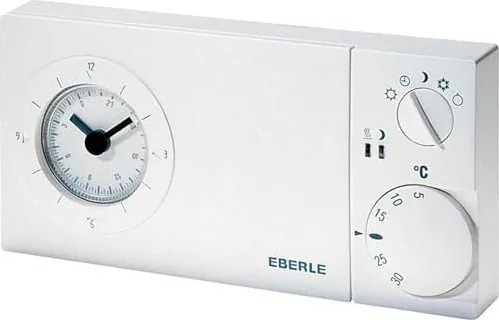
The easy 3s electronic clock thermostat is designed for
room temperature control in conjunction with:
•
heating systems, e.g. hot-water heaters, convector hea-
ters or floor heating
•
electric convector heaters, ceiling and storage heating
•
night-storage heaters
•
chillers
•
circulation pumps
•
burners and boilers
•
heat pumps, etc.
•
airconditioning applications (cooling only)
Features
•
very simple operation
•
comfort and setback temperature adjustable
•
5 operating modes (by rotary switch) for:
➩ permanent comfort temperature (5…30°C)
➩ permanent setback temperature (5…30°C)
➩ clock mode (automatic)
➩ frost protection (5°C fixed)
➩ OFF
•
Indicator lamps for: ➩ heat demand
➩ setback mode
•
available with daily or weekly timer
•
control by phone remote switch possible
•
output signal PWM or ON/OFF regulation (adjustable via
jumper)
•
relay output, 1 x changeover contact
•
remote sensor optional
•
emergency operation at sensor failure
•
hinged cover
•
new design 2000
2. Function description
The clock thermostat is designed to control the room tem-
perature.
In the automatic mode, a changeover is effected between
comfort and setback mode by the built in timer.
Optionally remote sensor can be used instead of built-in
sensor.
In setback mode the green indicator lamp lights up.
If room temperature drops below set value, heating will
start, the red indicator lamp will light up.
Indicator lamps
Red indicates when controller demands heat,
Green indicates when setback mode is activated.
Red flashing for failure. Operating voltage to be swit-
ched OFF and ON again.
Controller heat demand at PWM
If room temperature drops below the set value, heating
mode will start. The controller output is in the form of pul-
ses of varying length (PWM). The length of the pulses
depends on the difference between set and actual room
temperature.
The sum of pulse and pause times can be selected with
J4 (between 10 or 25 min.).
If there are large temperature differences, the controller
will switch ON or OFF permanent, e.g. when changing
over to temperature setback mode. PWM should only be
used for current ≤ 10A
Fig.1: Characteristic of impulse pause ratio depending on temperature
Cycle time setting
For inert applications (e.g. burners) we recommend the
long cycle time.
For quick applications (e.g. electric direct heaters) we re-
commend the short cycle time.
Plug-in jumper J4 Time
(right side of board)
Double-pole jumper 25 min
connection (as-delivered condition)
Single-pole jumper 10 min
connection
Heat demand of the controller at ON/OFF regulation
When room temperature drops below set temperature the
output will be switched on, whereas it will be switched off,
when set value is exceeded.
Fig. 2: ON/OFF regulation
Plug-in jumper J3 Regulation
(right side of board)
Double-pole jumper ON/OFF
connection
Single-pole jumper PWM
connection (as delivered condition)
Phone remote switch (only available at special variants)
Via an external phone switching device the conroller can
be put into mode of comfort or setback temperature. As
long as contact (terminal 19) is closed, the comfort tem-
perature will be “used“. This function ist activated in the
modes 2 automatic, Ñ setback temperature permanent
and P Frostprotection.
set temperature
temperature
OFF
ON
Hysteresis
On
Off
Temperature
10/25 min
set temperature
3. Installation
The controller should be arranged in a place within the
room which:
• is easily accessible for operation
• is free from curtains, cupboards, shelves, etc.
• enables free air circulation
• is free from direct sun radiation
• is free from draughts (e.g. opening of windows and doors)
• is not affected directly by the source of heat
• is not located on an external wall
• is located approx. 1,5 m above floor level
Mounting directly on conduit box or with adapter
frame ARA easy.
Electric connection
Warning! Disconnect electric circuit from supply.
Proceed as follows:
• pull off temperature setting knob
• push retaining hook outwards using screwdriver
• remove housing cover
• make connection in compliance with wiring diagram (see
housing cover).
• watch notes
Remote sensor
Having connected the remote sensor, the integral sensing
component will be switched off automatically.
The sensor cable is extendable up to a length of max.
50 m. Please use a two-core 230 V cable with a cross sec-
tion of 1.5 mm
2
.
The sensor cable (F 193 720) should be installed into a
protection tube (pocket). This facilitates later replacement.
In case of failure (break or short-circuit) the controller swit-
ches into emergency operation:
at PWM: 30% heating capacitiy
at ON/OFF: Relay OFF
Warning! Sensor cables carry operating voltage.
4. Technical data
Temperature setting range:
comfort temperature 5…30°C
setback temperature 5…30°C
frost protection approx. 5°C fixed
Regulation proportional controller
(due to PWM quasi-continuous, see Fig.1)
Cycle period adjustable 10 or 25 min.
(sum of PWM ON and OFF times)
Proportional band 1,5 K
Hysteresis ~0,5 K, ≤ 10 A see Fig. 2
~0,5K at 16 A and use with remote sensor
~2,5 K, at 16 A without remote sensor
ON/OFF regulation adjustable via jumper
Output relay, 1 volt-free* changeover contact
Switching current 10 mA…16 A cos ϕ = 1
max. 4 A cos ϕ = 0,6
max. 10 electro-thermal actuators
Switching voltage 24…250 V AC
Mode selector switch comfort / automatic / setback /
frost protection / OFF
Phone remote switch Input for 230 V AC (via an external
(as variant) phone switching device)
Indicator lamp: red controller demands heat
green setback mode
Temperature sensor: internal
Remote sensor type F 190 021 (wall mounting)
type F 193 720 length 4 m
both extendable up to 50 m
Sensor characteristics 42 kΩ at 20°C
26 kΩ at 30 °C
Range limitation inside setting knob
Clock:
accuracy < 10 min./year
switching time setting every 15 min. with daily timer
every hour with weekly timer
power reserve approx. 100 h
Protection class of housingIP 30
Degree of protection II (see Warning 1)
Ambient temperature –10…40°C, without condensation
Storage temperature –25…65°C
Dimensions 160 x 80 x 36 mm
Weight approx. 220 g
* The volt-free contact of this mains-operated unit does not ensure
the requirement for the use of safety extra-low voltage (SELV).
For units with 230 V supply voltage
Type easy 3st with daily timer
easy 3sw with weekly timer
Article-Nr. easy 3st 517 2701 51 100
easy 3sw 517 2702 51 100
Operating voltage 195…253 V AC 50/60 Hz
Power consumption < 1,5 W
For units with low voltage output
Type easy 3st 1mA with daily timer
easy 3sw 1mA with weekly timer
Article No. easy 3st 1mA 517 2711 51 100
easy 3sw 1mA 517 2712 51 100
Operating voltage 195...253V AC 50/60Hz
Switching current >1 mA, >1V or max. 10(4) A AC
Power consumption < 1,5 W
5. Wiring diagram
Symbol explanation
U Heaing P Cooling Remote sensor
☎
Phone remote switch
Note
For heating applications
• connect n/c actuators to terminal 2.
• connect n/o actuators to terminal 3.
For cooling applications
• connect n/c actuators to terminal 3
• connect n/o actuators to terminal 2
• To use the red lamp as indicator for “cooling ON”,
connect n/o actuators to terminal 2
• When mode selector switch is in OFF position n/c
and n/o actuators will be closed logically.
6. Operation
Temperature setting
Comfort temperature (daytime temperature)
is set by means of externally visible seting knob (1)
Setback temperature (night temperature)
is set by means of adjustment knob (2) beneath cover.
Time setting
by putting one finger on dial (3) and turning in any
direction, you can set the time.
Arrow (4) points to the selected time.
Switching time setting
Bring movable tappets (5) into required position using
a pointed object.
Outer ring = comfort temperature
Inner ring = setback temperature
Mode selector switch (6) – externally
É Comfort temperature, permanent
2 Automatic mode, time-controlled changeover
between comfort and setback temperature
Setback temperature, permanent
P Frost protection, permanent (5°C)
OFF, there is no control activity. The controller itself is
not disconnected from operating voltage.
21
12
4 5 6
0
3
6
9
12
15
18
3
Ñ
6
5
4
3
2
1
U 468 931 012 911-04
Installation and
Operation Instructions
Electronic
Clock Thermostat
easy 3s
Warning!
This unit must not be opened and installed except by autho-
rized persons and in compliance with the circuit diagram pro-
vided inside the cover. It is mandatory in all work on the unit to
observe the current safety regulations.
In order to classify for protection class II it is necessary to take
adequate installation measures.
This separately mounted unit is designed for temperature con-
trol exclusively in dry and closed rooms with standard environ-
ment. The unit features radio-interference suppression in
compliance with VDE 0875 T.14 and EN 55014, res-
pectively and works according to operating principle 1 C
(EN 60730).

Chat with your Eberle Easy 3SW manual using AI

Get instant AI answers from your Eberle Easy 3SW manual

Ask anything about the Eberle Easy 3SW. Answers come from this manual, with the pages they are based on.

Ask a Question

0/1000

Do you recommend Easy 3SW?

Yes No

Frequently Asked Questions

A

It is used to regulate room temperature in heating and cooling systems. It can work with hot-water heating, electric heaters, floor heating, boilers, pumps, heat pumps, and cooling-only air conditioning setups.

Is this answer helpful?

A

The 3SW version uses a weekly timer, which is ideal for schedules that repeat across the week. It is a good choice for users who want more structured, automatic temperature changes.

Is this answer helpful?

A

Yes. The thermostat can control heating applications and also cooling-only systems. Wiring and terminal selection must match the intended application for proper operation.

Is this answer helpful?

A

Yes. It has separate comfort and setback temperatures. The comfort setting is used for daytime conditions, while the setback setting helps save energy during reduced-demand periods.

Is this answer helpful?

A

The thermostat switches to emergency operation. In PWM mode it uses a fallback heating level, while in on/off mode the relay switches off for safety and predictable behavior.

Is this answer helpful?

A

No. It should be mounted in a spot with good air circulation, no direct sunlight, no drafts, and away from heat sources or exterior walls. This helps it read room temperature accurately.

Is this answer helpful?

A

It offers comfort mode, automatic timer mode, setback mode, frost protection, and off. It can also be configured for PWM or on/off regulation depending on the application.

Is this answer helpful?

M: OA-GPT-54-NAN

Advantages and Disadvantages

Advantages

  • Simple operation with clear mode selection and readable indicator lamps.
  • Supports many systems, including heating, cooling, pumps, boilers, and heat pumps.
  • Weekly timer option, comfort/setback scheduling, and frost protection add flexibility.
  • Remote sensor support and emergency mode improve reliability in real-world use.
VS

Disadvantages

  • Installation should be done by a qualified electrician, so it is not a DIY-friendly device.
  • Best performance depends on choosing the right control mode and jumper settings.
  • Sensor and wiring details may feel technical for users who want a very basic thermostat.
M: OA-GPT-54-NAN

Product Specification

Type

Actuator

Function

Heating control, Thermostat, Temperature

Dimensions

3.15x6.30x1.42in

Special features

IP30

M: OA-GPT-54-NAN

Product Description

Eberle Easy 3SW Room Thermostat

The Eberle Easy 3SW Room Thermostat is a practical solution for controlling room temperature with confidence and simplicity. Designed for homes and light commercial spaces, it works with a wide range of systems, including hot-water heating, electric heaters, underfloor heating, boilers, heat pumps, circulation pumps, and even cooling applications. Its main appeal is straightforward operation paired with flexible control options, making it a smart fit for users who want reliable comfort without complicated setup.

One of the strongest points of this model is its adaptable operating modes. With comfort temperature, setback temperature, automatic timer control, frost protection, and off mode, it gives users the freedom to match heating behavior to daily routines. The thermostat also supports both daily and weekly timing versions, which makes the easy 3sw especially attractive for households or installations that follow a repeating weekly schedule. For those searching for the Eberle Easy 3SW Room Thermostat Manual, the device’s controls are designed to be intuitive once the basic functions are understood.

The thermostat uses either PWM or classic on/off regulation, depending on the jumper setting and application. That flexibility helps tailor performance to different heating systems, from slower burner-based setups to faster electric direct heating. It also includes indicator lamps for heat demand and setback mode, so the current status is easy to read at a glance. In addition, the option to connect a remote sensor adds installation versatility, while emergency operation provides a useful fallback in case of sensor failure.

Installation is best handled by a qualified electrician and should be done in a location that supports accurate temperature sensing: away from sunlight, drafts, furniture, and direct heat sources. The unit is intended for dry indoor rooms and includes a neat hinged cover, compact housing, and a clean design that blends into modern interiors. With a potential-free relay output, wide switching range, and low power consumption, it offers a balanced mix of convenience and technical capability.

Notes

  • Best suited for rooms where stable, responsive temperature control matters.
  • Remote sensor support is helpful for more demanding layouts.
  • PWM mode is ideal for many heating systems, while on/off mode suits simpler control needs.
  • Always follow the wiring and safety instructions during installation.
M: OA-GPT-54-NAN

© Copyright 2026 Manual.ly