
Dremel DigiLab 3D45 Manual
PDF manual · 396 Pages
English



Quick check
Incorrect answer, please try again.
Chat with your Dremel DigiLab 3D45 manual using AI
Get instant AI answers from your Dremel DigiLab 3D45 manual
Ask anything about the Dremel DigiLab 3D45. Answers come from this manual, with the pages they are based on.
Ask a Question
Do you recommend DigiLab 3D45?
Yes NoFrequently Asked Questions
The 3D45 is designed for Dremel 1.75 mm filament. Supported material families include PLA, ECO-ABS, and nylon. Each material needs appropriate nozzle and build-platform temperature settings for reliable adhesion and print quality.
Is this answer helpful?
Its maximum build volume is 10 x 6 x 6.7 inches, or 255 x 155 x 170 mm. Larger models need to be resized or divided into smaller pieces before printing.
Is this answer helpful?
Yes. The printer can connect through Wi-Fi or Ethernet for network workflows. It also supports remote monitoring, print queues, and cloud-based functions where those services are available.
Is this answer helpful?
Apply a thin layer of the specified glue, make sure the platform is clean, and level it using the touch-screen guided process. Re-level the platform whenever it is reinstalled to support a consistent first layer.
Is this answer helpful?
Yes. You can select supported build data from the printer's internal storage, a USB flash drive, or a print queue. The onboard touch screen provides controls for starting, pausing, and stopping builds.
Is this answer helpful?
Use the printer in a dry, well-ventilated area on a flat, nonflammable surface. Keep clear space around it, do not reach inside while it operates, and avoid touching the nozzle or platform until they cool below 60 C.
Is this answer helpful?
Advantages and Disadvantages
Advantages

- Enclosed printer design with a camera, chamber fan, lid, and front door for controlled, observable builds.
- Fine 50-micron layer capability and a 10 x 6 x 6.7 inch build volume support detailed, practical projects.
- Touch-screen controls simplify leveling, filament changes, build selection, and print status management.
- Wi-Fi, Ethernet, USB, internal storage, and remote workflow support offer flexible ways to send builds.
- Supports PLA, ECO-ABS, and nylon with a heated platform up to 100 C and nozzle up to 280 C.
Disadvantages

- The printer is intended to work only with Dremel 1.75 mm filament, limiting material and brand flexibility.
- Successful prints require regular glue application, platform cleaning, and careful leveling.
- At 42.8 lb, it is relatively heavy and needs a stable dedicated workspace.
- Remote services and cloud features depend on regional availability, network access, and compatible devices.
- Hot surfaces, moving parts, and plastic odors require ventilation, supervision, and safe operating practices.
Product Specification
Process
Fused Filament Fabrication (FFF)
Manufacturer-recommended material
0.07 in filament
Print size
10.04 x 6.69 x 6.10 in (W x H x D)
Layer height
2-4 mil
Print bed
Heated
Interfaces
USB 2.0, card reader (SD/SDHC), LAN, Wi-Fi, RFID
Dimensions
20.28 x 15.98 x 15.51 in (W x H x D)
Weight
42.77 lb (empty)
Product Description
Dremel 3D DigiLab 3D45 - Read, Download & Print Free
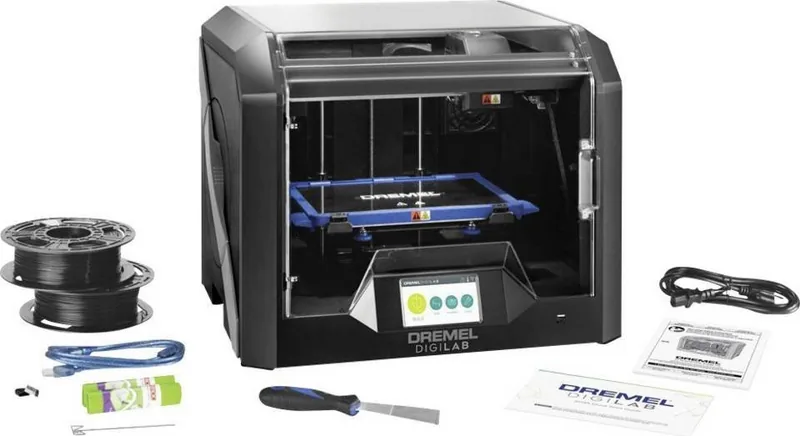
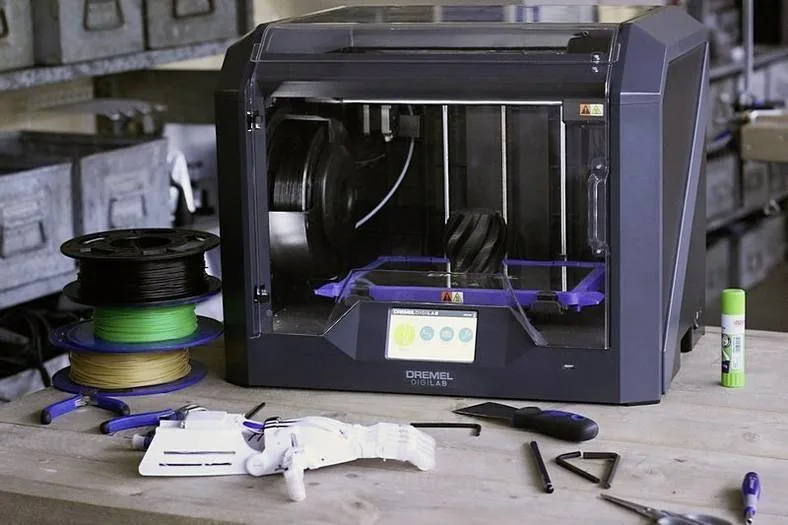
The Dremel 3D DigiLab 3D45 is a capable, enclosed 3D printer designed for makers, classrooms, and creative workspaces that value guided operation alongside practical print quality. Its single-extruder system supports Dremel 1.75 mm filament, including PLA, ECO-ABS, and nylon, allowing users to create prototypes, models, learning projects, and durable custom parts.
Built for Detailed, Controlled Printing
With a maximum build volume of 10 x 6 x 6.7 inches (255 x 155 x 170 mm), the 3D45 offers useful capacity for a wide range of objects without demanding an oversized workspace. It can print layers as fine as 50 microns, helping users pursue smoother surfaces and finer details when a project calls for precision. The extruder reaches up to 280 C, while the heated glass build platform reaches up to 100 C for materials that benefit from stable bed temperatures.
The enclosed design includes a front door, top lid, internal camera, and chamber fan. These features support observation and access while helping maintain a more consistent build environment. A filament runout sensor can pause a build when material is depleted, reducing the chance of wasting a long print because a spool unexpectedly runs out.
Simple Controls and Connected Workflow
A 4.5-inch full-color IPS touch screen puts common tasks within easy reach. Users can load or change filament, level the build platform, select models, review temperatures, pause a job, or stop it directly at the printer. Guided leveling uses a sensor and adjustment knobs, helping prepare the platform for dependable first-layer adhesion.
For flexible workflows, the Dremel 3D DigiLab 3D45 supports USB storage, direct computer connections, Ethernet, and Wi-Fi. Network features enable remote monitoring, print queues, status updates, and cloud-based workflows where available. The printer also includes 8 GB of internal storage, making it convenient to retain frequently used projects on the machine.
Practical Setup and Care
Reliable results depend on a level, clean build platform and a thin layer of the specified glue. Users should keep the printer on a flat, nonflammable surface in a dry, ventilated area with clear space around it. The printer should be monitored during operation, and the nozzle and platform must be allowed to cool before handling.
Notes
- Use approved Dremel filament and recommended temperature settings.
- Store filament dry at room temperature to protect print consistency.
- Keep the build platform clean, avoid scratches, and level it after reinstalling it.
- Update firmware through the network or a USB drive when updates are available.
Search for 67,706 Manuals online


Type-in Brand or Model
Edward James
4 months ago
Is the Dremel 3D45 easy to set up and does it produce good prints without extensive tuning?
Manual.ly
4 months ago
Yes. Reviews consistently describe it as a plug-and-play printer with straightforward operation and good to very good print quality, especially when using Dremel RFID-enabled filament profiles. Both Wi-Fi and Ethernet networking work reliably, although hidden Wi-Fi networks may not be selectable during setup. Its enclosed build chamber and filament recognition also make it a practical option for beginners and quick functional prototypes.