
Drawmer 1970 Manual
PDF manual · 12 Pages
English



Quick check
Incorrect answer, please try again.
Chat with your Drawmer 1970 manual using AI
Get instant AI answers from your Drawmer 1970 manual
Ask anything about the Drawmer 1970. Answers come from this manual, with the pages they are based on.
Ask a Question
Do you recommend 1970?
Yes NoFrequently Asked Questions
The Drawmer 1970 provides up to 66dB of gain on each microphone channel. This is achieved through a twelve-position switch that adds gain in precise 6dB steps, allowing users to easily replicate previous settings and maintain total control over input levels.
Is this answer helpful?
The Big mode reduces the side-chain sensitivity to low frequencies. This results in less gain reduction being applied to bass frequencies, effectively making the bass sound louder and bigger. It is particularly useful for buss compression where thick tones are desired alongside dynamic control.
Is this answer helpful?
Yes, the 1970 features comprehensive linking facilities that allow the signals from both channels to be combined. When linked, an average control voltage is created to apply the same degree of gain reduction to both channels, preventing image shifting caused by differing dynamics between left and right signals.
Is this answer helpful?
The Wet/Dry Mix knob creates a parallel compression effect by blending the uncompressed dry signal with the compressed wet signal. This allows the user to retain the natural punch and transients of the original sound while adding the density and glue of compression, all controlled by a single knob.
Is this answer helpful?
Yes, the unit features +48V Phantom Power for condenser microphones. This is selected via the Source rotary switch, and a red LED illuminates to indicate that the voltage is active. Users should only activate this setting when using microphones that specifically require it.
Is this answer helpful?
Activating the Bypass switch connects the input source directly to the output via a fully balanced hard-wire path. This completely removes the signal from the compressor FETs, mix controls, and gain stages, providing an ultra-clean signal path for A/B comparisons or when no compression is needed.
Is this answer helpful?
Advantages and Disadvantages
Advantages

- Ultra-clean preamps using THAT Corporation technology for transparent recordings
- Variable Wet/Dry Mix allows for easy parallel compression without external gear
- Switchable mic impedance settings enable creative tonal shaping and proper mic matching
- Big and Air modes preserve low-end weight and high-frequency detail during compression
- Fully balanced hard-wire bypass ensures zero coloration when bypassing the circuit
Disadvantages

- Side-chain insert points are unbalanced which may require specific cabling solutions
- Passive EQ controls interact with each other, potentially altering center points unexpectedly
- No active EQ section provided, relying solely on passive tone shaping
- Requires manual fuse replacement and voltage selector adjustment for different regions
- Rear panel connections can be complex for beginners unfamiliar with side-chain routing
Product Specification
Type
Compressor, Mic-Preamp
Channels
2
Format
19" Rack (2HE)
Product Description
The Drawmer 1970: A Modern Classic for Professional Audio
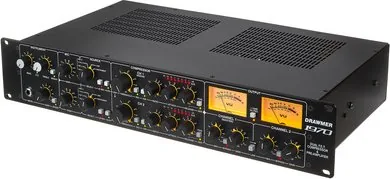
The Drawmer 1970 Dual FET Compressor and Pre-Amplifier stands as a testament to the evolution of professional audio equipment. Building upon the legendary heritage of the original Drawmer 1960, this unit expands on that foundation with a significantly enhanced feature set. It is designed to bring vintage audio characteristics into the modern studio at an affordable price point, making it one of the most adaptable mic preamplifier and compressor combinations available today.
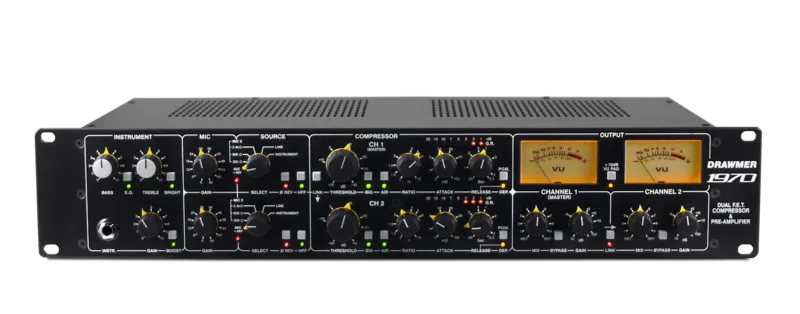
At the heart of the 1970 are two ultra-clean microphone preamplifiers powered by the latest THAT Corporation technology. These preamps deliver 66dB of gain with switchable mic impedance settings, ensuring accurate matching for any dynamic or condenser microphone. Whether you are tracking instruments via the dedicated DI input, recording vocals, or capturing guitar cabinets with multiple microphones, the 1970 provides the transparency needed for pristine recordings. The design philosophy prioritizes clean signal paths, allowing engineers to add warmth, saturation, or tube coloring later in the chain rather than being forced to commit to distortion at the source.
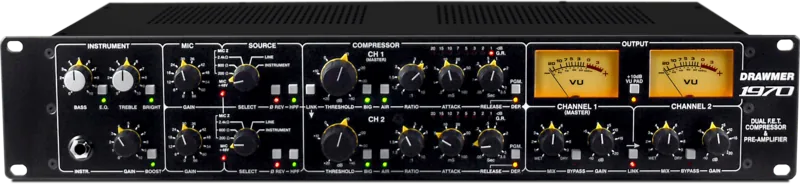
The control surface offers intuitive access to classic compression parameters like Threshold, Ratio, Attack, and Release, complemented by unique features such as Big and Air modes. The Big mode preserves deep lows during buss compression, while the Air mode re-introduces high frequencies lost during heavy processing, keeping cymbals vibrant and vocals open without harshness. A standout feature is the variable Wet/Dry Mix knob, which enables parallel compression directly on the unit without needing external mixing gear. This allows for effortless control over the perceived amount of compression while maintaining punch and dynamics.
Constructed with rugged steel chassis and an aluminum front panel, the 1970 is built to withstand the rigors of both studio and live environments. Designed and handmade in the UK, it includes internal low-hum toroidal power supplies and time-delay relays for clean power up and down sequences. From its backlit analog VU meters to its comprehensive linking facilities for stereo operation, every detail is crafted to provide complete and effortless control over your audio signal.
Search for 67,706 Manuals online


Type-in Brand or Model