
Drawmer 1968 MKII Manual
PDF manual · 10 Pages
English



Quick check
Incorrect answer, please try again.
Chat with your Drawmer 1968 MKII manual using AI
Get instant AI answers from your Drawmer 1968 MKII manual
Ask anything about the Drawmer 1968 MKII. Answers come from this manual, with the pages they are based on.
Ask a Question
Do you recommend 1968 MKII?
Yes NoVideo Manual
Drawmer 1969 | No Talking Demo
Frequently Asked Questions
The 1968 MkII combines a fast J-FET gain reduction circuit with a 12AX7 tube makeup stage to produce an open, transparent sound with tube warmth and controlled dynamics, suitable for stereo bussing, vocals and instruments.
Is this answer helpful?
BIG and BIGGER make the sidechain less sensitive to low-frequency energy, reducing low-frequency ducking and resulting in a firmer bottom end with enhanced sub-bass while still controlling harmonic content to avoid boominess.
Is this answer helpful?
Attack offers six switchable settings from 2 ms to 50 ms. Release has three fixed times (100 ms, 500 ms, 1 s) and three program-dependent modes that adapt between shorter and longer times to suit incoming material.
Is this answer helpful?
Yes — full sidechain access is provided via unbalanced stereo 1/4" jacks (ring = send, tip = return, sleeve = ground) and the S/C Listen mode lets you monitor the processed sidechain signal.
Is this answer helpful?
Yes — a stereo link function makes Channel 1 the master controller and applies the same gain reduction to both channels to preserve stereo image and prevent image shifting.
Is this answer helpful?
Use the supplied mains cable with earth connected, replace fuses only with specified IEC127-2 time-delay types, avoid tampering with the cable, provide ventilation for tube heat, and have qualified personnel perform voltage selection or internal fuse replacement.
Is this answer helpful?
Inputs are 20k ohm impedance with a nominal operating level of +4 dBu; outputs are 50 ohm with a maximum output level around +21 dBu, using balanced XLR connectors.
Is this answer helpful?
Advantages and Disadvantages
Advantages

- Transparent, open sound combining fast J-FET gain reduction with tube warmth from a 12AX7 makeup stage.
- Flexible timing: six attack settings and six release modes (including program-dependent options).
- Sidechain access and sidechain-listen for de-essing and frequency-conscious compression.
- BIG/BIGGER modes reduce low-frequency pumping while preserving a solid bass response.
- Professional I/O: balanced +4 dBu XLRs, true stereo link, and VU metering with +10 dB mode.
Disadvantages

- Tube circuitry generates heat — requires ventilation and careful rack placement.
- Internal fuse and voltage changes require opening the unit; not a user-level swap for novices.
- No dedicated ratio control (soft-knee design) may limit very specific compression curves.
- Sidechain is unbalanced, which can be less ideal in noisy environments without careful wiring.
- At heavier settings, makeup gain up to 20 dB may require careful gain staging to avoid clipping.
Product Specification
Type
Compressor
Channels
2
Format
19" Rack (1U)
Product Description
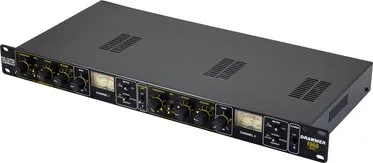
Drawmer 1968 MkII — Dual Channel Vacuum Tube Compressor
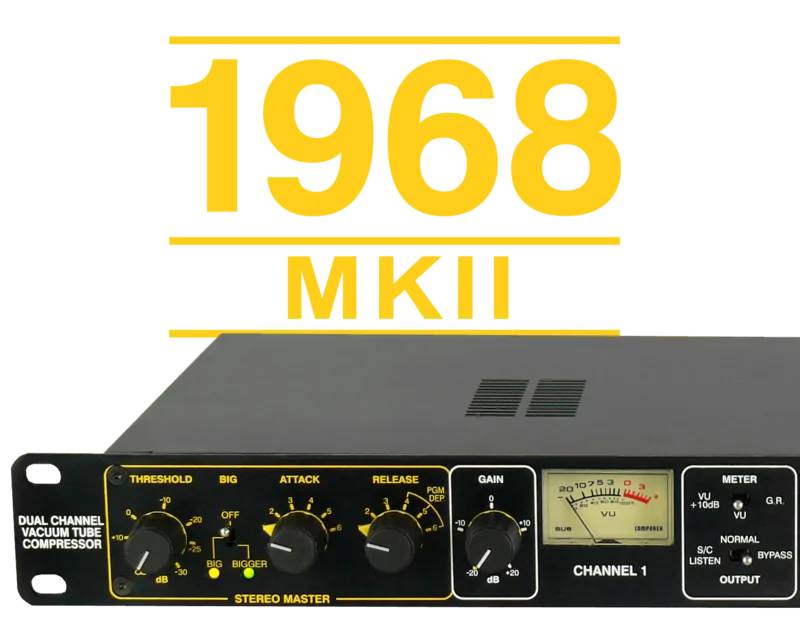
The Drawmer 1968 MkII is a 1U tube/FET dual-channel compressor designed to deliver an open, transparent sound while offering musical control over dynamics. Combining a fast J-FET gain reduction stage with a 12AX7 tube makeup amplifier, the unit provides up to 20 dB of output gain, soft-knee compression and flexible attack and release behavior suited to both program and instrument work. Its design emphasizes musicality: no ratio control is needed thanks to the soft-knee characteristic, while selectable "BIG" and "BIGGER" modes tame low-frequency pumping to preserve a solid, non-boomy low end.
Key features and operation
The 1968 MkII offers six attack times (2, 9, 15, 25, 30, 50 ms) and six release settings (three fixed and three program-dependent), giving precise control from tight transients to long program-dependent smoothing. Extensive sidechain access allows external EQ insertion for vocal shaping or de-essing, and a sidechain-listen mode lets you audition processing in isolation. A three-position VU meter switch displays output level, gain reduction or a +10 dB scaled VU mode for hot signal workflows; meters include a red warning for approaching clipping.
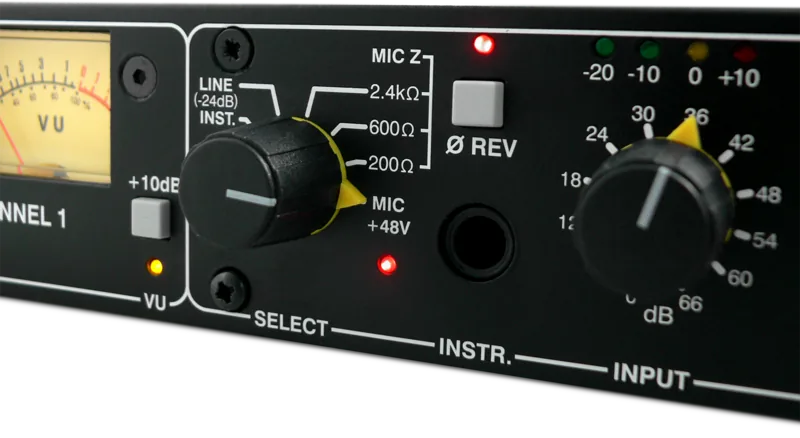
Connectivity is professional-grade: balanced XLR inputs/outputs operating at +4 dBu, unbalanced sidechain jacks wired on stereo 1/4" connectors, and a stereo-link option for true dual-channel or linked stereo operation. Rack-mountable at 1U, the unit requires sensible ventilation due to tube heat and includes safety and fuse-change procedures for voltage conversion between 115 V and 230 V.
Practical uses
The 1968 MkII excels on stereo bus compression, vocal levelling, and instrument tracking where warmth and transparency are required. The tube makeup stage adds harmonic richness and fullness while the FET-based gain reduction delivers fast, controlled dynamics. The BIG/BIGGER options make it especially useful for mixes with strong low-frequency content, allowing heavier compression without pumping.
Notes
- Use balanced connections and proper grounding to minimize interference and ground loops.
- Keep ventilation above the unit and avoid mounting over heat-generating gear.
- Fuse replacements and voltage-selector changes should be performed by a competent person.
Search for 67,706 Manuals online


Type-in Brand or Model