

Drawmer 1960 Manual
PDF manual · 13 Pages
English



Quick check
Incorrect answer, please try again.
Chat with your Drawmer 1960 manual using AI
Get instant AI answers from your Drawmer 1960 manual
Ask anything about the Drawmer 1960. Answers come from this manual, with the pages they are based on.
Ask a Question
Do you recommend 1960?
Yes NoFrequently Asked Questions
The 1960 offers balanced XLR Line and Mic inputs (one mic position with +48V phantom), plus a front-panel Aux input optimized for instruments and keyboards with passive Bass and Treble controls and a Bright switch.
Is this answer helpful?
Stereo Link averages the left and right compressor control settings so both channels apply the same degree of gain reduction, preventing image shifting when processing stereo signals. Use it when compressing stereo mixes or stereo sources to maintain stable imaging.
Is this answer helpful?
Attack has three switchable settings: Fast, Medium and Slow. Release offers four fixed times (400 ms, 1 s, 2 s, 4 s) plus two program-dependent modes that adapt from 200 ms to 20 s or 400 ms to 2 s, providing flexible behaviour for different material.
Is this answer helpful?
Yes. The side-chain access is part of the compressor feedback stage and can be patched to insert external EQ or processing for frequency-conscious compression and de-essing. S/C Listen lets you monitor the side-chain signal.
Is this answer helpful?
Because it uses vacuum tubes, allow ventilation and avoid mounting near heat sources. Use the supplied mains cable, fit correct fuses when changing mains voltage, and refer servicing to qualified technicians to avoid voiding the warranty.
Is this answer helpful?
The mic preamp offers 0–60 dB of gain. Measured mic input noise is very low (example spec: -128.5 dB at +60 dB gain), making it suitable for quiet sources and high-gain applications.
Is this answer helpful?
Inputs and outputs are electronically balanced XLRs wired pin 1 screen, pin 2 hot, pin 3 cold. Nominal operating level is +4 dBu and the maximum output level is +22 dBm (balanced).
Is this answer helpful?
Advantages and Disadvantages
Advantages

- Hybrid tube/solid-state design delivers warm tube coloration with reliable solid-state control.
- Mic preamp provides up to 60 dB gain and very low noise, suitable for quiet sources.
- Aux input with passive Bass/Treble and Bright switch enables guitar-like tonal shaping and overdrive.
- Stereo Link and side-chain access support coherent stereo compression and frequency-dependent processing.
- Comprehensive release options including program-dependent settings adapt to varied material.
Disadvantages

- Tube circuitry generates heat; requires rack ventilation and careful placement.
- No dedicated ratio control; relies on Soft Knee behavior which may limit precision for some users.
- Tube components and servicing may incur higher maintenance costs and require qualified technicians.
- Side-chain and insert jacks are unbalanced, which may complicate some patchbay routings.
- Changing mains voltage requires manual fuse and switch adjustments, adding setup steps.
Product Specification
Type
Compressor, Limiter
Channels
2
Format
19" Rack (2U)
Product Description
Drawmer 1960 Vacuum Tube Compressor
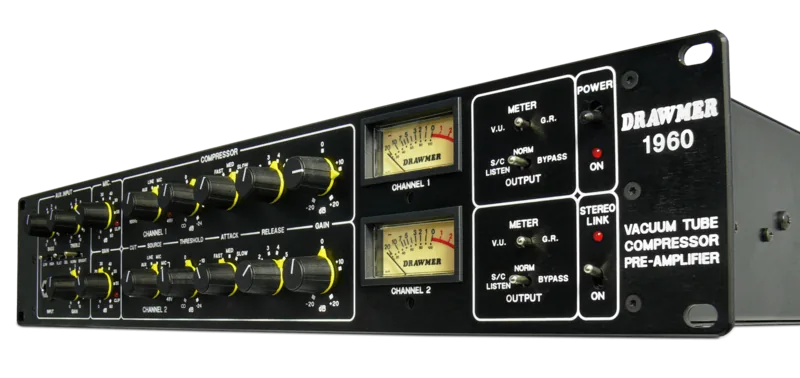
The Drawmer 1960 is a hybrid dual-channel vacuum tube compressor designed for studio, live, location recording and musician rack use. Combining tube preamplification with solid-state circuitry, it delivers warm tube character alongside precise dynamics control. Mic inputs offer up to 60 dB of gain and low noise performance, while a dedicated auxiliary input accommodates instruments and keyboards with guitar-style passive Bass and Treble EQ. The front-panel Aux stage includes a Bright switch to emphasize presence around 2 kHz and a low/high gain selector for level matching or overdrive tones.
Key Features and Operation
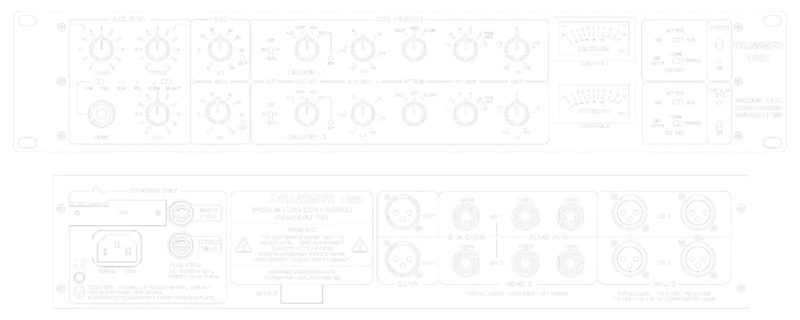
The unit provides balanced XLR inputs/outputs, side-chain access for external EQ or de-essing, and stereo-linking to maintain imaging when processing stereo mixes. Compressor controls are straightforward: Source Select (Line, Mic, Aux with phantom on one mic position), switchable High-pass (50/100/Off), Threshold, Attack (Fast/Medium/Slow), and Release with four fixed times plus two program-dependent options for adaptive behavior. Its Soft Knee compression eliminates a dedicated ratio control and yields musical, progressive gain reduction. A VU meter can display either output level or gain reduction, and a S/C Listen mode routes the side-chain to the output for monitoring.
The microphone preamp offers fine gain control and clip indication; the Aux input’s tone-shaping and gain structure make it ideal for instrument processing, including creative tube overdrive. Installation is rack-standard (2U), with guidance to allow ventilation due to tube heat. The 1960 meets EMC standards when properly grounded and recommends balanced operation to minimize hum and noise. Power selection and fuse procedures are documented for safe voltage changes.
Practical Use
Typical workflows include tracking stereo mixes, feeding DAT/location recorders with built-in mic preamps and compression, and using the Aux input for guitar or keyboard processing where EQ and compression are applied before the recorder or mixing console. Stereo Link mode ensures coherent L/R compression, while side-chain insert points enable frequency-dependent compression techniques.
Notes:
- Provides warm tube coloration with low-noise mic gain up to 60 dB.
- Side-chain and insert points allow flexible routing for de-essing or external processing.
- Requires ventilation due to tube heat and correct fuse rating when changing mains voltage.
Search for 67,706 Manuals online


Type-in Brand or Model