
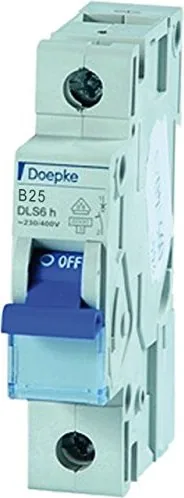
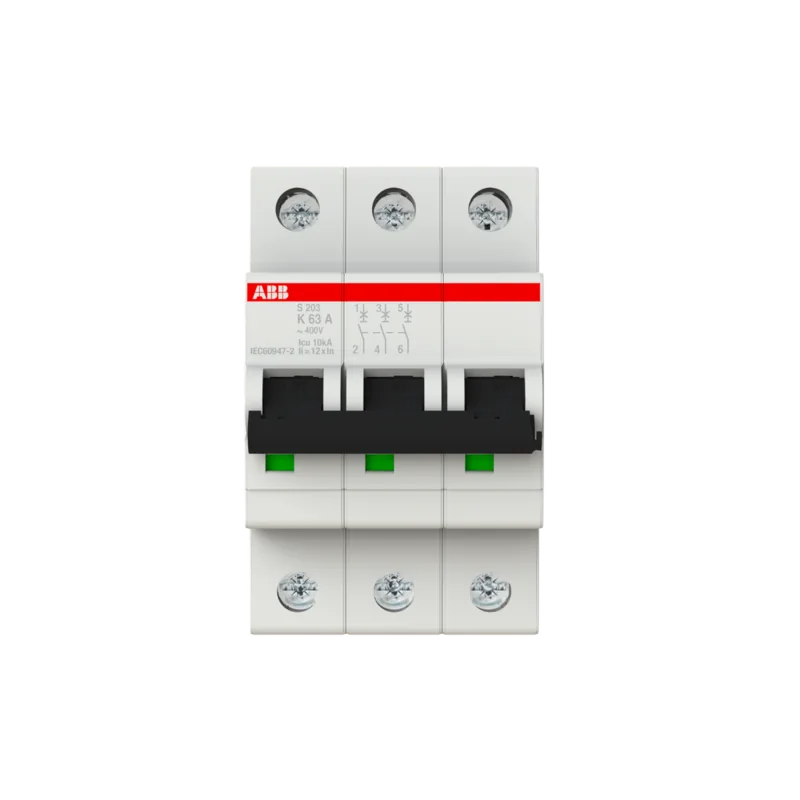
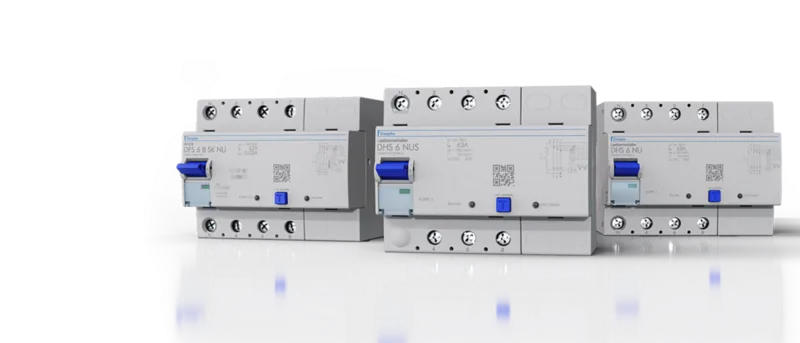
Doepke DLS 6h B25-1 Manual
PDF manual · 5 Pages
English



Quick check
Incorrect answer, please try again.
Chat with your Doepke DLS 6h B25-1 manual using AI
Get instant AI answers from your Doepke DLS 6h B25-1 manual
Ask anything about the Doepke DLS 6h B25-1. Answers come from this manual, with the pages they are based on.
Ask a Question
Do you recommend DLS 6h B25-1?
Yes NoFrequently Asked Questions
The Doepke DLS 6h B25-1 combines residual-current detection and overcurrent protection in one unit, protecting circuits from earth-faults, short circuits, and overloads while providing B-characteristic tripping at a 25 A nominal rating.
Is this answer helpful?
All installation and service work must be performed by qualified electricians or persons trained in electrical engineering to ensure correct wiring, compliance with torque and conductor specifications, and safe operation.
Is this answer helpful?
Use the built-in test button on the device to simulate an earth-fault and verify the breaker trips. Regular manual testing is recommended per local regulations to confirm the residual-current mechanism remains operational.
Is this answer helpful?
The B25 trip curve is suitable for general-purpose circuits such as lighting, socket outlets, and household appliances where moderate inrush currents occur; it offers good selectivity for typical residential and light commercial loads.
Is this answer helpful?
No. The DLS 6h B25-1 is intended for residential and light commercial use with a 25 A rating. High-current or specialized industrial circuits typically require devices with higher ratings and specific characteristics for coordination.
Is this answer helpful?
Confirm conductor cross-sections, terminal torque values, DIN-rail mounting space, and compatibility with upstream protection. Also ensure accessibility for periodic testing and compliance with local electrical codes.
Is this answer helpful?
Yes. Besides periodic functional testing via the test button, inspect for secure terminals and signs of wear. Regular checks help ensure reliable residual-current protection and safe long-term operation.
Is this answer helpful?
Advantages and Disadvantages
Advantages

- Integrated RCD and MCB protection in a single compact module saves panel space and simplifies wiring.
- B25 trip characteristic balances protection and selectivity for general-purpose circuits with moderate inrush.
- Built-in test button enables simple periodic verification of residual-current function without removal.
- Clear terminal labeling and DIN-rail format allow quick installation and tidy distribution board layout.
- Multilingual safety instructions support correct handling across different regions and installers.
Disadvantages

- Requires qualified electrician for installation, limiting DIY use.
- Single-module design may not suit high-current or specialized industrial circuits.
- May need coordination with upstream protection to avoid selectivity issues in complex systems.
- Fixed rating (25 A) lacks on-the-fly adjustability for circuits needing different nominal currents.
- Periodic manual testing is required; passive devices cannot guarantee continuous verification without maintenance.
Product Specification
Type
AC
Poles
1
Rated voltage
400V
Rated current
25A
Tripping characteristic
B
Rated breaking capacity
6kA
Energy limitation class
3
Width
0.71 in
Module units
1
Product Description
Doepke Circuit Breaker DLS 6h B25-1 Manual
The Doepke Circuit Breaker DLS 6h B25-1 is a robust residual-current circuit breaker with overcurrent protection (RCBO) designed for residential and light commercial installations. Combining sensitive residual-current detection with reliable short-circuit and overload protection, this unit offers compact, all-in-one safety for individual circuits. Its B25 trip characteristic provides good selectivity for general-purpose circuits such as lighting, sockets, and household appliances while limiting nuisance tripping from harmless inrush currents.
Compact and ergonomic, the DLS 6h model fits standard DIN-rail panels and supports clear terminal labeling for quick wiring. The device supports conductors within typical cross-sections and torque specifications, ensuring secure connections. Built-in test capability allows periodic verification of the residual-current function without removing the device, simplifying maintenance and compliance with safety routines.
Key features include high-sensitivity fault detection, coordinated thermal-magnetic tripping with B-characteristics at 25 A nominal rating, and a design intended for easy installation by qualified electricians. The unit emphasizes safety by requiring installation and service by trained personnel and includes multilingual safety instructions to ensure correct handling across markets.
Performance-focused yet user-friendly, the DLS 6h B25-1 is suitable where reliable protection for single circuits is needed without using separate RCD and MCB devices. Its construction and labeled terminations allow tidy panel layouts and straightforward commissioning. The product’s mechanical operation and manual test button permit quick in-situ checks, and the product’s compactness leaves space for additional devices in distribution boards.
Suitable applications include household branch circuits, small commercial outlets, and service circuits where both earth-fault protection and overcurrent protection are required in a single module. Its trip curve and rating make it a versatile option for mixed loads while maintaining coordination with upstream protection when selected appropriately.
Notes:
- Installation and all electrical work must be performed by qualified electricians or trained personnel.
- Regular testing using the built-in test button is recommended to ensure ongoing residual-current protection.
- Verify conductor sizes and torque values before installation to ensure safe and compliant connections.
Search for 67,706 Manuals online


Type-in Brand or Model