
Doepfer A-113 Manual
PDF manual · 14 Pages
English



Quick check
Incorrect answer, please try again.
Chat with your Doepfer A-113 manual using AI
Get instant AI answers from your Doepfer A-113 manual
Ask anything about the Doepfer A-113. Answers come from this manual, with the pages they are based on.
Ask a Question
Do you recommend A-113?
Yes NoFrequently Asked Questions
The A-113 works best with rectangular wave signals from a Voltage Controlled Oscillator. These signals provide the clearest frequency division for generating subharmonics effectively.
Is this answer helpful?
The module supports the storage of fifty distinct presets. This allows users to save complex configurations and recall them instantly without loss of data during operation.
Is this answer helpful?
It uses standard 10-pin Eurorack power for control but requires an additional plus five volt supply with one hundred milliamps power for operation, often needing an external adapter.
Is this answer helpful?
Four different mixtures are selected using gate signals on two foot controller inputs. Users can send appropriate voltage pulses to switch between the available combination settings.
Is this answer helpful?
The Mix Out jack provides the summed signal of all four frequency dividers. The contribution of each subharmonic to this sum is determined by the level knobs for each output channel.
Is this answer helpful?
Yes, four dedicated level knobs control the contribution of each subharmonic to the mixed sum. This allows for precise balancing of the individual frequency divider signals.
Is this answer helpful?
Detailed patch examples and schematic diagrams are often available on the manufacturer website or within the official product documentation for advanced users to reference.
Is this answer helpful?
Advantages and Disadvantages
Advantages

- Four independent subharmonic outputs with independent level control allow for deep and nuanced sound shaping.
- Fifty internal presets ensure that complex settings can be saved and recalled instantly during live performance.
- Two foot controller inputs enable dynamic mixture switching for expressive and real-time control flexibility.
- Seven-segment displays provide clear visual feedback on divisor values and the currently active mixture status.
- Outputs generate sawtooth waveforms which possess a full spectrum of harmonics for rich and complex timbres.
Disadvantages

- Requires a separate plus five volt power supply which must be sourced externally by the user.
- Limited to four frequency dividers which may restrict the complexity of polynomial synthesis structures.
- Does not include a built-in power supply connector requiring the purchase of an additional adapter.
- Mixture selection relies on specific gate signal levels which may require additional routing and cable management.
- Output waveforms are sawtooth rather than sine waves which may limit some specific sonic applications.
Product Specification
Type
Synthesizer Module
Keys
No
Sound Generation
Analog
Polyphony
1-voice
Controller
Knob
Speaker
No
Display
No
Audio Ports
5x Line Out (0.25 inch jack)
Additional Ports
2x Footswitch
Product Description
Deepening Your Synthesis with the Doepfer A-113 Subharmonic Generator
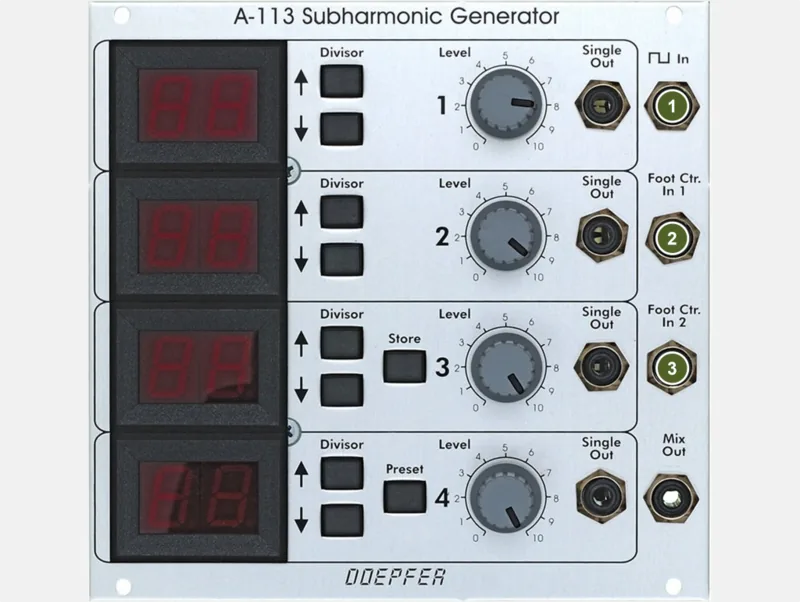
The Doepfer A-113 Subharmonic Generator stands as a unique and powerful addition to any modular synthesizer system seeking to expand its sonic palette. Unlike standard oscillators that emphasize harmonic overtones, this unit focuses on subharmonics. By dividing the frequency of an incoming input signal, it generates tones that sit an octave or more below the source pitch. This process mimics the inner workings of the legendary Mixtur-Trautonium synthesizer from the 1930s, offering a bridge between vintage technology and modern digital precision within the A-100 rack space. Settings in the Doepfer A-113 Subharmonic Generator Manual guide the mixer levels.
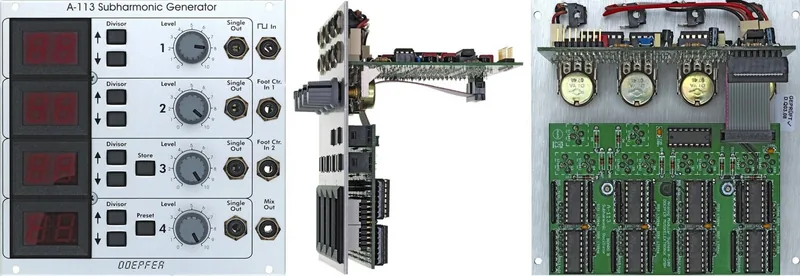
At the heart of the A-113 are four independent frequency dividers. Each divider accepts an integer divisor value ranging from one to twenty-four. Users can set these values using dedicated on-board buttons, with the current setting clearly visible on individual seven-segment displays. Four separate outputs deliver the individual subharmonic signals as sawtooth waves. Since sawtooth waves inherently contain a full spectrum of harmonics, each subharmonic output carries a rich, complex timbre right out of the box. Additionally, a mixed output sums all four signals in proportions controlled by four dedicated level knobs.
Control flexibility is central to the design. Users can select from four different mixtures using gate signals on two foot controller inputs. This allows for dynamic switching during performance without manual intervention. A robust storage feature supports fifty presets, ensuring that complex settings can be saved and recalled instantly. This makes the module suitable for both experimental soundscapes and structured compositions on stage. The display system also offers visual feedback regarding the active Mixtur selection through decimal point indicators, ensuring clarity during live adjustments.
Sound design possibilities are vast. The subharmonics can be processed individually or collectively. One might route a single subharmonic into a filter for deep drone work, or combine them to create chordal structures. The resulting sound is often described as metallic, hollow, or organ-like. This distinct character adds weight and darkness to otherwise bright synthesizer signals. It creates a mirrored version of the harmonic series, offering a specific minor chord character compared to the major character of standard harmonics.
Power requirements are specific to this unit. It requires an additional plus five volt power supply of one hundred milliamps, often provided by a dedicated adapter. Remember to monitor power consumption when adding multiple units to your system. Experimentation with patching these outputs through filters, ring modulators, or vocoders yields infinite possibilities for unique textures and evolving pads suitable for electronic music production.
Notes
Remember to monitor power consumption when adding multiple units to your system. The subharmonic series creates a mirrored version of the harmonic series, offering a specific minor chord character compared to the major character of standard harmonics. Experimentation with patching these outputs through filters, ring modulators, or vocoders yields infinite possibilities for unique textures and evolving pads suitable for electronic music production.
Search for 67,732 Manuals online


Type-in Brand or Model