
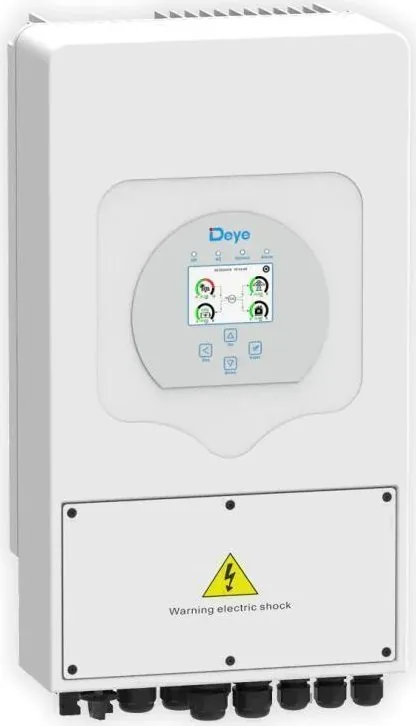
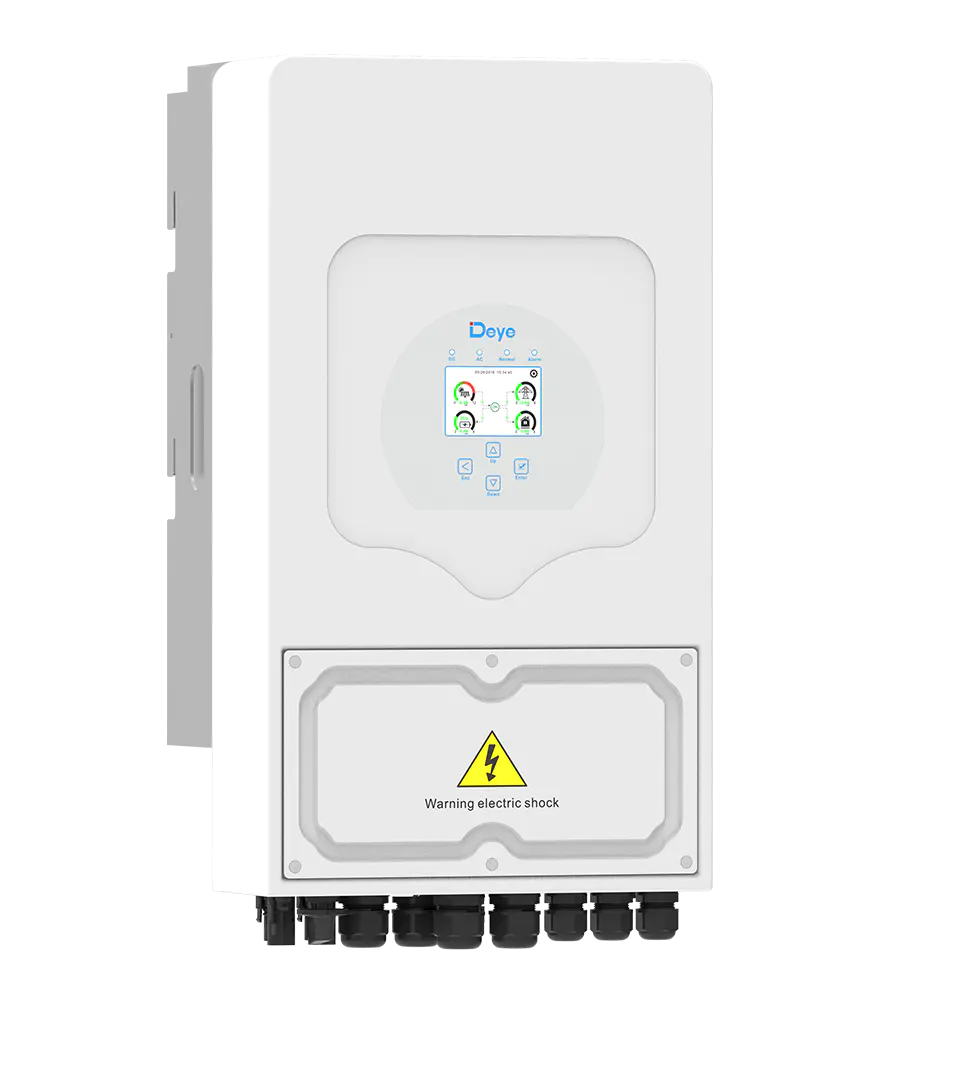
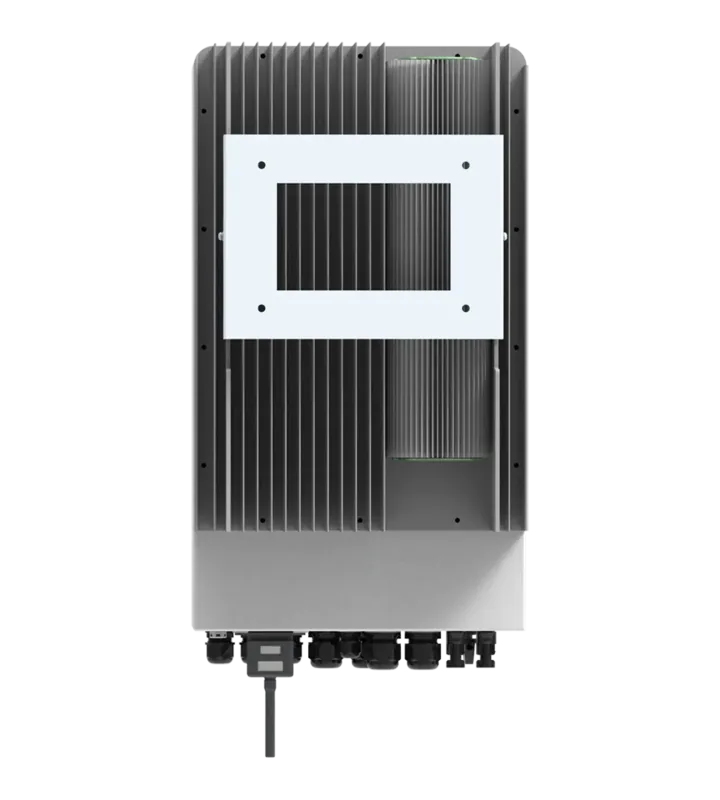
Deye SUN-3.6K-SG03LP1-EU Manual
PDF manual · 51 Pages
English



Quick check
Incorrect answer, please try again.
Chat with your Deye SUN-3.6K-SG03LP1-EU manual using AI
Get instant AI answers from your Deye SUN-3.6K-SG03LP1-EU manual
Ask anything about the Deye SUN-3.6K-SG03LP1-EU. Answers come from this manual, with the pages they are based on.
Ask a Question
Do you recommend SUN-3.6K-SG03LP1-EU?
Yes NoFrequently Asked Questions
The inverter supports lead‑acid and lithium battery chemistries with configurable charge/discharge parameters. PV and battery ranges must match the device’s MPPT and DC input limits (typical PV MPPT range 125–500 V, check the data sheet for battery voltage and current limits).
Is this answer helpful?
Install the CT with the arrow pointing toward the inverter as instructed; ensure CT secondary wiring and meter RS485 configuration are correct. If load readings are incorrect, reverse the CT orientation and confirm DIP/RJ45 communication settings.
Is this answer helpful?
Yes — it supports backup-load output and configurable backup delay settings. Proper wiring of the backup-load and AC breakers is required; observe the rated backup output (AC breaker/amp ratings) and commissioning steps to enable off‑grid supply.
Is this answer helpful?
The unit integrates multiple protections (over/under voltage, over/under frequency, short‑circuit, anti‑islanding, surge/lighting protection and market-specific arc‑fault detection). It complies with various international standards (IEC, CEI, VDE and regional grid codes); refer to the manual for the exact list per model and firmware.
Is this answer helpful?
Select PV modules so Voc doesn’t exceed inverter max Voc and ensure Voc at cold temperature remains within MPPT range. The manual specifies max DC input power, MPPT voltage window and max strings per MPPT—follow those values and IEC 61730 safety guidance.
Is this answer helpful?
The inverter supports RS485 (Modbus), CAN/BMS interfaces, Wi‑Fi for cloud services (via data logger) and CT metering. RJ45 pinouts and RS232/Wi‑Fi logger details are provided in the manual for system integration.
Is this answer helpful?
Consult the fault code table in the manual for suggested checks (battery voltage, AC connections, CT wiring, temperature). Perform recommended resets or power cycles; if the issue persists, gather logs and contact the manufacturer or authorized service center with the inverter ID and alarm codes.
Is this answer helpful?
Advantages and Disadvantages
Advantages

- Hybrid inverter: integrates PV, battery and grid with multiple working modes for flexible energy management.
- Comprehensive protections: over/under voltage, over/under frequency, anti-islanding, arc-fault (market dependent).
- BMS and communications: RS485/BMS/CAN, Wi‑Fi support and CT-based metering for accurate monitoring.
- Configurable battery support: Li-ion and lead‑acid charge profiles, external temperature sensor and BMS auto-adjust.
- Detailed local UI: LCD screens with energy graphs, fault codes and setup menus simplify commissioning and diagnostics.
Disadvantages

- Complex installation: requires careful wiring, grounding, correct CT orientation and adherence to local codes.
- Feature variability: some advanced features (arc-fault, smart load behaviors) depend on firmware/region availability.
- Derating in some regions: power and PV input limits may be reduced (e.g., Germany) compared to nominal ratings.
- Warranty exclusions: damage from improper installation, modification or natural events is not covered.
- Requires professional setup for parallel systems and generator integration to avoid configuration errors.
Product Specification
Note
Prices include partial 0%-VAT tax rates for AT and DE
Type
Hybrid inverter, with fan, off-grid capable
Input voltage
125-500V Direct current (DC)
Max. input current
13A
MPP voltage range
150-425V Direct current (DC)
Number of MPP trackers
2
Max. PV generator power
4.68kWp
Output power
3.6kW
Output phases
1-phase
Efficiency
97.6% max., 96.5% ηEU
Input
MC4
Interfaces
RS-485
Noise level
<30dB
Protection class
IP65
Ambient temperature
-40F to +140F
Dimensions
12.99x22.83x9.13in (WxHxD)
Weight
45.19kg
Product Description
Deye SUN-3.6K-SG03LP1-EU Manual — Product Overview
The Deye SUN-3.6K-SG03LP1-EU is a hybrid single-phase inverter engineered for residential and small commercial solar-plus-storage systems. Combining PV MPPT inputs, battery charging and AC-coupled grid interaction, it supports seamless energy management: solar generation, battery charge/discharge, grid import/export and backup loads. The unit integrates communication (RS485/BMS/CAN), CT-based metering, Wi‑Fi connectivity and advanced setup menus for system configuration and safety compliance.
Key features and function
This inverter offers multiple MPPT trackers, high-efficiency conversion, integrated anti-islanding detection and protections (over/under voltage, over/under frequency, DC/AC overcurrent, arc-fault detection for selected markets). It supports lithium and lead-acid batteries with configurable charge/discharge profiles, BMS communication and external battery temperature sensing. The device can be wall-mounted, includes PV input lightning protection and provides detailed LCD screens for real-time power, SOC, voltages, currents and historical energy graphs.
Installation and wiring
Installation guidance covers AC grid, generator, backup-load wiring, PV string selection per MPPT, DC breaker sizing, CT placement for load metering and grounding requirements. The manual emphasizes selecting correct cable sizing, secure terminal torque, compliance with local electrical codes and commissioning steps including DIP switch settings for parallel systems, RS485 addressing and CT orientation for accurate measurement.
Operation and modes
The SUN-3.6K supports multiple working modes: grid-following, battery-first, load-first, smart-load output and generator-assisted charging. Advanced scheduling (“usage time”) and export-limiting (zero-export) features let users shape when the inverter charges/discharges or sells power to the grid. Firmware-dependent options include arc-fault monitoring, automatic restart, and configurable protections and thresholds.
Monitoring and diagnostics
An intuitive LCD provides main-screen summaries, solar/load/grid curves, battery/BMS pages and alarm listings. Built-in fault codes help diagnose issues like BMS communication failures, AC/DC anomalies, high heatsink temperature or CT/metering errors. The manual details self-test routines, CEI/IEC compliance tests and recommended corrective steps.
Safety, compliance and maintenance
The product adheres to multiple international standards (IEC, CEI, VDE and others depending on region). The manual stresses mandatory earthing, ventilation clearance, professional installation, and lists warranty exclusions (misuse, unauthorized repair, natural disasters). Regular inspection and following commissioning checklists preserve performance and safety.
Notes
- Verify PV Voc and MPPT voltage range before array connection.
- Observe correct CT arrow orientation for accurate load display.
- Use the recommended cable sizes and torque values; follow local regulations.
- Obtain the latest firmware and manual from the manufacturer for new features and fixes.
Search for 67,706 Manuals online


Type-in Brand or Model