Manual.ly Logo

Dennerle CO2 Long-term Test Correct + pH Manual

0.0 · 0 Ratings

PDF manual · 7 Pages

English

M: OA-GPT-54-NAN
page

/ 7

Loading...
a78cc3a6a66b08aa2102e37a98e8c48365eb page 4
6 7
Profi-Line
CO
2
long-term test Correct
For the continuous, exact control of CO
2
content in the aquarium.
- Instructions for use: Please read carefully and keep in a safe place. -
Congratulations on buying this high-quality CO
2
long-term test from DENNERLE. If used properly and treated with due care, this test will provide a simple,
convenient and precise means of monitoring the CO
2
content in your aquarium water - the essential basis for magnificent plant growth.
DENERLE wishes you lasting enjoyment from your aquarium!
How the CO
2
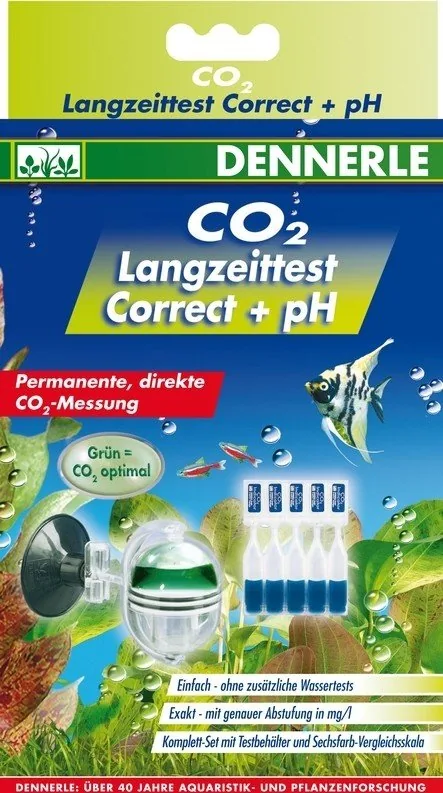
long-term test Correct works
The CO
2
from the aquarium water diffuses through the bottom openings of
the test container into the reaction chamber. Here it dissolves in the speci-
al CO
2
indicator. After a short time, the CO
2
content in the special indicator
corresponds precisely to that in the aquarium water (state of equilibrium).
The colouring of the special CO
2
indicator varies according to the CO
2
con-
tent: from • blue = not enough CO
2
through • green = ideal CO
2
content
to • yellow = too much CO
2
. The level of CO
2
in the aquarium can be read
directly from the colour matching scale.
The special advantages
of the CO
2
long-term test Correct
Conventional long-term CO
2
tests are filled with a mixture of aquarium
water and “drop indicator”. In contrast, the CO
2
long-term test Correct
employs a high-purity, ready-to-use “ampoule indicator” which has been
developed especially by DENNERLE.
This offers the following key advantages:
• Simplicity
No additional measurement of carbonate hardness is
necessary. Only a single colour matching scale is required.
• Safety:
The CO
2
long-term test Correct indicates the correct CO
2
content at all times - irrespective of any other acids in the
aquarium-water, e.g. humic acids. The test also remains
unaffected by any changes in carbonate hardness resulting
from an increase in water hardness, evaporation or a
change of water.
• Accuracy:
The CO
2
long-term test Correct enables direct determination
of the CO
2
content in milligrams per litre – avoiding the
need for additional water measurements and the laborious
practice of converting values in tables. The test is equally
efficient at low carbonate hardness levels!
What‘s what
Filling and using the
CO
2
long-term test Correct
1. Remove test container from clasp.
Pull off top part of test container.
2. Take an ampoule of special CO
2
indi-
cator and ensure that there is no indi
-
cator in the neck of the ampoule! For
this purpose, shake the indicator
down to the bottom of the ampoule
(in the same manner as a thermome-
ter is shaken before taking someone‘s
temperature). Open ampoule by twi-
sting off the sealing tab.
3. Drip the entire contents of the ampou-
le into the top part of the test contai-
ner.
4. Slot bottom part of housing including
conical reflector into the top part.
Check that the O-rings are fitted cor-
rectly!
5. Turn test container carefully and insert
container in clasp.
6. Use the suction clip to secure the CO
2
long-term test in an upright position at
a clearly visible point in the aquarium
where a gentle flow of water prevails.
Stick the colour matching scale to the
outside of the front pane.
Please note:
As the CO
2
takes some time to diffuse into the indicator, the
colouring of the indicator always responds to changes in the CO
2
content
after a delay of several hours. Y
ou should therefore always increase the sup-
ply of CO
2
in small steps spread over several days until the ideal CO
2
con-
tent is attained.
The right amount of CO
2
For magnificent plant growth, DENNERLE recommends a CO
2
level in the
aquarium of between 15 and 30 mg/l, whereby 20 to 25 mg/l is
ideal. The number of bubbles per minute required to achieve this level of
CO
2
depends on a broad range of factors (types of plants in the aquarium,
motion of the water, surface area/volume ratio, etc.). The appropriate CO
2
supply level thus requires to be determined individually for the specific aqua-
rium concerned.
Rule of thumb for the basic setting: Begin at approx. 10 bubbles per minu
-
te per 100 l of aquarium water, i.e. 2 x 10 = 20 bubbles per minute for a
200 l aquarium. Check the CO
2
supply and the CO
2
content level in the
aquarium water regularly, adjusting the CO
2
supply rate as necessary.
Please note: The more vigorously the surface of the water is set in motion
(e.g. by filters, additional aeration), the more CO
2
will be expelled from the
aquarium again.
Use as a long-term pH test
The pH value in an aquarium is determined primarily by the carbonate
hardness and the level of CO
2
, some of which forms carbonic acid when it
dissolves in the water. Provided that there are no other substances in the
water which will have a substantial influence on the pH level (e.g. major
quantities of humic acids or nitrate, pH plus / pH minus preparations), the
DENNERLE CO
2
long term test can also be used to monitor the pH value in
the aquarium. For this purpose, you must:
Sales: DENNERLE GmbH, D-66957 Vinningen
Customer services: DENNERLE GmbH, D-66981 Münchweiler
www.dennerle.de
GB
Bottom part of test container
Top part of test container
Conical reflector
O-ring
Clasp
Mounting bracket
Longlife suction clip
Special CO
2
indicator
Colour matching scale
• Measure the carbonate hardness of
the aquarium water (tests available
from specialist retailers).
• Stick an appropriate colour matching
scale to the outside of the front pane.
The pH value of the aquarium water can
now be read directly from the colour scale.
Professional tips from DENNERLE:
• Protect your valuable pressure reducer from corrosion caused by back-
flowing water at all times! For this purpose, use only check valves
designed for use with CO
2
, such as the special CO
2
check valve
from DENNERLE. Standard air check valves may become brittle
through contact with CO
2
within only a short space of time, resulting
in leaks. This usually goes unnoticed.
• Large quantities of valuable CO
2
may be lost every day through lea-
king CO
2
hoses. We thus recommend the special Softflex CO
2
hose from DENNERLE.
• Even when using CO
2
diffusors with integrated bubble counter it is
expedient to install an additional bubble counter near the pressure
reducer, as this provides a simpler, faster and more accurate means
of setting the number of bubbles. The DENNERLE CO
2
bubble
counter Exact offers the ultimate in user-friendly reading coupled
with exceptional precision: The CO
2
bubbles produced by the CO
2
bub-
ble counter Exact have a mean weight of 0.125 mg and a volume of
0.063 ml. 10 bubbles per minute thus correspond to a CO
2
supply of
1.8 g or 0.9 litres per day.
Special information
• Keep CO
2
long-term test and indicator away from children!
• The sprecial CO
2
indicator is harmless and does not contain any chemical sol-
vents. Prolonged skin contact and eye contact should nevertheless be avoi-
ded.
• The indicator may cause stains. Contact with clothing, carpets, wood or simi-
lar should thus be avoided.
• Any indicator which may be dropped into the aquarium water by mistake is
harmless for all fish, plants and any other creatures living in the aquarium.
• The ampoule is filled with special CO
2
indicator under a protective atmosphe-
re. The filling level may vary for technical reasons.
• Protect the special CO
2
indicator from sunshine, heat and frost. Always keep
ampoules protected from light during storage.
Spare parts and useful accessories
(available from specialist retailers)
3041 Special CO
2
indicator, 5 ampoules
3042 2 Longlife suction clips, black
3060 Special CO
2
Softflex hose, 2 m
3053 Special CO
2
check valve
3050 CO
2
bubble counter Exact
For further information on the range of aquarium plants and accessories
from DENNERLE, consult your dealer or check out DENNERLE‘s free profes-
sional tips!
DENNERLE professional tips are available from your dealer and
on the internet at www.dennerle.de!
Measure the carbonate hardness regularly and always use an appropriate
colour scale.
Replacing the special CO
2
indicator
Like most colouring agents, the special CO
2
indicator is subject to ageing as
a result of photochemical processes.
In order to guarantee the quickest and most exact colour response
at all
times, we thus recommend filling the test container with fresh special CO
2
indicator every 4 weeks.
For this purpose, open the test container and pour the old indicator down
the drain. Rinse test container with tap water and dr
y with a kitchen cloth
or similar before refilling.
Cleaning the CO
2
long-term test Correct
Use warm water and a soft sponge. Do not use any cleaning agents!
The test container can be dismantled for cleaning. If necessary, grease the
two O-rings slightly (!) with Vaseline (from a pharmacy, drugstore) before
re-assembling the test container.
IMPORTANT: Do not use any other substances to lubricate the O-rings (e.g. washing-
up liquid, hand cream, etc.), as these may result in incorrect colour indications.

Chat with your Dennerle CO2 Long-term Test Correct + pH manual using AI

Get instant AI answers from your Dennerle CO2 Long-term Test Correct + pH manual

Ask anything about the Dennerle CO2 Long-term Test Correct + pH. Answers come from this manual, with the pages they are based on.

CO2 Long-term Test Correct + pH Maintenance Schedule

Remind me when maintenance is due
Monthly
Replace CO2 Special Indicator

Empty old indicator and refill test container with fresh ampoule every 4 weeks to ensure accurate color reaction.

As needed
Clean test container

Wash with warm water and soft sponge without cleaning agents; lubricate O-rings with Vaseline if necessary.

Free maintenance reminders

Timed to your purchase date. Always free, unsubscribe anytime.

By submitting you agree to the privacy policy. Unsubscribe with one click in any email.
M: QW-35-FL

Ask a Question

0/1000

Do you recommend CO2 Long-term Test Correct + pH?

Yes No

Frequently Asked Questions

A

It continuously measures the CO2 level in aquarium water using a color-changing special indicator. The reading helps you maintain a stable CO2 supply for planted tanks and can also support pH monitoring in suitable water conditions.

Is this answer helpful?

A

Blue indicates too little CO2, green shows the ideal range, and yellow means too much CO2. The scale is placed on the outside of the aquarium glass, so you can check the result directly without removing the test.

Is this answer helpful?

A

It uses a special ready-made ampoule indicator instead of a mixed drop solution. That means no extra carbonate hardness measurement is needed, and the result is less affected by other acids or changes in water hardness.

Is this answer helpful?

A

Yes, but only when the aquarium water is otherwise stable and free from major pH-altering substances. In that case, the CO2 test can help estimate pH alongside CO2 control by using the correct KH-based color scale.

Is this answer helpful?

A

About every 4 weeks. The indicator ages over time, so fresh liquid helps maintain fast and accurate color responses. The old indicator should be discarded, and the test container should be rinsed before refilling.

Is this answer helpful?

A

Yes. The manual states that if a small amount accidentally enters the aquarium, it is harmless to fish, plants, and other inhabitants. Still, it should be handled carefully and kept away from children.

Is this answer helpful?

A

Use warm water and a soft sponge only. Do not use cleaning agents. If needed, the O-rings may be lightly greased with Vaseline before reassembly, but avoid soaps or creams that could affect the color reading.

Is this answer helpful?

M: OA-GPT-54-NAN

Advantages and Disadvantages

Advantages

  • Simple setup with a ready-to-use ampoule indicator and one easy color scale.
  • More reliable CO2 reading because it is less affected by humic acids and KH changes.
  • Can also support pH monitoring when water conditions are suitable.
  • Easy maintenance: replace the indicator about every 4 weeks and clean with warm water.
VS

Disadvantages

  • Color changes are delayed by several hours, so adjustments must be made slowly.
  • Accurate pH use depends on stable water conditions and regular KH checks.
  • The indicator needs careful handling and storage away from light, heat, and frost.
M: OA-GPT-54-NAN

Product Specification

Application

CO2 supply, plant fertilization, water values

Type

CO2 permanent test (plastic), CO2/pH indicator solution

Specifications

5x 0.04 fl oz test liquid, 5x one month range

Suitability

Freshwater

Consumables

Dennerle CO2 Special-Indicator + pH

Special features

Comparison scale for sticking on

M: OA-GPT-54-NAN

Product Description

Dennerle CO2 Long-term Test Correct + pH Manual

If you want healthier aquarium plants and more stable water care, the Dennerle CO2 Long-term Test Correct + pH Manual is built to make daily monitoring easier. This compact checker is designed for continuous CO2 control in freshwater aquariums, helping aquarists read gas levels at a glance instead of guessing from plant growth or fish behavior. For planted tanks, that kind of clarity can make all the difference.

Clear color readings, less guesswork

The system works with a special ready-to-use ampoule indicator that sits inside the test chamber. As aquarium water diffuses into the unit, the indicator settles into equilibrium with the tank water and changes color according to CO2 levels. Blue means too little CO2, green shows the ideal range, and yellow warns that the level is too high. A simple color scale on the glass gives a direct reading.

Practical for planted aquariums

Dennerle recommends a CO2 range of about 15 to 30 mg/l, with 20 to 25 mg/l considered ideal for strong plant growth. The manual also explains that bubble rate depends on plant mass, surface movement, tank size, and filtration, so each aquarium needs its own setup. A safe starting point is about 10 bubbles per minute per 100 liters of water, then adjust slowly over several days.

More than just a CO2 checker

Under the right conditions, the test can also help monitor pH. Because aquarium pH is strongly influenced by carbonate hardness and dissolved CO2, the same device can support pH tracking when the water does not contain other major pH-altering substances. That makes it a useful dual-purpose tool for aquarists who want more control with fewer separate tests.

Easy upkeep and reliable performance

The indicator should be replaced roughly every 4 weeks to keep the color response fast and accurate. Cleaning is straightforward: use warm water and a soft sponge, without detergents. The manual also advises careful handling of the O-rings and recommends CO2-safe accessories such as check valves, tubing, and bubble counters to reduce loss and protect equipment.

Notes

  • Best used in a visible area with gentle water flow.
  • Keep the indicator away from children, heat, frost, and direct sunlight.
  • Spilled indicator is described as harmless to aquarium life.
  • Avoid soaps or hand creams on parts that affect color reading.
  • Regular KH checks improve pH-related accuracy.
M: OA-GPT-54-NAN

© Copyright 2026 Manual.ly