
CTEK PRO25S Manual
PDF manual · 6 Pages
English



Quick check
Incorrect answer, please try again.
Chat with your CTEK PRO25S manual using AI
Get instant AI answers from your CTEK PRO25S manual
Ask anything about the CTEK PRO25S. Answers come from this manual, with the pages they are based on.
Ask a Question
Do you recommend PRO25S?
Yes NoVideo Manual
Features and Setup: CTEK PRO25S Battery Charger User Guide
Frequently Asked Questions
The PRO25S supports 12V lead-acid types (WET, EFB, Ca/Ca, AGM, GEL) and 12V lithium cells like Li-FePO4 (LFP) within specified temperature ranges. Capacity ranges: roughly 40–500Ah for lead-acid and 30–450Ah for lithium, depending on conditions.
Is this answer helpful?
Programs: Normal (14.4V/25A) for routine charging, Recond (15.8V/1.5A) to restore deeply discharged WET/Ca batteries (use once yearly or after deep discharge), Supply (13.6V/25A) as a 12V power supply/float, and Lithium (13.8V/25A) for Li-FePO4.
Is this answer helpful?
The integrated temperature sensor adjusts charging voltage to ambient temperature to optimize charging and battery life. Place the sensor in the positive clamp or as close to the battery as possible for accurate compensation.
Is this answer helpful?
Power steady: mains connected. Power flashing: energy-save or standby (no battery or low voltage). Error LED indicates clamp polarity, battery type mismatch, shorted clamps or interrupted charging; follow checklist and restart with MODE if needed.
Is this answer helpful?
Yes—automatic wake-up runs up to 5–10 minutes. If unsuccessful, press and hold MODE ~10 seconds for manual wake-up. If still unsuccessful, remove parallel loads or the battery may need replacement.
Is this answer helpful?
Yes, it is designed for professional workshop use with protections like reverse polarity and short-circuit protection. Recond causes controlled gassing—ensure good ventilation and avoid sealed spaces during that program.
Is this answer helpful?
Input 220–240VAC 50–60Hz, output 12V 25A, IP44, start voltages 2.0V (lead-acid) / 8.0V (lithium), low back current <2.3Ah/month, low ripple <4%, operating -20°C to +50°C. Warranty: 2 years from original purchase.
Is this answer helpful?
Advantages and Disadvantages
Advantages

- High 25A output ideal for fast charging medium-to-large batteries and workshop use.
- Multi-step intelligent charging restores and maintains batteries (desulphation, bulk, absorption, float, pulse).
- Supports both lead-acid types and Li-FePO4 with dedicated programs and temperature compensation.
- Robust safety: reverse polarity, short-circuit protection, spark protection (except Supply mode) and low back current.
- Flexible Supply mode for use as a stable 12V power source or unlimited float maintenance.
Disadvantages

- Supply mode disables spark protection, requiring cautious use around exposed terminals.
- Recond program involves controlled gassing — not suitable for sealed or poorly ventilated battery locations.
- Large and powerful unit may be overkill for small consumer batteries under ~30Ah.
- Lithium wake-up may fail on some batteries, requiring manual intervention or replacement.
- Requires mains input (220–240VAC) and is not suitable for remote, off-grid use without AC supply.
Product Specification
Suitable for
Lead, LiFePo
Battery voltage
12V
Max. charging current
25A
Display
LED
Special features
Pulse repair function
Color
black
Weight
3.97 lb
Product Description
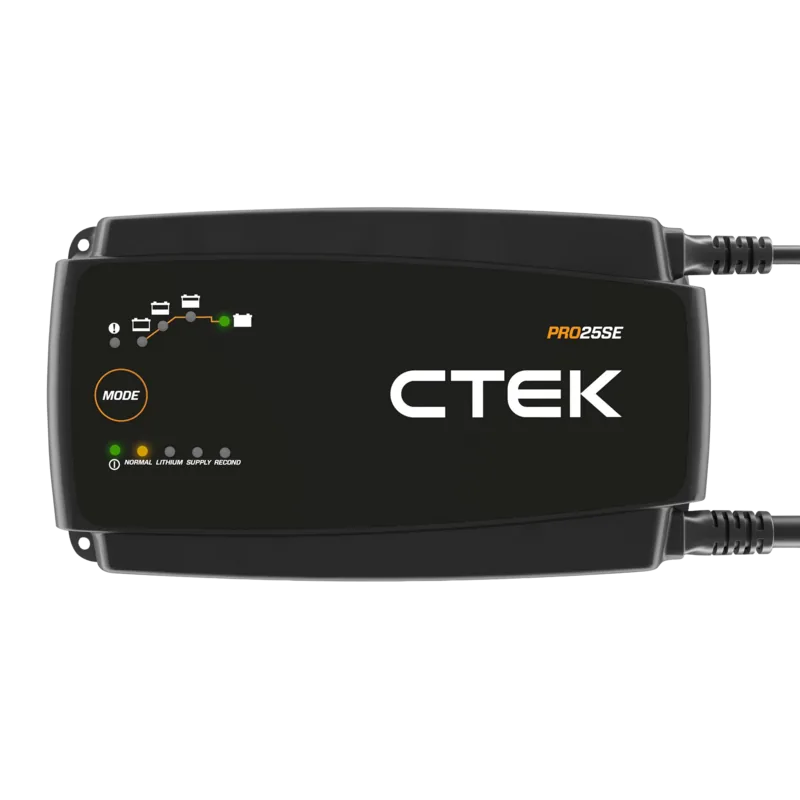
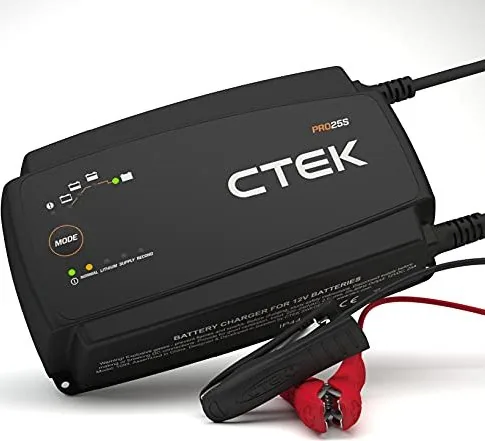
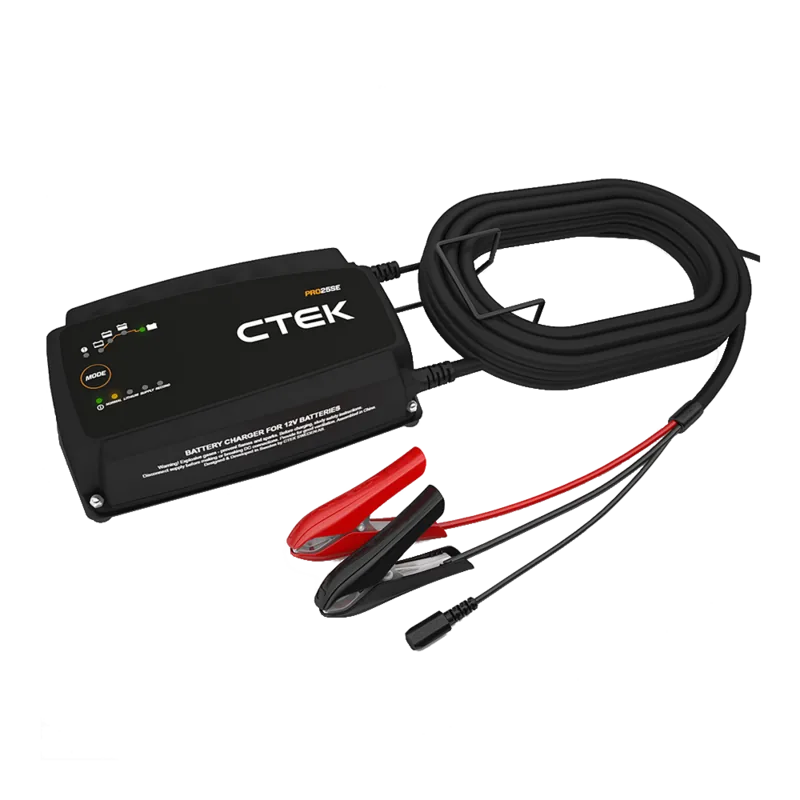
CTEK PRO25S — Powerful, Intelligent 25A Charger
The CTEK PRO25S is a professional-grade switch mode battery charger designed for demanding workshops, fleets, and heavy-duty applications. Delivering up to 25A at 12V, it supports a wide range of lead-acid and compatible lithium chemistries, including WET, AGM, GEL, Ca/Ca and Li-FePO4. Its multi-step charging strategy intelligently assesses battery condition, restores capacity, and maintains full charge with minimal maintenance drain.
Equipped with automatic temperature compensation and a suite of safety protections (reverse polarity, spark protection, short-circuit protection and energy-save mode), the PRO25S adapts charging voltage and current to ambient conditions and battery health. Charging programs include Normal (14.4V/25A), Recond (15.8V/1.5A) for rejuvenating deeply discharged lead-acid batteries, Supply mode (13.6V/25A) for use as a stable 12V power source or unlimited float maintenance, and a dedicated Lithium program (13.8V/25A) for Li-FePO4 batteries within the specified temperature range.
The charger implements an advanced multi-step sequence: desulphation/accept tests, bulk (high current to ~80–90%), absorption (tapering current to near 100%), analysis (load/hold test), optional reconditioning (controlled gassing for lead-acid), float maintenance and pulse maintenance. LED indicators show power, error and program states; the unit features an automatic and manual "wake up" for lithium batteries with under-voltage protection to re-engage those that have been disconnected by battery protection circuits.
CTEK PRO25S is designed for batteries from roughly 30–500Ah (varies by chemistry) and gives typical times to 80%: 40Ah ~1.5h, 100Ah ~3h, 200Ah ~6h, 300Ah ~16h. Technical specs include 220–240VAC input, IP44 rating, very low back current (<2.3Ah/month), low ripple (<4%), operating range -20°C to +50°C, and a two-year warranty. The charger is built for workshop use where reliable, repeatable, and safe high-current charging is required.
Notes
- Place the temperature sensor close to the battery or on the positive clamp for accurate compensation.
- In Supply mode spark protection is disabled — use with caution.
- Use Recond sparingly (about once a year or after deep discharge) to restore lead-acid battery capacity.
- For lithium batteries outside the 0–40°C range, consult the battery manufacturer before charging.
Search for 67,706 Manuals online


Type-in Brand or Model
Garth Homenick
9 months ago
Does this charger support both lead-acid and lithium batteries, including reconditioning deeply discharged batteries?
Manual.ly
9 months ago
Yes. The device supports multiple charging modes for different battery types, including lead-acid batteries and lithium batteries. It also includes a function to help recover or recondition batteries that are deeply discharged, to the extent possible. For correct use, please review the manual before operating, since the exact supported modes and settings depend on the battery type and model. If you want the detailed mode overview, you can usually find the corresponding CTEK documentation as a PDF. When set correctly, it is also suitable for charging battery packs used in workshops.