
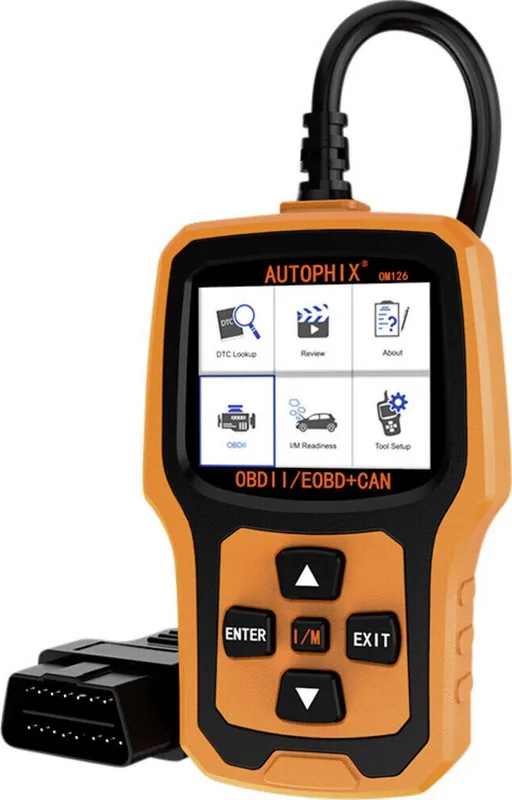
Conrad OM126 Manual
PDF manual · 2 Pages
English


Quick check
Incorrect answer, please try again.
Chat with your Conrad OM126 manual using AI
Get instant AI answers from your Conrad OM126 manual
Ask anything about the Conrad OM126. Answers come from this manual, with the pages they are based on.
Ask a Question
Do you recommend OM126?
Yes NoFrequently Asked Questions
The OM126 is a universal OBD2 diagnostic device used to read supported vehicle fault codes. Its internal fault-code library helps users begin identifying possible causes of engine-related warnings or system issues.
Is this answer helpful?
The OM126 supports CAN, J1850 PWM, J1850 VPW, ISO 9141, and KWP2000 protocols. Vehicle compatibility depends on the diagnostic protocol used by the vehicle.
Is this answer helpful?
No. The device is powered by the vehicle battery through the diagnostic connection. Its stated operating voltage range is 8 to 18 V.
Is this answer helpful?
Vehicle testing should be performed with caution. Do not connect or disconnect the diagnostic device while the ignition is on or the engine is running. Keep clear of hot and moving engine parts.
Is this answer helpful?
Disconnect the device before cleaning. Use a dry, lint-free cloth only. Avoid aggressive cleaners, rubbing alcohol, and chemical solutions because they may damage the housing or cause malfunction.
Is this answer helpful?
Avoid moisture, high humidity, direct sunlight, extreme temperatures, strong shocks, flammable gases, vapors, solvents, and mechanical stress. Operate the device in a safe, well-ventilated area.
Is this answer helpful?
Advantages and Disadvantages
Advantages

- Universal OBD2 code reader with an internal fault-code library for quicker initial diagnosis.
- Supports CAN, J1850 PWM, J1850 VPW, ISO 9141, and KWP2000 OBD2 protocols.
- Powered by the vehicle battery, so no separate power supply is required.
- Compact 125 x 77 x 26 mm design and 210 g weight support convenient storage and handling.
- Operates across 8 to 18 V, suitable for typical vehicle electrical systems.
Disadvantages

- Compatibility depends on the vehicle having a supported OBD2 system and protocol.
- It is intended for code reading and does not replace professional mechanical diagnosis.
- Moisture, extreme temperatures, impacts, and chemical cleaners can damage the device.
- Safe use requires careful vehicle-test procedures, especially around a running engine.
- The device must not be connected or disconnected while the ignition is on or the engine is running.
Product Specification
Interface
OBD II
Display
LCD
Ports
USB
Power supply
OBD-powered
Dimensions
4.92 x 3.03 x 1.02 in
Weight
7.41 oz
Product Description
OBD II Diagnostic Device OM126 - Read, Download & Print Free
The OBD II Diagnostic Device OM126 is a compact universal code reader designed to help drivers and DIY vehicle owners identify engine-related fault codes through a compatible OBD2 connection. Powered directly by the vehicle battery, it provides a practical way to begin investigating warning lights and possible system issues without relying on a separate power source.
Practical Diagnostics for Everyday Vehicle Checks
With its internal fault-code library, the OM126 helps users interpret supported OBD2 trouble codes more conveniently. It supports common communication protocols, including CAN, J1850 PWM, J1850 VPW, ISO 9141, and KWP2000. This broad protocol support makes it a useful diagnostic companion for many vehicles equipped with an OBD2 system.
The device is built for straightforward use in a workshop, garage, or other suitable vehicle service setting. Its compact 125 x 77 x 26 mm housing and 210 g weight make it easy to store with other automotive tools. The operating voltage range of 8 to 18 V is suited to standard vehicle electrical systems, allowing the scanner to receive power when connected to the diagnostic port.
Designed With Safety in Mind
Vehicle testing requires care, particularly when the engine is running. The OM126 should be used only in a safe, well-ventilated environment, with the parking brake engaged and the transmission placed in Park or Neutral. Keep hands, clothing, tools, and test equipment away from hot or moving engine components.
Extra caution is important near ignition coils, wires, distributor components, and spark plugs. Test equipment should not be connected or disconnected while the ignition is on or the engine is running. Eye protection is recommended during vehicle work, and exhaust fumes should never be ignored.
Care and Storage Notes
Keep the OM126 dry and protect it from moisture, extreme temperatures, direct sunlight, strong impacts, flammable vapors, and solvents. For cleaning, disconnect the device and use only a dry, lint-free cloth. Abrasive cleaners, rubbing alcohol, and chemical solutions may damage the housing or affect reliable operation.
Notes
The OM126 is intended as a universal OBD2 code reader, not a replacement for qualified mechanical diagnosis. If the unit is visibly damaged, does not operate correctly, or has been exposed to severe conditions, stop using it until its condition has been assessed. Dispose of the device through appropriate electronic recycling channels at the end of its service life.
Search for 67,706 Manuals online


Type-in Brand or Model