
colorFabb XT-CF20 Manual
PDF manual · 5 Pages
English



Quick check
Incorrect answer, please try again.
Chat with your colorFabb XT-CF20 manual using AI
Get instant AI answers from your colorFabb XT-CF20 manual
Ask anything about the colorFabb XT-CF20. Answers come from this manual, with the pages they are based on.
Ask a Question
Do you recommend XT-CF20?
Yes NoFrequently Asked Questions
XT-CF20 is a copolyester based on Eastman Amphora AM1800, reinforced with approximately 20% milled carbon fiber and proprietary additives to enhance mechanical properties and printability.
Is this answer helpful?
Avoid overheating above ~270°C to prevent thermal decomposition. Use typical copolyester printing temperatures as a starting point, ensure adequate ventilation, and consider a hardened nozzle to resist abrasion from carbon fibers.
Is this answer helpful?
No. Under EU CLP (Reg. 1272/2008) the filament is not classified as dangerous. However, decomposition fumes from overheating can be harmful, so follow ventilation and handling guidelines.
Is this answer helpful?
For standard FDM printing, special PPE is generally not required. Maintain good hygiene, avoid contact with molten material, and use eye protection and heat-resistant gloves if handling hot parts or during maintenance.
Is this answer helpful?
Store dry at ambient temperature, protected from moisture. Dispose of waste and packaging in accordance with local regulations; do not release material into drains, watercourses, or soil.
Is this answer helpful?
XT-CF20 is ideal for functional prototypes, jigs, fixtures, and small-batch end-use parts needing higher stiffness, dimensional accuracy, and a professional carbon-fiber look.
Is this answer helpful?
Yes. The milled carbon fiber is abrasive and can wear brass nozzles. Use hardened steel, ruby, or other wear-resistant nozzles for extended printing with this filament.
Is this answer helpful?
Advantages and Disadvantages
Advantages

- High stiffness and improved dimensional stability for functional parts.
- Matte black carbon-fiber aesthetic ideal for professional prototypes.
- Lower warpage than many standard copolyesters, easier to print large parts.
- Chemically stable under normal use and non-classified as hazardous in EU.
- Supplied on spools with consistent density (≈1.35 g/cm³) for predictable prints.
Disadvantages

- Contains milled carbon fiber which can abrade standard brass nozzles over time.
- Must avoid overheating (>270°C) to prevent thermal decomposition and fumes.
- Not soluble in water and has low biodegradability; disposal must follow regulations.
- Potential for burns from molten filament—care needed during handling.
- Limited data on long-term toxicology and ecological degradation profiles.
Product Specification
Type
Carbon (80% CPE, 20% carbon fiber)
Suitability
universal
Print temperature
464-500°F
Heatbed recommendation
140-158°F
Elongation at break
7.5%
Modulus of elasticity
6,200 MPa
Tensile strength
76 MPa
Dimensional stability
176°F
Density
84.28 lb/ft3
Base color
black
Shade
matte anthracite
Special features
increased wear on print nozzle
Product Description
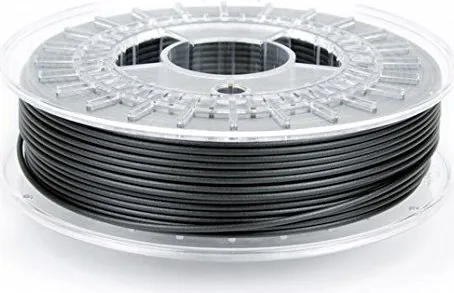
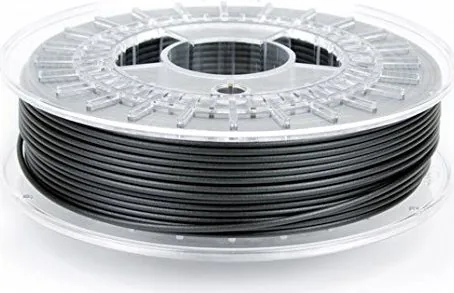
colorFabb XT-CF20 Eastman Amphora AM1800, Carbon, 3D printing filament Manual
colorFabb XT-CF20 pairs Eastman Amphora AM1800 copolyester with 20% milled carbon fiber to produce a robust, high-performance 3D printing filament. Designed for FDM printing, this filament emphasizes dimensional stability, increased stiffness, and improved thermal resistance compared to standard copolyesters. The carbon fiber fill imparts a matte black finish and a tactile, engineered look while reducing warpage and improving part strength for functional prototypes and end-use parts.
Key material attributes
This filament has a density of approximately 1.35 g/cm³ and is supplied wound on spools for typical desktop and industrial FDM machines. It is odorless and insoluble in water. The filament is chemically stable under normal handling and printing conditions and should be used within recommended temperature ranges to avoid thermal degradation. Avoid overheating above 270°C to prevent decomposition and formation of gaseous byproducts such as CO2, CO and aldehydes.
Safe handling and printing tips
When printing, ensure adequate ventilation and avoid contact with molten material to prevent burns. Standard personal protective equipment is generally not required for routine FDM use, but follow good hygiene practices: do not eat, drink or smoke while handling filament. Store the filament dry at ambient temperature and protect it from moisture to preserve printability and mechanical performance.
Performance and applications
XT-CF20 is suited for functional prototypes, jigs, fixtures, and small-batch production parts where higher stiffness, dimensional accuracy, and a carbon-fiber aesthetic are desired. It resists many common environments but should not be exposed to strong acids or oxidizing agents. The filament is non-classified as hazardous under applicable EU regulations and is not considered PBT/vPvB.
Limitations and considerations
While formulated for stable printing, thermal decomposition from overheating or burning can generate hazardous fumes—use appropriate ventilation and avoid excessive nozzle temperatures. Because the material contains milled carbon fiber, it may be abrasive to standard nozzles; hardened steel or other wear-resistant nozzle materials are recommended for extended use.
Notes
- Not classified as dangerous under EU CLP (1272/2008).
- Follow local regulations for disposal; do not release into drains or the environment.
- In case of burns from molten filament, cool with water for at least 10 minutes and seek medical attention.
- Avoid ingestion and inhalation of decomposition products; seek fresh air and medical help if exposed.
Search for 67,706 Manuals online


Type-in Brand or Model