
colorFabb woodFill Manual
PDF manual · 3 Pages
English



Quick check
Incorrect answer, please try again.
Chat with your colorFabb woodFill manual using AI
Get instant AI answers from your colorFabb woodFill manual
Ask anything about the colorFabb woodFill. Answers come from this manual, with the pages they are based on.
Ask a Question
Do you recommend woodFill?
Yes NoFrequently Asked Questions
Print woodFill Pine at typical PLA extrusion temperatures (around 190–220°C). The base polymer melts near 140–160°C, but practical extrusion requires higher temperatures for reliable flow. Adjust within the range for optimal layer adhesion and finish.
Is this answer helpful?
A hardened or wear-resistant nozzle is recommended because wood fibers can abrade standard brass nozzles over time. Use a nozzle diameter of 0.4 mm or larger to reduce clogging and ensure reliable extrusion.
Is this answer helpful?
Light sanding, staining, oiling, or varnishing works well. Start with medium grit and progress to fine grit for smoothness. Apply stains or oils sparingly to accentuate grain; test finishes on scrap prints first.
Is this answer helpful?
Yes, with precautions. Ensure good ventilation during printing and avoid inhaling dust when sanding. Wear a particle mask for finishing and avoid contact with molten filament to prevent burns.
Is this answer helpful?
Store in a cool, dry place in sealed packaging with desiccant to prevent moisture uptake. Keep away from direct heat and ignition sources to preserve filament quality and prevent degradation.
Is this answer helpful?
WoodFill Pine is best for aesthetic and decorative uses. Its polymer-wood composite is not ideal for high-stress or high-temperature structural components—use engineering filaments for mechanical parts.
Is this answer helpful?
Pause printing, unload filament, and attempt a cold or atomic pull with cleaning filament. If blockage persists, remove the nozzle for cleaning or replacement; using a larger nozzle can prevent future clogs.
Is this answer helpful?
Advantages and Disadvantages
Advantages

- Authentic wood-like appearance and texture with visible grain and warm tones.
- Easily sanded and stained for realistic finishing and customizable results.
- Compatible with standard PLA printing temperatures and FDM workflows.
- Reduced warping and stable storage when kept dry and away from heat.
- Ideal for decorative prints, models, and items needing a wooden aesthetic.
Disadvantages

- Contains wood fibers—requires larger nozzles and can increase nozzle wear.
- May produce dust when sanding; respiratory protection recommended.
- Can clog fine nozzles or cause stringing if retraction and speed aren’t tuned.
- Not suitable for high-temperature or structural applications due to polymer base.
- Decomposes if overheated, releasing combustion byproducts—avoid burning.
Product Specification
Type
Wood (70% PLA/PHA, 30% Pine wood fibers)
Suitability
universal
Print Temperature
383-428 F
Melting Temperature
311 F
Heatbed Recommendation
122-140 F
Melt Flow Index
0.01-0.02 lb/10min
Impact Strength
19kJ/m²
Elongation at Break
5%
Modulus of Elasticity
477.17 ksi
Tensile Strength
6.67 ksi
Dimensional Stability
131 F
Density
71.79 lb/ft3
Base Color
wooden
Color Shade
Pine
Product Description
colorFabb woodFill Pine 3D-Print Filament Manual
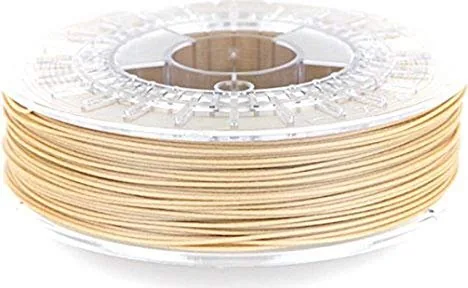
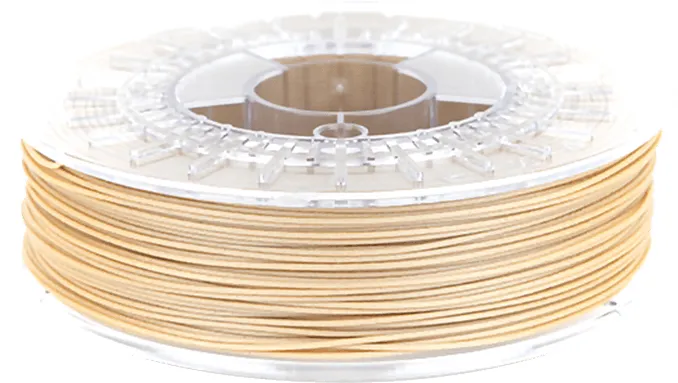
colorFabb woodFill Pine blends the warmth and texture of natural pine fibers with the printability of PLA-based filaments, offering a wood-like finish without the hassles of actual wood. Designed for hobbyists, model makers, and designers who want printed parts to mimic timber aesthetics, this filament combines 10–20% wood fibers with a polymer matrix to create realistic grain, subtle color variation, and a tactile surface that accepts sanding and staining.
The filament prints at standard PLA temperatures (around 190–220°C) with a recommended melting range near 140–160°C for the base polymer, though practical extrusion temperatures are higher to ensure flow and layer adhesion. Expect a faint woody aroma during printing and a brownish hue in the raw material that renders into warm, natural tones on finished parts. The filament is formulated to reduce warping and is generally stable under normal storage when kept dry and cool.
Because it contains wood fibers, woodFill Pine requires a few practical considerations: larger nozzle diameters (0.4 mm or higher) help prevent clogging, reduced print speeds improve surface quality, and softened retraction settings limit stringing. The composite can be post-processed like real wood—light sanding, staining, or oiling can deepen the grain effect and produce convincing wooden prototypes, decorative objects, or small furniture accents.
Safety-wise, handle the filament like other polymer composites: avoid inhaling dust when sanding, protect skin from contact with molten material, and ensure good ventilation during printing. The material is not classified as hazardous in transport, and it is stable under recommended storage conditions, but decomposition at high temperatures can release typical combustion products—so do not overheat or burn scraps.
colorFabb woodFill Pine is a versatile choice when you want the look and feel of pine with the convenience of FDM printing. It’s ideal for decorative prints, scale models, cosplay props, and any project where wood appearance and post-processing flexibility matter.
Notes
- Store in a cool, dry place; use desiccant to minimize moisture uptake.
- Use a hardened nozzle for extended printing to resist abrasion from wood fibers.
- Sand and finish gently to avoid clogging vents with fine dust.
Search for 67,706 Manuals online


Type-in Brand or Model