
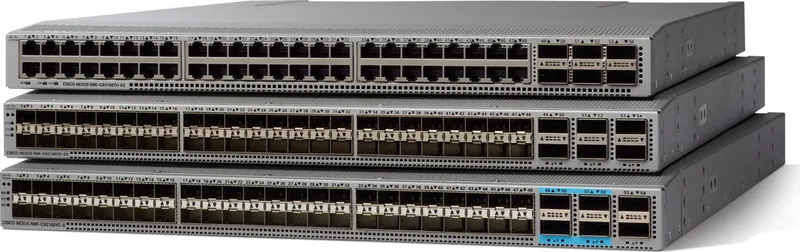


Cisco Nexus 93108TC-EX Manual
PDF manual · 74 Pages
English



Quick check
Incorrect answer, please try again.
Chat with your Cisco Nexus 93108TC-EX manual using AI
Get instant AI answers from your Cisco Nexus 93108TC-EX manual
Ask anything about the Cisco Nexus 93108TC-EX. Answers come from this manual, with the pages they are based on.
Ask a Question
Do you recommend Nexus 93108TC-EX?
Yes NoFrequently Asked Questions
It is designed for data center leaf-spine-APIC deployments, especially in ACI environments. The switch provides dense copper access ports and high-speed QSFP28 uplinks for scalable fabric connectivity.
Is this answer helpful?
The switch includes 48 RJ-45 copper ports and 6 QSFP28 uplink ports. The copper ports support 100M, 1G, and 10G speeds, while the QSFP28 ports support up to 100G.
Is this answer helpful?
No. The chassis must use matching power supply types. You cannot mix AC, DC, and HVAC/HVDC modules in the same switch. Matching wattage and airflow direction is also required.
Is this answer helpful?
Yes. Fan modules and power supplies can be replaced while the switch is operating, as long as the replacement module matches the existing airflow direction and power type.
Is this answer helpful?
The switch supports port-side intake, port-side exhaust, and dual-direction behavior for HVAC/HVDC power supplies. All installed fan and power modules must align to the same airflow pattern.
Is this answer helpful?
Yes. It should be installed in a suitable 19-inch rack or cabinet with proper clearance, cooling, and grounding. A grounded rack is preferred, or you can use a customer-supplied grounding cable.
Is this answer helpful?
Advantages and Disadvantages
Advantages

- 48 RJ-45 ports provide high-density copper connectivity for server-facing access.
- 6 QSFP28 uplinks support scalable 10G, 40G, and 100G backbone connections.
- 1RU rackmount design saves space in crowded data center racks.
- Hot-swappable fans and power supplies support maintenance with minimal disruption.
Disadvantages

- All power supplies and fans must match airflow direction, which limits mixed configurations.
- AC, DC, and HVAC/HVDC power supplies cannot be mixed in the same chassis.
- Rack, grounding, and environmental preparation must be planned carefully before installation.
- Optical cabling and ACI fabric design add complexity compared with a basic access switch.
Product Specification
Function
Switch, SAN switch
Type
Standalone, Rackmount (via mounting brackets)
Network ports
48x RJ-45, 6x QSFP28
Speeds
48x RJ-45 (100/1000/10GBase-T), 6x QSFP28 (10G/40G/100Gb/s)
PoE
N/A
Backplane
2.16Tb/s, 1.5Gp/s, 40MB packet buffer, 256k MAC addresses
Officially supported standards
802.1AX, 802.1D, 802.1Q, 802.1p, 802.3ab, 802.3ae, IGMP
Configuration
Web interface, Console, Serial (RJ-45, USB-A 2.0, Rear), Network (SFP, RJ-45, Dedicated, 10/100/1000Base-T, Rear)
Cooling
Active, 4x fans (1.57 in, 1x hot-plug each)
Dimensions (WxHxD)
17.28x1.73x22.48 in, 1U
Weight
17.64 lb
Color
Silver
Special features
Metal housing, removable mounting brackets, firmware updates possible, redundant power supply (redundant power feed), 2x hot-plug power supply units
Manufacturer's warranty
One year
Note
For this device, "link aggregation" was officially specified with the obsolete standard IEEE802.3ad. Since 2008, this function has no longer been managed by IEEE "Working Group 3" (IEEE 802.3, CSMA/CD - Ethernet), but by "Working Group 1" (IEEE 802.1, High Level Interface - Internetworking) and is technically defined unchanged via IEEE 802.1AX.
Product Description
Cisco Nexus 9300-EX Rackmount 10G Managed Switch, 48x RJ-45, 6x QSFP28 Manual
The Cisco Nexus 9300-EX rackmount switch is built for dense, modern data center environments where reliable performance and clean cabling matter just as much as raw port count. In ACI-oriented deployments, it serves as a compact 1RU leaf switch that bridges servers, controllers, and spine uplinks with a practical mix of copper and high-speed optical connectivity.
What makes this model stand out is its balance of access and uplink capacity. The 48 RJ-45 ports support 100-Megabit, 1-Gigabit, and 10-Gigabit speeds, making it well suited for server connections, staging networks, and mixed legacy infrastructure. On the uplink side, the 6 QSFP28 ports provide a path to 10G, 40G, or 100G connectivity, giving teams room to scale without reworking the entire rack design.
This switch is also designed with operational discipline in mind. Cisco emphasizes proper airflow direction, rack placement, and module consistency to keep the system stable under load. Fans and power supplies can be swapped, but they must match the chassis airflow strategy and power type. That attention to thermal planning is especially useful in hot-aisle/cold-aisle layouts, where cooling efficiency directly affects uptime.
The installation workflow is similarly practical for network teams. The chassis supports grounding, rack-mount brackets, slider rails, and dedicated power planning for AC, DC, or HVAC/HVDC environments. For administrators, that means the hardware is flexible enough for different facilities, while still demanding a structured deployment process that helps reduce errors during setup.
In day-to-day use, the switch fits well into ACI fabric topologies where each leaf connects upward to every spine switch for optimal forwarding and resilient multipathing. Maintenance is straightforward too: fan modules, power supplies, console access, and management connections are all covered with clear operating expectations. The result is a platform that feels enterprise-focused from first install to long-term service.
Notes
- Keep all fan and power modules aligned to the same airflow direction.
- Use grounded racks or a dedicated grounding cable for safe operation.
- Verify cabling, power source type, and uplink compatibility before deployment.
- Clean transceivers and optical cables regularly to preserve signal quality.
Search for 67,706 Manuals online


Type-in Brand or Model