
Chauvin Arnoux CA 773 Manual
PDF manual · 104 Pages
English



Quick check
Incorrect answer, please try again.
Chat with your Chauvin Arnoux CA 773 manual using AI
Get instant AI answers from your Chauvin Arnoux CA 773 manual
Ask anything about the Chauvin Arnoux CA 773. Answers come from this manual, with the pages they are based on.
Ask a Question
Do you recommend CA 773?
Yes NoFrequently Asked Questions
Its main purpose is voltage absence testing and hazardous-voltage detection on low-voltage electrical installations. It is intended to help qualified users verify electrical status before work begins.
Is this answer helpful?
It indicates nominal voltages from 12 to 1000 V AC or DC, and up to 1400 V DC. It also identifies AC or DC and shows DC polarity.
Is this answer helpful?
Yes. The hazardous-voltage indication is designed to operate even when the batteries are discharged or absent. Batteries are still required for functions such as continuity testing, display operation, and self-test confirmation.
Is this answer helpful?
Connect both probes to the isolated circuit, ensure no voltage is detected, and hold the ohm button. The result appears on the digital display, with an audible signal for low-resistance continuity.
Is this answer helpful?
Yes. On suitable three-phase AC systems, it can indicate L123 or L132 phase order. The function requires phase-to-phase voltage between 50 and 1000 V AC.
Is this answer helpful?
The dual 30 mA buttons apply a load to help distinguish interference voltage from operating voltage below 400 V. On compatible circuits, this function can also trigger a 30 mA residual-current device.
Is this answer helpful?
Advantages and Disadvantages
Advantages

- CAT IV 1000 V safety rating supports testing near low-voltage installation sources.
- Detects 12 to 1000 V AC/DC and up to 1400 V DC, with polarity indication.
- Hazardous-voltage warning works even with weak or absent batteries.
- Combines continuity, phase detection, phase sequence, work light, and 30 mA RCD testing.
- IP65 housing, 2 m drop resistance, and optional IP2X probes support field use.
Disadvantages

- It is a voltage detector and should not be used as a precision measuring instrument.
- The 30 mA load-switching test can heat the unit and may require a cooling period.
- Phase detection works on earth-referenced networks and does not prove voltage absence.
- Live-circuit use is limited to a 30-second duty cycle followed by a 240-second rest period.
- Designed for qualified personnel following applicable electrical safety procedures.
Product Specification
Measurement range
12-1,000 V
Product Description
Chauvin Arnoux CA 773 Voltage Tester - Read, Download & Print Free
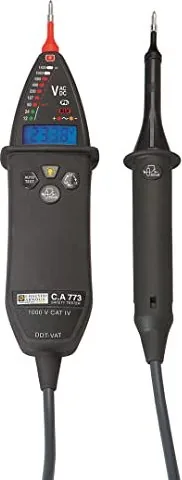
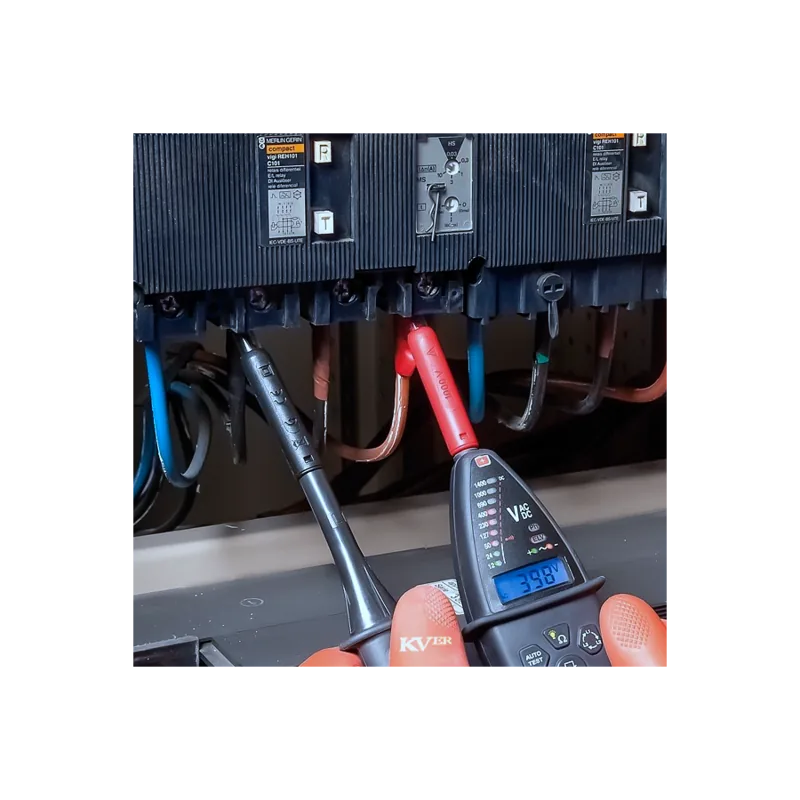
The Chauvin Arnoux CA 773 Voltage Tester is a professional two-pole safety tester designed for fast, dependable checks on low-voltage electrical installations. Built for qualified electricians and maintenance teams, it combines voltage indication, continuity testing, phase identification, phase-sequence verification, and 30 mA RCD testing in one compact instrument. Its CAT IV 1000 V rating supports work close to the source of an installation, including distribution systems and protective equipment.
Clear voltage status for demanding work
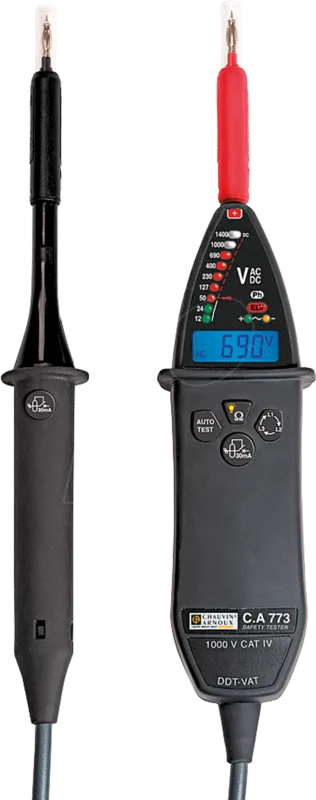
The tester automatically activates when its probes contact the circuit under test. A backlit digital display and bargraph show nominal voltage levels from 12 to 1000 V AC or DC, with DC capability extending to 1400 V. AC and DC are clearly identified, while polarity indicators help users recognize positive and negative DC connections. For potentially hazardous levels above 50 V AC or 120 V DC, the red ELV warning flashes and an audible signal provides an additional alert.
The CA 773 is primarily intended for voltage absence testing rather than precision measurement. Its voltage-presence indication remains operational for dangerous voltages even when the batteries are weak or missing, helping support safer electrical isolation procedures. A self-test function should be performed before use and after each test to confirm the condition of the leads, probes, electronic circuits, and batteries.
Practical functions beyond voltage detection
For troubleshooting, the CA 773 offers continuity checking when no voltage is present. Hold the ohm button to view the continuity result and receive an audible indication at low resistance. A white work light beneath the red probe improves visibility at dark terminals, panels, and connection points.
Single-pole phase detection helps locate a live phase on earth-referenced systems, while the phase-order feature identifies L123 or L132 rotation on three-phase networks. The integrated load-switching function can help distinguish interference voltage from operating voltage below 400 V. It can also trigger compatible 30 mA residual-current devices, although this function may warm the tester and requires a cooling interval after intensive use.
Rugged design and safety focus
With an IP65 protection rating, 2 m drop resistance, double insulation, and a 1 m lead, the CA 773 is suited to regular field use indoors or outdoors in dry conditions. It operates from two AA or LR6 alkaline batteries and delivers approximately 2,500 ten-second tests. The standard model uses 2 mm probes, while the CA 773 IP2X version includes guarded IP2X probes for additional contact protection.
Notes
- Keep fingers behind the probe guards during every test.
- Do not use damaged leads, probes, or housing.
- Phase detection does not replace a voltage absence test.
- Observe the 30-second maximum connection period and 240-second rest period on live circuits.
Search for 67,706 Manuals online


Type-in Brand or Model