
Manual.ly Logo

Carson Tyrann Single Blade 320 Manual

0.0 · 0 Ratings

PDF manual · 32 Pages

English

M: QW-35-FL
page

/ 32

Loading...
72334901dea92b602cd5abd09530e28c6e51 page d
13 // GB
Make sure that you have sufficient insurance cover when practising your hobby or take
out a special insurance for model aircraft. The contact address for this is Deutscher
Modellfliegerverband e.V. Rochusstr. 104 – 106, 53123 Bonn.
Only a well-maintained model will function properly. Only use approved spare parts and never
improvise with any unsuitable items.
It is the user’s responsibility to ensure that the model is functioning correctly and that all nuts,
bolts and screws are tightened.
Keep the model well beyond the reach of small children. They may unintentionally activate the
model and cause themselves injury with it, or they may put batteries and small parts into their
mouths and swallow them.
Preparations
Never start flying before you have made sure of the following points:
• Pay attention to visible damage on the model, remote control, battery charger, and lithium
battery.
• Ensure that the model is functioning correctly and that all screwed and plugged connections
are fitted precisely and tightly.
• The flight battery must be fully charged and correspond to the correct voltage. Only use
new/fresh batteries for the transmitter.
• Make sure that all servos respond correctly to the signals of the transmitter.
• Always check the radio operation before starting the model.
Flight operation
The model is primarily designed for indoor flights since its low weight and unstable flight
position resulting from the construction type make it very susceptible to air movements.
Moreover, the components are not dust- and moisture-proof.
Do not fly any longer than one battery charge
Afterwards, the model must cool down for at least 5 minutes.
Then recharge the battery. Avoid deep discharge in any case.
General information
• If you have little or no experience with model aircraft you should practice with a flight
simulation program first.
• Ask experienced model pilots for advice with the fine settings of your model aircraft.
• Familiarise yourself with the control functions of your trnasmitter.
• Start your first flights, standing behind the model and looking in the flight direction. In this
case, the control reaction equals the controlling direction.
• Also familiarise yourself with the movements of the model, when it flies towards you
(response opposite to the control direction)!
Safety Precautions Lithium batteries:
1. General: Lithium batteries (accumulators) are energy storage devices with a high energy
density and can present risks. For this reason, particular care is needed when charging,
discharging, storing and handling. Read these instructions very carefully before first using the
battery. Do not fail to take note of the warning notices and instructions for use. Misuse can lead
to risks such as explosion, overheating or fire. Failure to observe the instructions for use leads to
early failure and other defects. The instructions should therefore be kept in a safe place and it is
essential that they are handed over to the second user if the batteries are passed on.
2. Warning notices:
• Avoid short-circuits. A short-circuit may well destroy the product. Cables and connections
must be well insulated.
• It is essential when connecting the battery to ensure that the polarity is correct.
• Original plug connectors and cables may not be cut off or changed - if need be, use an
adapter cable.
• Do not expose the battery to excessive heat or cold or to direct sunlight. Do not throw in the
fire. Do not place the battery in contact with water or other liquids.
• Charge the battery only with charging units intended for the purpose and always use the
balancer connection. It is only by using the balancer connection that optimum charging can
be ensured. If this connection is not used, charging is subject to the risks mentioned above.
Before charging, always first allow the battery to cool to ambient temperature. Never charge
while hot.
• When charging, place the battery on a non-flammable, heat-resistant support. There should
be no flammable or readily ignited objects in the vicinity of the battery.
• During charging or operation, never leave the battery unsupervised.
• Do not fail to keep to the recommended charge/discharge current.
• The battery casing must not be damaged. It is essential to avoid damage by sharp objects
such as knives or the like, from dropping, impact, bending etc. Damaged batteries may no
longer be used.
• Batteries are not toys. They should be kept away from children.
3. Charging instructions: Lithium batteries are charged according to the CC-CV procedure.
CC stands for “constant current“, which is applied during the first phase of charging. Once the
battery reaches the maximum voltage configured in the charger, it switches to CV (constant
voltage) for the second phase of charging. The battery voltage no longer increases. The charging
current now falls continuously until the battery is fully charged. The maximum charging current
for the battery is 1C (C=nominal capacity of the battery, e.g. for a battery with a nominal
capacity of 2700 mA, the maximum charging current for the battery is 2700 mA (2.7 A)). Never
charge several batteries together from a single charger. Differing states of charge and capacities
can lead to overcharging and destruction.
4. Storage instructions: Lithium batteries should be stored charged to 20-50 % of their
capacity and at a temperature of 15-18 °C. If the cell voltage falls below 3 V, they should be
recharged. Deep discharge and storage when discharged (call voltage <3 V) will render the
battery unusable.
5. General terms of guarantee: There is a legal guarantee for production and material faults
as applicable at the time of dispatch. No liability is accepted for normal wear and tear. This
guarantee does not apply for defects attributable to improper use, inadequate maintenance,
third-party interference or mechanical damage. This applies, in particular, to used batteries
and batteries clearly showing signs of use. Damage and loss of performance due to improper
handling and/or overload are not product faults. Batteries are consumables and subject to a
certain ageing. This is influenced by factors such as the charge/discharge currents, the charging
procedure, the operating and storage temperatures and the state of charge during storage.
The ageing shows itself in, among other things, an irreversible loss of capacity. In the model
field, where batteries are frequently used to supply motors, very high currents can flow from
time to time.
6. Exclusion of liability: Since we are unable to have any control over charge/discharge, handling,
compliance with assembly and operating instructions, battery replacement and its care and
maintenance, Tamiya / Carson can accept no liability for loss, damage or costs incurred. Any claim
for damages that may result from operation, failure or faulty operation or that is in any way related
thereto will therefore be refused. We accept no liability for personal injury or material damage and
their consequences that arise from our delivery.
7. Disposal instructions: Batteries are hazardous waste. Damaged or unusable cells must be
disposed of in the correct manner.
No liability for printing errors, we reserve the right to make changes!
SAFETY PRECAUTIONS LITHIUM BATTERIES

Chat with your Carson Tyrann Single Blade 320 manual using AI

Get instant AI answers from your Carson Tyrann Single Blade 320 manual

Ask anything about the Carson Tyrann Single Blade 320. Answers come from this manual, with the pages they are based on.

Tyrann Single Blade 320 Maintenance Schedule

Before each flight
Inspect model for visible damage

Check the model, remote control, charger, and battery for any visible damage before every flight.

Show in the manual (page 13)
Before each flight
Tighten all screws and connections

Ensure that all screwed and plugged connections are fitted precisely and tightly before flying.

Show in the manual (page 13)
Before each flight
Verify servo response

Make sure that all servos respond correctly to the signals of the transmitter before starting the model.

Show in the manual (page 13)
Before each flight
Check radio range

Always check the radio operation and range before starting the model.

Show in the manual (page 13)
After each flight
Cool down model for 5 minutes

Do not fly longer than one battery charge. Allow the model to cool down for at least 5 minutes afterwards.

Show in the manual (page 13)
As needed
Replace damaged propeller blades

Damaged propeller or rotor blades must be replaced immediately. Do not attempt to repair them.

Show in the manual (page 12)
M: qwen/qwen3.8-flash

Ask a Question

0/1000

Do you recommend Tyrann Single Blade 320?

Yes No

Frequently Asked Questions

A

There is a 24-month warranty against manufacturing defects valid from the date of purchase from an authorized dealer.

Is this answer helpful?

A

It is designed primarily for indoor use. Outdoor flying requires no wind to prevent loss of control due to the light weight.

Is this answer helpful?

A

The LiPo battery typically takes one to two hours to fully charge using the included USB charger.

Is this answer helpful?

A

Children under sixteen years should only operate this under adult supervision as it is not classified as a toy.

Is this answer helpful?

A

Allow the motor to cool down for at least five minutes before attempting to fly the model again.

Is this answer helpful?

A

Yes, you can switch between Mode 1 and Mode 2 using the transmitter settings before you take off.

Is this answer helpful?

A

Insurance is often required by law for radio-controlled aircraft due to the operational risks involved.

Is this answer helpful?

M: QW-35-FL

Advantages and Disadvantages

Advantages

  • Ready to fly out of the box without assembly
  • Built-in gyro for stable flight behavior
  • LED lighting improves visibility during flight
  • Includes automatic takeoff and landing function
  • 2.4 GHz remote control prevents interference
VS

Disadvantages

  • Designed primarily for indoor use due to wind sensitivity
  • Short flight duration per single battery charge
  • Requires adult supervision for operators under 16
  • Motor requires cooling time between usage sessions
  • Insurance coverage often mandatory for operation
M: QW-35-FL

Product Specification

Type

Helicopter

Frequency

2.4 GHz

Drive

Electric Motor

Flight Time

18 min

Dimensions

12.60x9.84x3.15 in (LxWxH)

Weight

1.87 oz

M: QW-35-FL

Product Description

Experience the Joy of Flight with the Carson Tyrann Single Blade 320

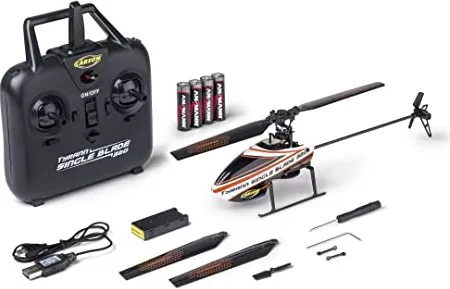
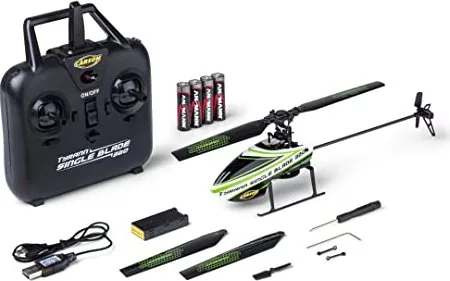
Picking up a new remote-controlled model is always an exciting moment for hobbyists looking to explore the skies. The Carson Tyrann Single Blade 320 stands out as a robust entry into the world of aerial robotics. This unit is designed for immediate operation, coming ready to fly right out of the box without requiring intricate screwdriver work. Users appreciate the convenience of the complete assembly which minimizes setup time significantly. You can find all the necessary technical details and precise instructions by referring to the Carson Tyrann Single Blade 320 Manual found in the package to ensure correct operation every single time. The 2.4 GHz remote control system ensures a stable connection during your flights without interference. It includes features like automatic height control and a built-in gyro for stabilization. This makes the learning curve much smoother compared to older brushless models. The LED lighting allows for better visibility, especially when flying during dusk or in low-light indoor environments. Additionally, the transmitter offers Mode 1 and Mode 2 settings, allowing pilots to choose their preferred throttle configuration for right or left-handed operation.

Safety is paramount when operating any flying device. The design is best suited for indoor environments because the lightweight construction makes it highly sensitive to outdoor wind conditions. Users are advised to operate the device in spacious rooms free from obstacles like furniture. When flying, always ensure you are on a flat surface and monitor the battery levels closely to avoid crashes. The included LiPo battery requires specific charging protocols to maintain longevity and prevent safety hazards during charge cycles. Ensure all screws and connections are tight before attempting flight to maintain stability. Battery voltage must correspond to proper specifications for optimal transmission range. If the model does not respond to commands, check the battery voltage first. Motor overheating indicates a need for a cooling period before further use. Do not fly in wind force greater than one to maintain control.

Important Maintenance Notes

Regular checks of the rotor blades and servo response are essential for safe operation every season. Always replace damaged propellers immediately to prevent instability during hover modes. The warranty covers manufacturing defects for two years if purchased from an authorized dealer. Be aware that insurance is required for operation as per local legal guidelines regarding remote-controlled aircraft. Avoid deep discharge of the battery cells to extend the overall lifespan. Keep the model out of reach of small children under sixteen years of age. Always follow the guidelines found in the documentation to void no warranty claims. Charging takes approximately one to two hours using the USB charger. Reload only when the model is fully cooled to prevent damage to the lithium cells.

M: QW-35-FL

© Copyright 2026 Manual.ly