
Boso Medicus Manual
PDF manual · 160 Pages
English



Quick check
Incorrect answer, please try again.
Chat with your Boso Medicus manual using AI
Get instant AI answers from your Boso Medicus manual
Ask anything about the Boso Medicus. Answers come from this manual, with the pages they are based on.
Medicus Maintenance Schedule
Calibration checks must be performed every two years by trained specialist staff or authorized institutions.
Use a soft dry cloth for the monitor. For small stains on the cuff, use standard washing-up liquid.
Use mikrozid sensitive liquid with at least 5 minutes exposure time. Spray disinfection is recommended for the cuff, especially if used by multiple people.
Free maintenance reminders
Timed to your purchase date. Always free, unsubscribe anytime.
Ask a Question
Do you recommend Medicus?
Yes NoDo you recommend Medicus?
Yes NoFrequently Asked Questions
The monitor supports cuffs for upper-arm circumferences of 22–32 cm (CA01) and 32–48 cm (CA02). Use only the specified cuff types to ensure measurement accuracy and proper fit.
Is this answer helpful?
Relax for five minutes before measuring, avoid nicotine and coffee for one hour, sit comfortably with back and arm supported, keep feet flat and legs uncrossed, place the cuff 2–3 cm above the elbow with the artery marker aligned, and keep the arm at heart level.
Is this answer helpful?
Common errors include insufficient inflation (increase preset pressure), no detectable pulse (check cuff position), or air leakage (inspect cuff connector and tubing). Repeat the measurement after correcting the issue and ensure the cuff is properly attached.
Is this answer helpful?
For clinical or professional use, metrological checks and calibration should be performed at least every two years by the manufacturer, designated authorities, or trained personnel. Regular checks help maintain measurement accuracy.
Is this answer helpful?
The Boso Medicus operates on four AA (LR6) alkaline batteries (DC 6 V) with a typical battery life of about 1,000 measurement cycles depending on inflation pressure and usage. A dedicated DC 6 V mains adapter (order no. 410-7-150) is available as an alternative.
Is this answer helpful?
The monitor does not affect pacemaker function, but arrhythmias or very weak pulses can impair measurement accuracy and lead to erroneous results. Consult a physician if readings are inconsistent or if you have cardiac devices.
Is this answer helpful?
Wipe the monitor with a soft dry cloth. Clean small cuff stains with mild dish detergent. For disinfection, use recommended disinfectants (e.g., mikrozid sensitive liquid) with at least five minutes contact time; for the cuff, spray disinfection is advised, especially when used by multiple users.
Is this answer helpful?
Advantages and Disadvantages
Advantages

- Clinical-grade accuracy compliant with EN 1060 and DIN testing standards.
- Simple one-button START/STOP operation with clear LCD for systole, diastole and pulse.
- Adjustable preset inflation with automatic higher-pressure fallback when needed.
- Suitable cuff range 22–48 cm included; lightweight and portable with case.
- Comprehensive guidance: preparation, cuff placement, cleaning, troubleshooting and calibration instructions.
Disadvantages

- Not suitable for neonates or very small arms outside 22–48 cm cuff range.
- Arrhythmias or very weak pulses (e.g., pacemaker patients) can yield unreliable readings.
- Requires periodic professional calibration every two years for medical use.
- May be affected by nearby wireless devices; maintain recommended distance.
- Cuff wear is excluded from warranty and requires replacement after heavy use.
Product Specification
Operating Mode
Mains operation, Battery operation (4x AA battery)
Measurement Type
Upper arm, Fully automatic
Cuff Circumference
8.66-18.90 in
Analyzed Data
Systole, Diastole, Pulse
Memory Function
no
Display
yes
Special Features
Date display, Time display, Automatic switch-off
Scope of Delivery
Bag, Blood pressure pass
Product Description
Boso Medicus Manual — Reliable Home Blood Pressure Monitor
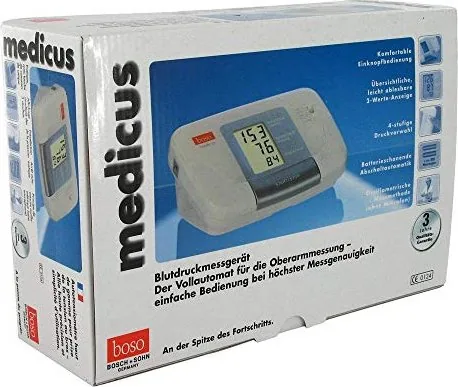
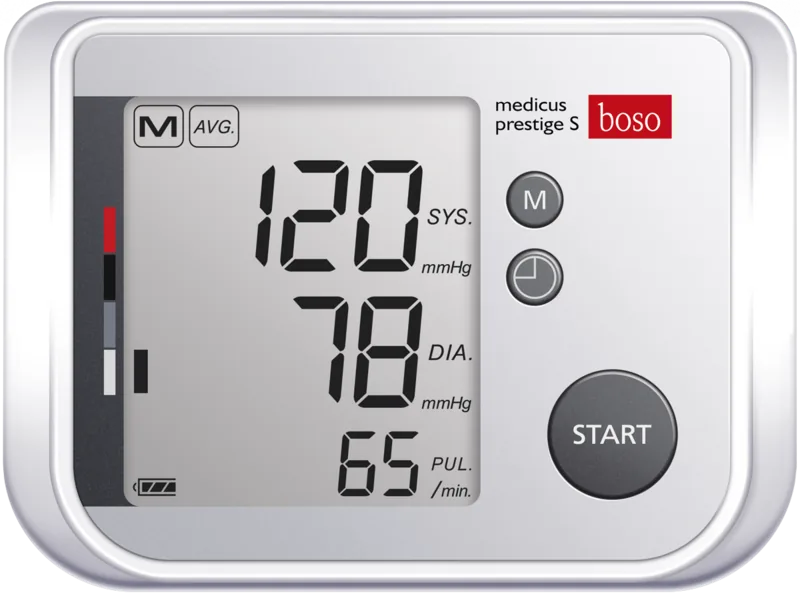
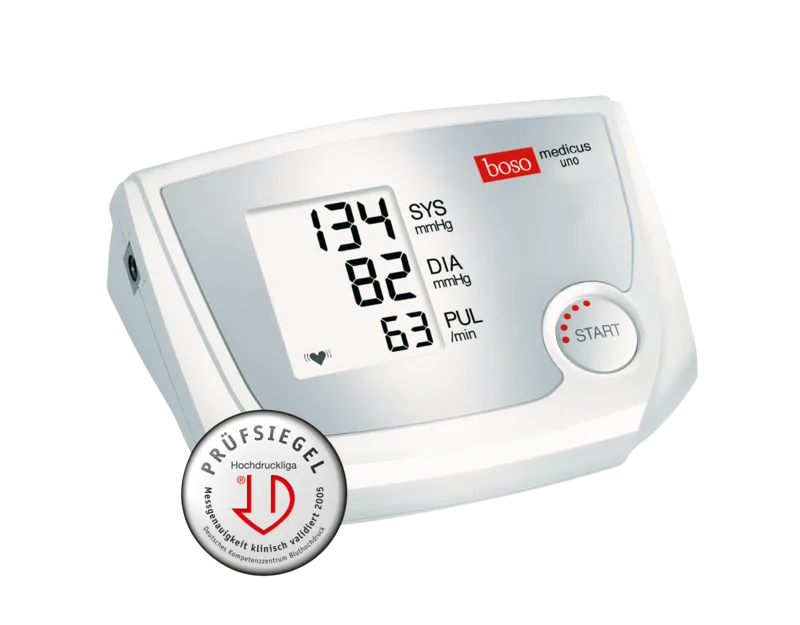
The Boso Medicus Manual introduces the Boso Medicus, a precision oscillometric upper-arm blood pressure monitor designed for home and professional use. Compact and user-friendly, the device supports arm circumferences from 22 to 48 cm and offers clear LCD readouts of systolic and diastolic pressures plus pulse rate. It uses four AA batteries or an optional 6 V mains adapter and provides a battery-status indicator, selectable cuff inflation pressure, and audible signals during operation. The Medics-focused design emphasizes clinical accuracy (compliant with EN 1060 standards) and comes with a cuff, carrying case, blood pressure record card and user instructions.
The manual walks users through setup and daily use: inserting batteries, connecting and positioning the cuff, selecting an inflation preset (recommended 150 mmHg for first measurements), and starting or stopping measurements with a single START/STOP button. It explains correct patient preparation—resting five minutes, avoiding nicotine and caffeine for an hour, seated posture with arm at heart level, and measuring consistently on the arm with higher readings. The device inflates to the preset pressure, automatically adapts if higher pressure is needed, then measures and displays systolic, diastolic, and pulse values with visual and acoustic pulse indicators. Error messages and troubleshooting guidance are provided for inadequate inflation, poor pulse detection, or air leaks.
Safety, maintenance and lifecycle guidance are covered: proper cuff selection and placement, contraindications (wounds, shunts, breast-amputation side), cleaning and disinfection recommendations, and disposal instructions for batteries and electronic waste. The manual highlights limitations (possible interference from wireless devices, arrhythmias or weak pulse affecting accuracy) and recommends clinical calibration and metrological checks at least every two years for professional use. A three-year factory warranty applies with exclusions for wear, misuse, and unauthorized repairs.
Notes:
- Measurement principle: oscillometric; measurement range 40–280 mmHg and pulse 40–200/min.
- Typical battery life ~1,000 cycles; device weight ~400 g without batteries.
- For reliable tracking, record each reading in the supplied blood pressure record card and consult a physician when values consistently exceed recommended thresholds.
Search for 67,732 Manuals online


Type-in Brand or Model