
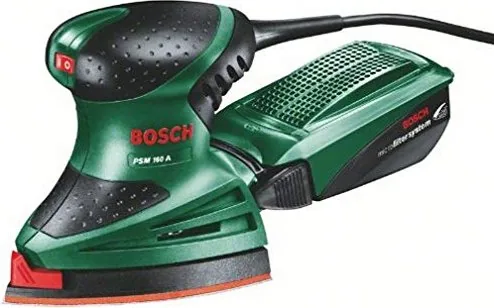
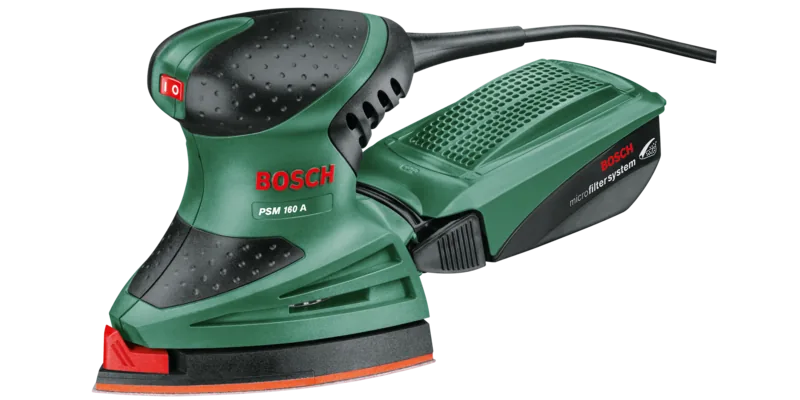
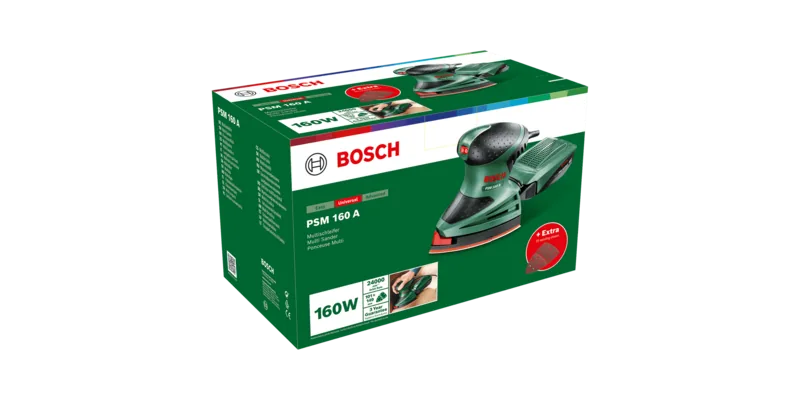
Bosch DIY PSM 160 A Manual
PDF manual · 70 Pages
English



Quick check
Incorrect answer, please try again.
Chat with your Bosch DIY PSM 160 A manual using AI
Get instant AI answers from your Bosch DIY PSM 160 A manual
Ask anything about the Bosch DIY PSM 160 A. Answers come from this manual, with the pages they are based on.
PSM 160 A Maintenance Schedule
Always empty the dust box or bag before taking a break to prevent self-ignition of dust.
Keep the machine and ventilation slots clean for safe and proper working.
Ask a Question
Do you recommend PSM 160 A?
Yes NoFrequently Asked Questions
It is intended for dry sanding and polishing of wood, filler, lacquer and coated surfaces, and is suited for profiles, corners and hard-to-reach areas; choose the correct grit for the material.
Is this answer helpful?
It has an integrated Microfilter dust box for onboard extraction and a 19 mm extraction adapter for external vacuum connection; use a special vacuum and P2 respirator for hazardous or carcinogenic dusts.
Is this answer helpful?
No. The PSM 160 A is designed for dry sanding only; water ingress increases the risk of electric shock and can damage the tool.
Is this answer helpful?
Empty the dust box before breaks and whenever it fills; clean the filter element with a soft brush to maintain suction and reduce fire risk from accumulated combustible dust.
Is this answer helpful?
Use coarse 40 for heavy material removal, medium 80–120 for general leveling, and fine 180 for final finishing on hard woods; always use matching grit sheets and Bosch original accessories when possible.
Is this answer helpful?
Remove debris from the Velcro backing, align sheet holes to plate holes, press the sheet onto the plate. For the plate, slide the SDS release to remove, fit from below and lock back in place.
Is this answer helpful?
Wear eye protection, hearing protection (noise can exceed 80 dB(A)), and a dust mask (P2) for fine or hazardous dusts; ensure good ventilation and secure the workpiece.
Is this answer helpful?
Advantages and Disadvantages
Advantages

- Lightweight 1.4 kg design for controlled work in tight spaces.
- Microfilter dust box plus external vacuum adapter for cleaner sanding.
- Multiple accessories (lamella pad, tongue extenders) increase versatility.
- Velcro-backed sheets and SDS plate release make changes quick and easy.
- Manufacturer provides noise and vibration data for safe planning.
Disadvantages

- Small 104 cm² sanding surface makes large-area work slower.
- 160 W motor is limited for heavy stock removal tasks.
- Strictly for dry sanding; cannot be used wet.
- Dust box needs frequent emptying during extended jobs.
- Noise can exceed 80 dB(A); hearing protection required.
Product Specification
Type
Multi-sander
Power
160W (230V)
No-load speed
12,000/min
No-load stroke rate
24,000/min
Oscillation diameter
0.06 in
Tool mounting
Quick-change system (SDS), Hook-and-loop fastening
Features
Softgrip, Dust extraction
Weight
3.09 lb
Scope of delivery
3-piece accessory set, Dust collection box
Product Description
Bosch DIY PSM 160 A Electro Multi-Sander Manual
The Bosch PSM 160 A is a compact, versatile multi-sander designed for precise dry sanding and polishing of wood, filler, paints and coated surfaces. Weighing about 1.4 kg and featuring a 160 W motor, this sander excels at work on profiles, corners and hard-to-reach spots thanks to its small sanding surface and a 1.6 mm orbital stroke. The tool includes a Microfilter dust box for integrated dust extraction and can accept an external vacuum via a 19 mm adapter for cleaner operation when tackling hazardous or fine dust.
Engineered for DIYers, the PSM 160 A offers two interchangeable sanding sheets mounted on a Velcro-backed sanding plate, allowing continued work even if one sheet becomes worn. The SDS-style release button lets you remove and refit the sanding plate easily; the plate can be rotated (120°) to extend usable life. Specialized attachments—lamella pad, flat tongue and oval tongue—expand access to slats, narrow gaps and curved or concave surfaces such as furniture rails or radiator crevices. A pad extender accessory helps reach window sills and tight cabinetry details.
Safety and ergonomics are integral: the insulated handle and clear on/off switch placement make operation intuitive, while Bosch emphasizes personal protective equipment (eye and ear protection, dust mask) and proper workplace ventilation. Noise is typically 76 dB(A) (can exceed 80 dB(A) during use); vibration measurement (ah = 5.5 m/s2) is provided for exposure assessment. The manual stresses dry sanding only, warns against overheating and advises emptying the dust collector regularly to reduce fire risk from combustible dust.
Maintenance is straightforward—keep vents and the tool clean, replace damaged cords only through authorized service, and use original Bosch sanding accessories for best results. Grain recommendations range from coarse (40) for heavy stock removal to fine (180) for finishing hard woods. The unit is double-insulated (class II) and intended for 230 V mains; regional variants may differ.
Notes:
- Use only for dry sanding and polishing; avoid water exposure.
- Empty and clean the Microfilter dust box frequently to prevent dust buildup and fire hazards.
- For hazardous or carcinogenic dusts (e.g., certain woods, lead-containing coatings), use appropriate vacuum systems and a P2 respirator.
- Maintain uniform pressure—excessive force increases wear without improving sanding rate.
- Always match sanding sheets by grit and replace worn sheets promptly.
Pros and Cons
Pros:
- Compact 1.4 kg design for comfortable, controlled sanding in tight areas.
- Microfilter dust box and external vacuum adapter reduce airborne dust.
- Versatile accessories (lamella pad, tongue extenders) for specialized tasks.
- Simple plate and sheet change with Velcro backing and SDS release.
- Clear safety and vibration/noise data for risk assessment.
Cons:
- Limited 104 cm² sanding surface may slow larger jobs.
- 160 W motor not ideal for heavy stock removal compared to larger sanders.
- Dry-sanding only; cannot be used for wet applications.
- Dust box capacity requires frequent emptying during long sessions.
- Noise can exceed 80 dB(A); hearing protection is necessary.
Most Important Results (3-5 each)
Performance:
- 160 W motor with 12,000 rpm no-load speed and 12,400 cycles/min orbital stroke for fine surface work.
- 1.6 mm orbit diameter balances removal rate and finish quality.
- Effective for wood, filler, lacquer and light metal polishing with correct accessories.
Dust & Safety:
- Microfilter dust box integrated; external vacuum adapter (19 mm) supports shop vac hookup.
- Sound pressure typically 76 dB(A); may exceed 80 dB(A); wear hearing protection.
- Vibration ah=5.5 m/s2 (K=1.5); consider work patterns and protective measures for prolonged use.
Usability & Maintenance:
- Velcro-backed sanding plate and two replaceable sheets simplify servicing and extend usable runtime.
- SDS-style plate release and 120° plate rotation increase longevity of the sanding surface.
- Keep vents clean; replacement of power cord must be done by Bosch or authorized service.
FAQ: [ { "question": "What materials can the Bosch PSM 160 A sand?", "answer": "It is intended for dry sanding and polishing of wood, filler, painted and lacquered surfaces and is suitable for profiles, corners and hard-to-reach areas; select appropriate grit for the material." }, { "question": "How does dust extraction work with this sander?", "answer": "The sander includes a Microfilter dust box for integrated extraction and accepts a 19 mm vacuum hose via an extraction adapter for external vacuums; use a specialist vacuum for hazardous or carcinogenic dusts." }, { "question": "Can I use the tool for wet sanding?", "answer": "No. The PSM 160 A is designed for dry sanding only; water ingress increases the risk of electric shock and can damage the tool." }, { "question": "What sanding sheets and grits should I use?", "answer": "Use Bosch original Velcro-backed sheets. Grit recommendations: coarse 40 for heavy stock removal, medium 80–120 for leveling, and fine 180 for finishing hard woods. Match sheets by grit." }, { "question": "How do I replace the sanding plate or sheets?", "answer": "Tap debris off the Velcro backing, align the sanding sheet holes with the plate holes, press firmly. For the plate, slide the SDS release button to remove, refit from below and lock the SDS button." }, { "question": "What safety gear is recommended when using the sander?", "answer": "Always wear eye protection, hearing protection, and a dust mask (P2) when needed. Ensure good ventilation and avoid working in explosive atmospheres. Empty the dust box often to reduce fire risk." } ]
Search for 67,706 Manuals online


Type-in Brand or Model
Sven Richter
8 months ago
Does the multi sander come with enough sanding paper, and is the microfilter easy to remove and clean?
Manual.ly
8 months ago
The included sanding paper is often only a starter amount, so many customers order replacement sanding sheets/pads (ideally in different grits) for larger projects. The multiedge sanding performance depends on using the right grit for the job. For the microfilter, it is designed to help collect dust, but it may not be perfectly easy to remove for everyone. We recommend cleaning it regularly (after short work sessions) and making sure it is properly seated after refitting. If your model allows it, follow the manual for any cleaning or rinsing steps and let it dry completely before use.