
Behringer Pro-1 Manual
PDF manual · 20 Pages
English



Quick check
Incorrect answer, please try again.
Chat with your Behringer Pro-1 manual using AI
Get instant AI answers from your Behringer Pro-1 manual
Ask anything about the Behringer Pro-1. Answers come from this manual, with the pages they are based on.
Ask a Question
Do you recommend Pro-1?
Yes NoVideo Manual
Review & tutorial: Behringer PRO-1 // 10 Patch ideas // Comparison vs Neutron, Crave and others
Frequently Asked Questions
Yes — the audio signal path (oscillators, filter and VCA) is analog. Control connectivity (USB-MIDI and patch CV) and some utility features use digital components, but the core sound generation is analog.
Is this answer helpful?
Absolutely. The Pro-1 is class-compliant USB MIDI, shows up in DAWs without drivers, and also offers 5-pin MIDI In/Out/Thru and dip-switch MIDI channel selection for hardware compatibility.
Is this answer helpful?
The unit is monophonic by voice, but it supports Poly Chain to combine multiple units for multi-voice setups. It also offers poly mode behavior via panel switching for certain performance modes.
Is this answer helpful?
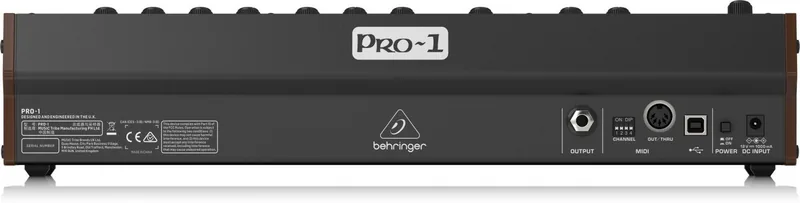
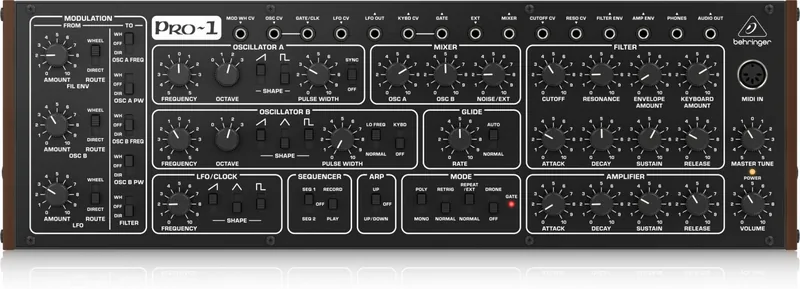
The Pro-1 provides a full patch bay: Mod Wheel CV, OSC CV, Gate/Clock input, LFO CV and out, KB CV (1V/oct), Gate out, Ext audio input, Mixer out, Cutoff/Resonance CV, Filter and Amp envelope outputs, plus headphone and audio outputs.
Is this answer helpful?
Firmware updates are available from Music Tribe / Behringer’s website. Download the updater, follow the included release notes and update steps carefully, and connect the Pro-1 via USB to perform the update.
Is this answer helpful?
Yes. An EXT input lets you route external audio through the Pro-1’s mixer and VCF/VCA for filtering and envelope processing directly on the unit.
Is this answer helpful?
The Pro-1 uses the supplied 12 V DC power adaptor, consumes up to 8 W, and is designed to operate in moderate to tropical climates within a temperature range of roughly 5°C to 40°C (41°F to 104°F).
Is this answer helpful?
Advantages and Disadvantages
Advantages

- Authentic analog tone with dual VCOs and a 4-pole resonant VCF for thick, musical sound.
- Hands-on front panel with immediate control over oscillators, filter, envelopes and modulation.
- Extensive CV patch bay plus USB and 5-pin MIDI for modern studio and modular workflows.
- Built-in sequencers and arpeggiator enable complex patterns and live performance setups.
- Compact, road-friendly design with straightforward connectivity and firmware update support.
Disadvantages

- Monophonic voice architecture limits polyphonic chord performance without Poly Chain.
- No onboard effects (reverb/delay) — external processing required for spatialization.
- Learning curve for routing modulation between DIRECT and WHEEL paths for beginners.
- Some functions rely on DIP switches and hardware routing that can be less convenient than deep menu systems.
- External power adaptor required; check mains compatibility before use.
Product Specification
Type
Desktop Synthesizer
Keys
no
Sound Generation
analog
Polyphony
1-voice
Controller
Rotary controls
Speakers
no
Display
no
Audio Connections
AUX In (3.5mm Jack), Line Out (6.35mm Jack), 2x Line Out (3.5mm Jack), 1x Headphones (3.5mm Jack)
Other Connections
USB-B (USB to Host), MIDI In/Out/Thru
Features
Sequencer, Arpeggiator
Dimensions
16.69x3.74x5.35in (WxHxD)
Weight
3.97lb
Product Description
Behringer Pro-1 — Classic Analog Powerhouse
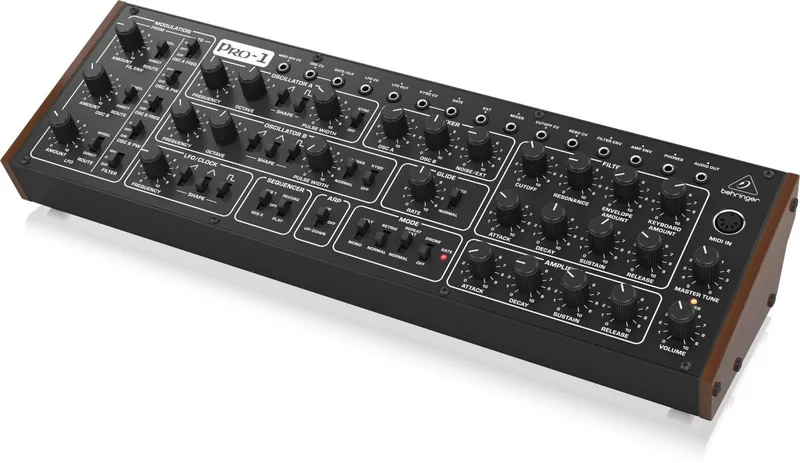
The Behringer Pro-1 is a hands-on analog synthesizer inspired by a legendary monosynth architecture, packed with modern connectivity and performance features. Sporting dual VCOs with selectable waveforms, a 4-pole low-pass VCF, dedicated VCA, and a flexible modulation section, it delivers thick, punchy analog tones ideal for leads, basses, pads and experimental textures. The front panel offers immediate control over frequency, octave, pulse width, sync and waveform shaping for both oscillators, plus noise/external input and a mixer for quick tonal blending.
Beyond its core voice engine, the Pro-1 includes an LFO (0.1–30 Hz) with multiple wave shapes, two 64-step sequencers, an arpeggiator with selectable directions, poly/mono modes, portamento (glide) with auto behavior, and an intuitive ADSR setup for both filter and amplifier stages. The 4-pole VCF provides resonant warmth and aggressive filtering, while dedicated ENV and keyboard CV amounts let you sculpt expression and harmonic motion precisely.
Connectivity is modern and versatile: USB-MIDI class-compliant for DAW integration, 5-pin MIDI In/Out/Thru, CV patch points (OSC CV, LFO CV, Gate/Clock, Mod Wheel CV, etc.), external audio input for filter processing, headphone and mono output jacks. The rear panel includes MIDI channel DIP switches, master tune and volume, and a software updater for firmware improvements. The unit’s build is compact and road-ready, with sensible power consumption and environmental operating specs.
For producers and performers seeking an authentic analog character with practical studio and live integration, the Pro-1 offers a deep feature set at an accessible price. From raw, aggressive sequences to warm, evolving pads, it covers a wide sonic palette while keeping hands-on control front and center.
Notes
- Dual 3340-style VCOs across four-octave ranges enable classic analog timbres and sub-audio behavior for complex modulation.
- Extensive patch bay (CV I/O) makes the Pro-1 Eurorack-friendly and excellent for modular integration.
- Firmware updates available via Music Tribe ensure ongoing improvements and compatibility.
Search for 67,706 Manuals online


Type-in Brand or Model